(Quick Answer) What Is Headless TPRM?
Headless TPRM is an API-first approach that embeds third-party data validation, enrichment, screening and risk scoring directly into existing enterprise systems. Organizations can apply TPRM intelligence within ERP, procurement and payment workflows without requiring every user or process to operate through a separate TPRM portal.
How Does Headless TPRM Work?
Headless TPRM uses APIs to bring third-party validation and risk intelligence into existing enterprise workflows.
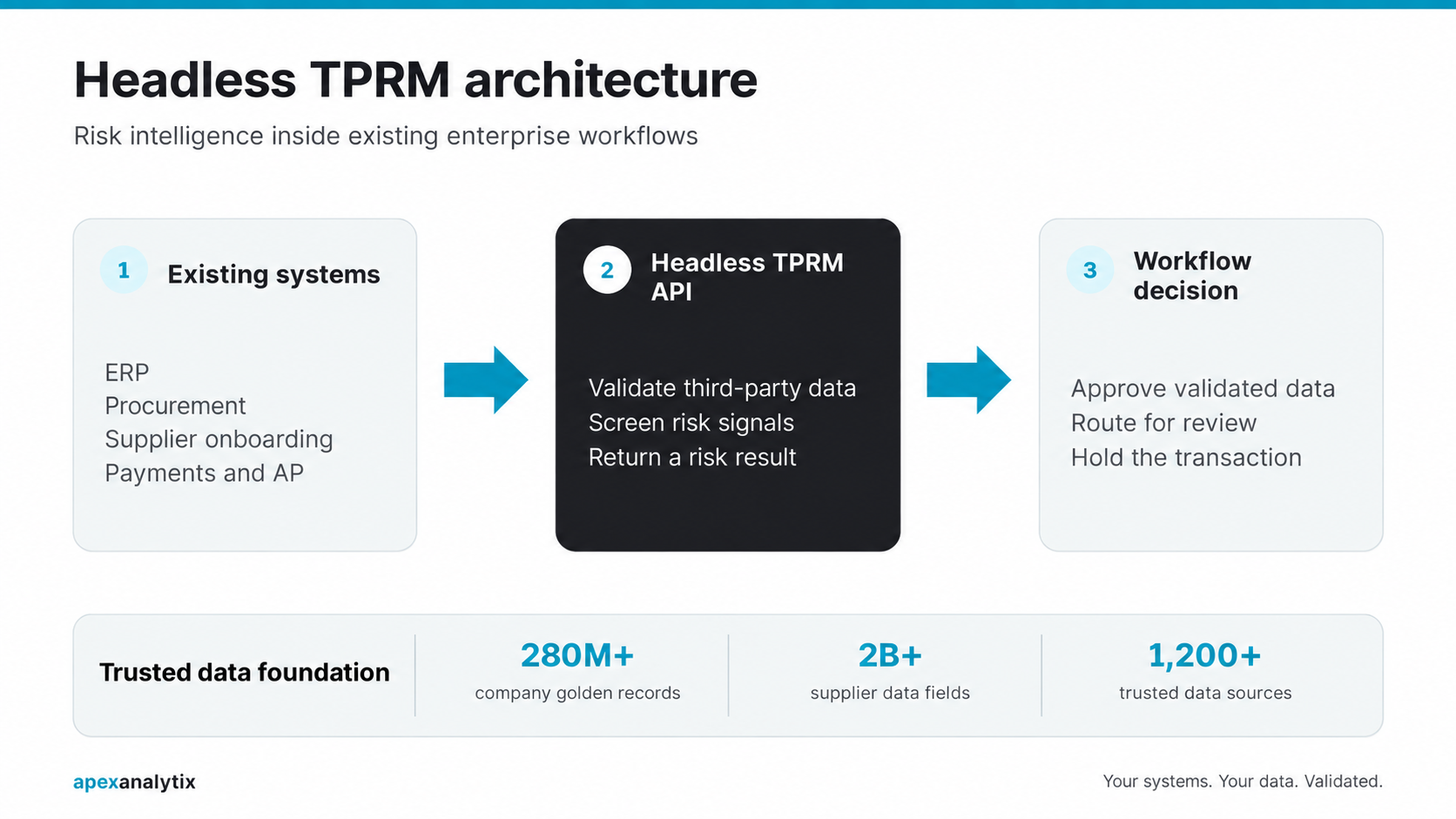
- Third-party data enters an existing system. Supplier information is submitted or changed within an ERP, procurement, onboarding or payment application.
- The system calls the API. The application sends the relevant information for validation, screening or risk scoring.
- Trusted sources validate the data. The service checks details such as business identity, tax IDs, bank accounts, addresses or sanctions exposure.
- Results return to the workflow. The API sends structured validation results and risk signals back to the originating system.
- Business rules determine the action. The organization can approve the record, hold the transaction or route it to the appropriate team for review.
Existing system → API request → Trusted data sources → Risk result → Approved action
This process allows organizations to apply TPRM controls at the point of ingestion while users continue working inside their existing systems.
Why Traditional TPRM Delivery Creates Friction
Third-party risk decisions occur throughout the relationship lifecycle, from onboarding and contracting to payment changes and ongoing monitoring. Traditional delivery can create friction when every decision depends on a separate portal or manual transfer of information.
Risk data sits across multiple systems
Procurement, security, compliance, finance and legal often use different applications and processes. For established global enterprises, moving every business unit and workflow into one TPRM portal may require significant time, resources and organizational change.
Data loses accuracy as it moves
Teams may transfer supplier information through spreadsheets, email or manual entry. Each handoff creates an opportunity for records to become incomplete, outdated or inconsistent, weakening risk scoring and vendor master accuracy.
Risk checks can happen too late
When tax, banking, sanctions or fraud checks occur after data enters an ERP or payment workflow, issues may surface only after approvals have advanced or funds are at risk.
A dedicated TPRM platform remains valuable for complex assessments, investigations and oversight. APIs extend that intelligence to the point of ingestion, allowing organizations to strengthen controls while keeping their existing systems and operating model.
How Headless TPRM Fits the Broader Delivery Model
Organizations do not need to access third-party intelligence through a single channel. The appropriate delivery method depends on the user, workflow and decision involved. The apexanalytix model provides three complementary channels: Platform, API and Chat.
The Platform provides a structured environment for supplier registration, validation, screening and ongoing risk management. It supports teams that need to oversee complete processes, investigate issues and maintain a comprehensive view of third-party activity.
The API channel supports Headless TPRM by embedding validation and risk intelligence directly into existing enterprise systems. It is especially useful for organizations that want to strengthen controls within established ERP, procurement, payment or onboarding environments without completing a full portal migration.
Chat provides a conversational experience for users who need quick access to sourced third-party information through supported AI assistants.
| Delivery Channel |
Primary Experience |
Best-Fit Use Cases |
| Platform |
Structured access through a supplier registration and risk interface |
Supplier onboarding, bank account ownership validation, compliance screening, data refresh and ongoing monitoring |
| API or Headless TPRM |
Validation and risk intelligence embedded directly into existing systems |
ERP and procurement integration, point-of-ingestion risk scoring, tax ID and address validation, payment and fraud workflows |
| Chat |
Natural-language queries through supported AI assistants |
Sourced supplier answers, sanctions or PEP checks and rapid data access for procurement, AP or compliance analysts |
The distinction is important. An API changes where TPRM capabilities operate by placing them inside existing systems and workflows. Chat changes how users request and receive information. Both channels can draw from the same trusted data foundation, helping organizations apply consistent third-party intelligence across different teams, technologies and decision points.
Why Trusted Data Is the Foundation of Headless TPRM
“Your AI is only as good as your data.” That principle is especially important in Headless TPRM. APIs can deliver information quickly, but the resulting validation, risk score or recommendation is only as dependable as the data behind it.
Fast APIs Still Depend on Accurate Data
Incomplete or outdated third-party data can create blind spots throughout the relationship lifecycle. For example:
- An outdated business registration may make an inactive company appear legitimate.
- A valid bank account may have no confirmed connection to the supplier.
- Inconsistent names, addresses or ownership details may weaken sanctions screening.
These gaps can contribute to fraud exposure, compliance failures and inaccurate risk decisions, even when the underlying technology delivers results in real time.
The apexanalytix Data Foundation
apexanalytix supports Headless TPRM with a third-party data foundation that includes:
- 280M+ proprietary company golden records, scored for accuracy and age
- 2B+ fields of supplier data supporting vendor-master accuracy
- 1,200+ trusted sources from governments, regulators and authoritative third parties
- 100+ prohibited and sanctions lists used during registration and ongoing screening
This data supports the validation and enrichment of addresses, tax IDs, VAT numbers, bank accounts, business registrations and beneficial ownership. It also provides intelligence related to fraud signals, sanctions, PEPs, adverse media, diversity status and insurance coverage.
Headless delivery determines where risk intelligence appears. Trusted data determines whether teams can act on it confidently.
When validated information reaches an ERP, procurement platform or payment application at the point of ingestion, the organization can apply its existing rules with greater confidence. Records can be approved, flagged or routed for additional review before incomplete or higher-risk information moves farther into the workflow.
Headless TPRM vs. Traditional TPRM
Traditional and headless TPRM can support the same risk objectives, but they deliver data and controls differently. The distinction centers on where users work, how systems exchange information and when risk checks occur.
Where Headless TPRM Fits in Enterprise Workflows
Headless TPRM supports risk decisions throughout the third-party lifecycle by bringing validation, screening and risk intelligence into existing enterprise workflows.
Validate Suppliers Within Existing Systems – Organizations can validate addresses, tax IDs, bank accounts and business registrations when supplier information enters an ERP, procurement platform or onboarding application.
Assess Risk at the Point of Ingestion – API-based risk scoring can evaluate sanctions, adverse media, PEP and behavioral signals as third-party data enters a workflow. Results can determine whether a record proceeds or requires review. Explore apexanalytix data capabilities.
Protect Bank Account Changes and Payments – Bank account ownership validation can confirm whether an account belongs to the supplier’s legal entity and flag suspicious change requests before payments are released.
Validate Global Identity and Tax Data – Organizations can validate tax IDs, VAT numbers and global addresses against authoritative sources during onboarding and supplier maintenance.
Embed Sanctions and PEP Screening – Sanctions, prohibited-party and PEP screening can operate within onboarding and approval workflows, allowing potential matches to reach compliance teams through established processes.
Enrich and Maintain Vendor Master Data – Third-party data enrichment can add industry codes, diversity status, locations and company details to supplier records, supporting a more complete and accurate vendor master.
How apexanalytix Delivers Headless TPRM
apexanalytix delivers validated third-party data and risk intelligence directly into the systems organizations already run, allowing teams to strengthen TPRM without replacing their existing ERP, procurement or business workflows.
The foundation includes 280M+ proprietary company golden records, 2B+ supplier data fields and 1,200+ trusted sources from governments, regulators and authoritative third parties. This gives organizations access to standardized, independently validated information instead of relying solely on data submitted by third parties.
Through its API channel, apexanalytix provides more than 70 capabilities across eight categories. Organizations can embed real-time validation of addresses, tax IDs, bank accounts and business registrations into their existing applications. Risk scoring and anomaly detection can also incorporate sanctions screening, adverse media, politically exposed person detection and behavioral patterns, helping teams identify potential concerns when information enters the workflow.
Developer connectors for Python, Node.js and Go support technical integration, while connectors for 30+ enterprise platforms, including Salesforce, SAP, Oracle and Snowflake, help organizations put validated data to work across their existing technology environments.
The same underlying data can be accessed through three complementary delivery channels: Platform for structured workflows, API for Headless TPRM and Chat for natural-language queries. This gives organizations flexibility in how they apply third-party intelligence while maintaining a consistent data foundation across teams and systems.
| apexanalytix Data Foundation |
Scale |
| Proprietary company golden records |
280M+ |
| Supplier data fields |
2B+ |
| Trusted data sources |
1,200+ |
| API capabilities |
70+ across eight categories |
| Connected enterprise platforms |
30+ |
Frequently asked questions
What does headless TPRM mean?
Headless TPRM is an API-first approach that embeds third-party data validation, screening and risk scoring into existing ERP, procurement, onboarding and payment systems instead of requiring every process to run through a separate interface.
Does headless TPRM replace a TPRM platform?
Headless TPRM complements a traditional TPRM platform. APIs support embedded risk checks inside operational systems, while the central platform remains useful for assessments, investigations, case management, administration and program oversight.
How is headless TPRM different from TPRM automation?
TPRM automation reduces manual risk-management tasks. Headless TPRM describes how those capabilities are delivered through APIs to other applications. A headless TPRM workflow may use automation, but automation can also operate within a traditional platform.
Is headless TPRM the same as conversational TPRM?
No. Headless TPRM uses APIs to embed risk capabilities into enterprise systems. Conversational TPRM allows users to request third-party information through an AI assistant. Both can draw from the same governed data foundation.
Which systems can connect to headless TPRM?
Headless TPRM can connect with ERP, procurement, supplier onboarding, GRC, payment, vendor master and data platforms that support approved API integrations. Compatibility depends on the provider’s APIs, connectors and security requirements.
How is sensitive third-party data protected?
Headless TPRM protects sensitive data through controls such as encryption, secure API authentication, role-based access, data minimization and audit trails. Organizations should also define retention, privacy, residency and human-review requirements.
The Future of TPRM Is Embedded
Third-party risk programs still need central governance, specialist investigation and complete supplier oversight. They also need risk decisions to occur inside operational systems when data is entered or changed. Headless TPRM connects those needs by extending trusted validation and risk services into existing workflows without requiring every interaction to move into a separate portal.
Bring Trusted Third-Party Intelligence Into Your Existing Systems
apexanalytix delivers validated third-party data, risk scoring and screening directly into ERP, procurement, onboarding and payment workflows through APIs. Strengthen your TPRM controls while keeping the systems and operating model your teams already use.
Explore Data and API Capabilities →