Vendor management becomes harder when the data behind vendor decisions cannot be fully trusted. KPMG’s 2026 Global Third-Party Risk Management Survey of 851 organizations found that only 17% reported the highest level of data quality across their third-party risk programs.
Poor vendor data can slow onboarding, weaken compliance and risk checks, and increase payment and fraud risks. Because vendor management relies on accurate information throughout the relationship, data quality directly affects how consistently vendors are evaluated, approved, monitored, and paid.
This article explains how vendor management works, how it differs from supplier management and third-party risk management, and how enterprises measure and support the vendor lifecycle.
Key Takeaways:
- Vendor management covers the full relationship: It spans vendor selection, due diligence, onboarding, monitoring, payments, renewal, and offboarding.
- Different disciplines serve different purposes: Vendor and supplier management focus on business relationships, while TPRM focuses on the risks those external relationships create.
- Strong oversight creates measurable value: Better vendor data, risk visibility, onboarding consistency, payment accuracy, and fraud controls improve operational and financial performance.
- Shared ownership and technology matter: Cross-functional governance and vendor management software connect the people, data, workflows, and controls needed to manage complex vendor relationships.
- apexanalytix supports enterprise vendor management: apexanalytix connects validated supplier data, risk intelligence, payment integrity, and recovery across complex vendor relationships.
What Is Vendor Management?
Vendor management is the process of overseeing external companies throughout the business relationship, from initial selection and onboarding to ongoing monitoring, payment, renewal, and offboarding.
For large enterprises, the process connects vendor data, risk, performance, compliance, and financial controls across the organization. Procurement may manage the commercial relationship, while finance, accounts payable, risk, and compliance teams rely on the same vendor information for their own decisions.
Oversight continues after a vendor receives approval, as business details, ownership, financial health, compliance status, bank information, and other risk factors can change over time. Ongoing monitoring keeps the vendor record and risk profile current throughout the relationship.
Who Is Responsible for Vendor Management?
Ownership of vendor management varies by organization, vendor type, and risk level. In large enterprises, responsibility is usually cross-functional because commercial, operational, risk, legal, and payment decisions sit with different teams.
Common functions involved include:
- Procurement: Manages sourcing, commercial terms, and the procurement relationship
- Business owner: Defines business requirements and evaluates how the vendor performs against them
- Finance and accounts payable: Oversee payment-related vendor data, invoice processing, payment controls, and financial activity
- Risk and compliance: Assess financial, regulatory, sanctions-related, and other third-party risks
- IT and cybersecurity: Evaluate system access, data exposure, cybersecurity controls, and technology-related risk
- Legal: Reviews contractual terms, legal obligations, and regulatory requirements
Many enterprise models pair a business or contract owner with specialist teams responsible for specific risk areas. No single function typically has all the information needed to manage a complex vendor relationship across its full lifecycle.
Vendor Management vs. Supplier Management vs. Third-Party Risk Management
Vendor management and supplier management overlap, while third-party risk management (TPRM) intersects with both by focusing on the risks created by external business relationships.
Vendor management commonly focuses on companies that provide services, software, specialized expertise, or other external capabilities.
Supplier management more often covers companies that provide physical goods, materials, or components used in operations or production.
Third-party risk management focuses on risk across a broader range of external relationships. It can cover vendors, suppliers, contractors, business partners, and other third parties that create financial, operational, cybersecurity, compliance, or reputational exposure.
| Area |
Vendor management |
Supplier management |
Third-party risk management |
| Primary focus |
Managing service and technology relationships |
Managing goods, materials, and supply relationships |
Managing risk across external relationships |
| Typical relationships |
Service providers, software vendors, and specialists |
Manufacturers, distributors, and material suppliers |
Vendors, suppliers, contractors, partners, and other third parties |
| Main concern |
Service continuity, performance, and technology dependence |
Supply continuity, product quality, and capacity |
Financial, operational, cybersecurity, compliance, and reputational exposure |
| Common oversight |
Service performance, commercial terms, and vendor data |
Delivery performance, product quality, and supplier data |
Risk assessment, continuous monitoring, and changes in risk exposure |
The distinction is not universal. Many organizations and enterprise systems use vendor and supplier interchangeably, and the same company can fall into either category depending on what it provides.
7 Stages of the Vendor Management Process
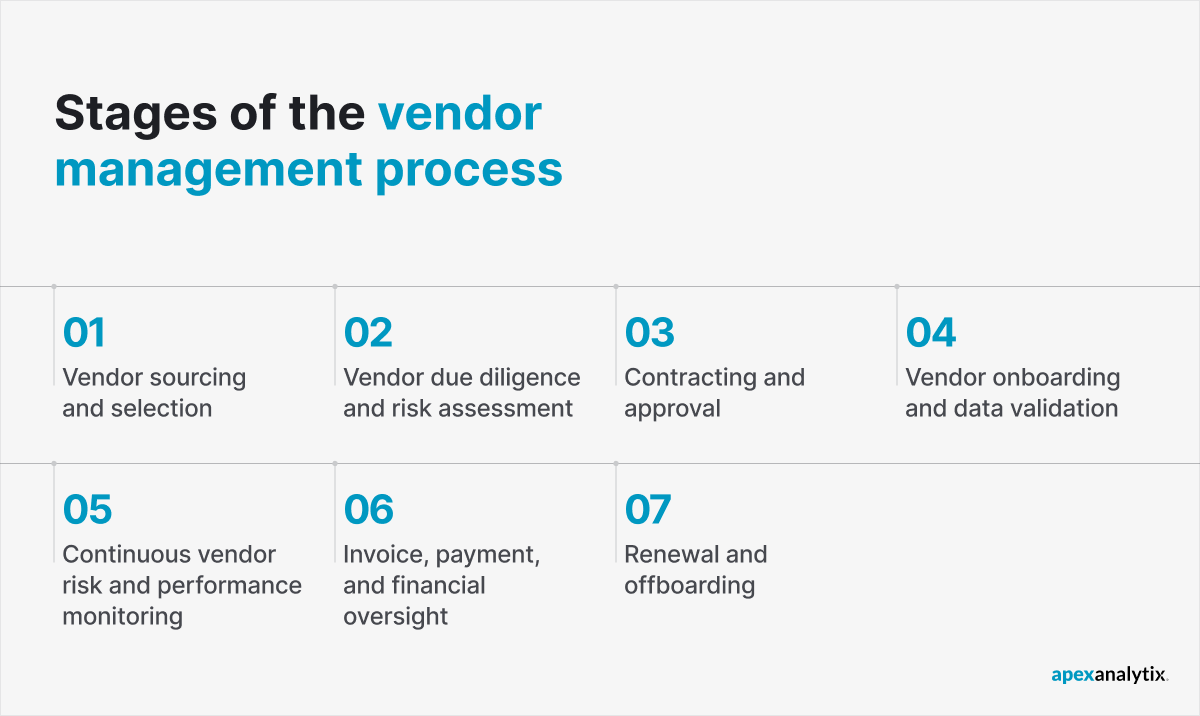
An enterprise vendor management lifecycle can be viewed in seven broad stages, from initial selection through offboarding:
1. Vendor sourcing and selection
The process starts with identifying vendors that can meet a defined business need.
Evaluation can include capabilities, capacity, geographic coverage, financial condition, and the importance of the proposed service or product to the business.
2. Vendor due diligence and risk assessment
Due diligence verifies the vendor and establishes its initial risk profile. The review can verify business identity and ownership and assess financial, compliance, cybersecurity, and other risks relevant to the relationship.
The depth of the review often depends on vendor criticality and risk exposure. A vendor with access to sensitive systems or a critical business process carries a different risk profile from a low-impact provider.
3. Contracting and approval
Contracting defines the terms that govern the relationship, including the scope of services, performance expectations, compliance obligations, data requirements, and responsibilities.
Internal approval connects those terms with due diligence findings and the organization’s governance requirements.
4. Vendor onboarding and data validation
Vendor onboarding turns an approved relationship into a verified vendor record. Common data includes the vendor’s legal name, tax information, addresses, ownership details, bank accounts, and required documentation.
Validation checks that information before it enters enterprise resource planning (ERP) and procure-to-pay (P2P) systems.
5. Continuous vendor risk and performance monitoring
Continuous monitoring compares current vendor information, performance, and risk signals with the profile established during due diligence.
Supplier risk management uses ongoing signals to keep the risk profile current after onboarding and provide updated information for later reviews and renewal decisions.
6. Invoice, payment, and financial oversight
Once transactions begin, vendor information becomes part of invoice processing and payment controls. Vendor master records, bank details, invoice data, credits, and payment history all influence payment accuracy.
Post-payment review can identify duplicate payments, missed credits, and other overpayments that passed through existing controls.
7. Renewal and offboarding
The final stage covers the decision to continue or end the relationship. Renewal uses current information on performance, risk, compliance, and business requirements before a new term begins.
Offboarding removes unnecessary access, updates vendor records, resolves outstanding transactions, and retains required documentation.
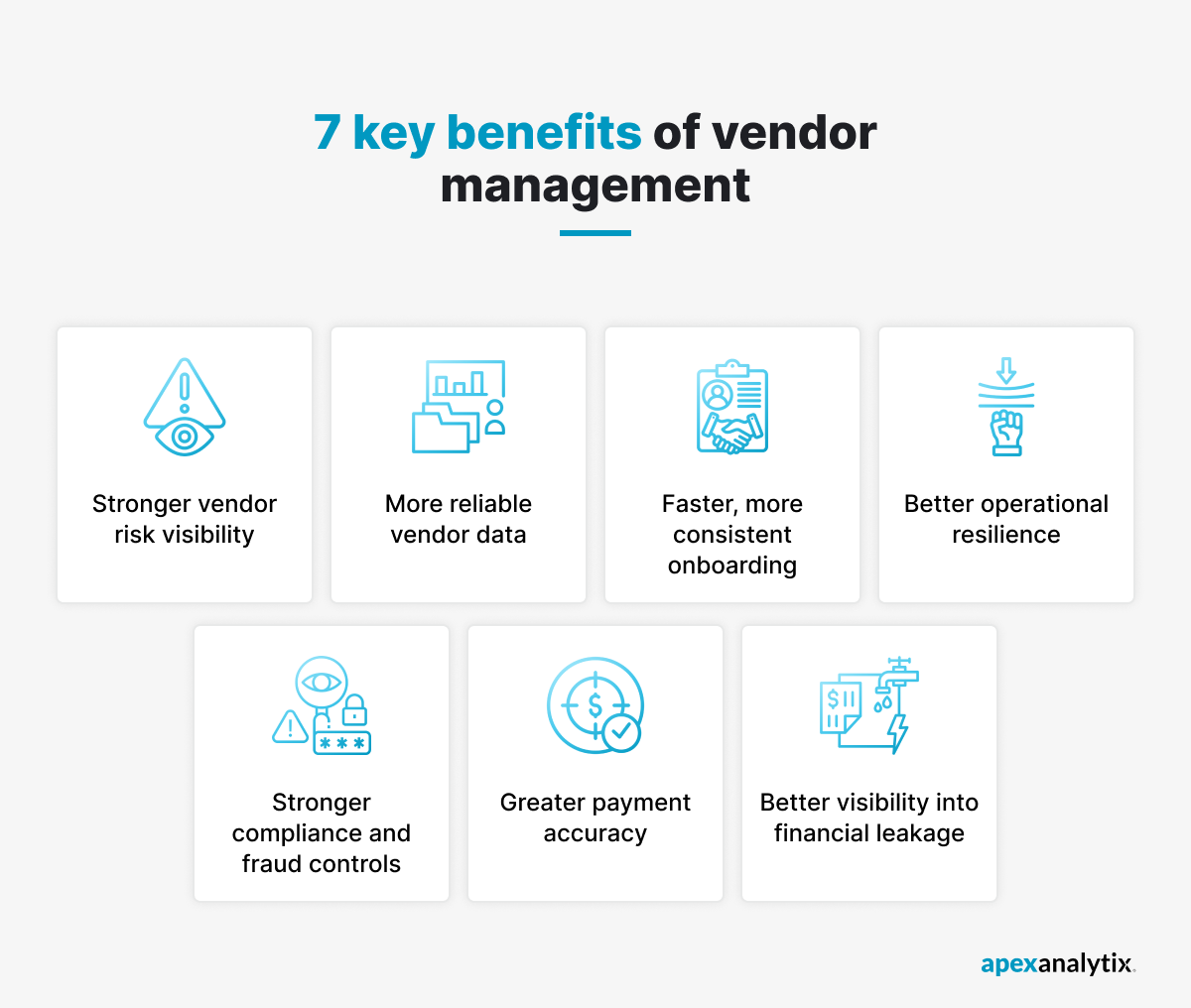
Key Benefits of Vendor Management
Effective vendor management improves how enterprises control vendor data, risk, compliance, performance, and payments across the relationship.
1. Stronger vendor risk visibility
A structured vendor management program combines financial, operational, cybersecurity, compliance, and performance information into a broader view of third-party exposure.
EY’s 2025 Global Third-Party Risk Management Survey found that among organizations with centralized TPRM structures, 52% reported increased understanding of risks during decision-making.
Vendor risk often sits across separate teams and systems, so a broader view makes it easier to see where exposure is concentrated.
2. More reliable vendor data
Strong vendor management validates key supplier details such as legal entity, tax, banking, ownership, and contact information during onboarding and reviews material changes throughout the relationship. This reduces conflicting, incomplete, or duplicate vendor records across enterprise systems.
Reliable data supports multiple stages and aspects of the business relationship because each process depends on accurate vendor information.
3. Faster and more consistent onboarding
Standardized data requirements and validation rules flag missing, incomplete, or inconsistent supplier information before the vendor moves to approval, reducing repeated follow-ups and rework later in the process.
Approval workflows can then apply the required reviews based on the vendor’s risk level, business role, and other defined criteria.
4. Better operational resilience
Vendor management shows which third parties support critical services, systems, and business processes. That context becomes important when a vendor issue threatens normal operations.
ISC2’s 2025 Supply Chain Risk Survey found that 34% of respondents from enterprise organizations had experienced a cybersecurity incident originating from a third-party vendor or supplier in the previous two years.
The finding shows how a problem outside the enterprise can affect its own systems and operations, especially when the third party supports a critical function.
5. Stronger compliance and fraud controls
Strong vendor management applies identity verification, compliance checks, approval requirements, and controlled processes for sensitive vendor changes throughout the relationship.
These controls make it harder for unauthorized or fraudulent changes to reach procurement or payment systems.
The 2025 AFP Payments Fraud and Control Survey found that 45% of respondents cited vendor imposter fraud, up 11% from the previous survey. The increase highlights the exposure created when vendor identities or payment details are compromised, especially during changes to bank details or payment instructions.
6. Greater payment accuracy
Strong vendor management controls how vendors are set up, approved, and changed before accounts payable releases funds. Clear approval and verification steps reduce the risk of payments being sent to the wrong vendor or bank account.
Accurate vendor records, bank details, invoice information, and payment history reduce the conditions that can contribute to duplicate, incorrect, and misdirected payments.
7. Better visibility into financial leakage
Connecting vendor records with invoice and payment activity makes financial issues easier to trace to the underlying transaction.
Duplicate payments, overpayments, missed credits, and other exceptions can reveal where financial value is being lost across the procure-to-pay process.
Vendor Management KPIs to Track
Vendor management KPIs show how effectively an organization manages onboarding, data quality, risk oversight, performance, and payments across the vendor lifecycle.
Common metrics include:
| KPI |
What it measures |
Why it matters |
| Vendor onboarding cycle time |
Average time from the start of onboarding to an approved vendor record |
Shows how efficiently vendor data, validation, and approvals move through onboarding |
| Vendor data completeness rate |
Percentage of required vendor fields and documents that are complete |
Shows whether vendor records contain the information required for downstream processes |
| Duplicate vendor rate |
Percentage of vendor records identified as duplicates |
Shows the extent of data-quality issues that can contribute to invoice and payment errors |
| Risk assessment coverage |
Percentage of in-scope vendors with a completed risk assessment |
Shows how much of the relevant vendor base has an established risk profile |
| High-risk vendor monitoring coverage |
Percentage of high-risk or critical vendors included in ongoing monitoring |
Shows how consistently elevated vendor risk remains under review after onboarding |
| Risk issue resolution time |
Average time from identification of a vendor risk issue to resolution |
Shows how quickly identified vendor risks are investigated and resolved |
| Vendor performance or SLA compliance |
Percentage of agreed service, delivery, quality, or other performance requirements met |
Shows how consistently vendors meet defined performance requirements |
| Vendor master change validation rate |
Percentage of sensitive vendor changes that complete required validation |
Shows how consistently changes to bank, ownership, or other sensitive information pass through required controls |
There is no universal target for these metrics. Targets depend on vendor criticality, transaction volume, risk requirements, and the organization’s governance model.
How Is Vendor Management Typically Conducted?
Vendor management can involve multiple teams, systems, and workflows across procurement, finance, risk, compliance, and accounts payable. Large enterprises often use vendor management software to coordinate these activities and connect vendor processes with ERP and P2P systems.
The software can support different parts of the vendor lifecycle, from onboarding and approvals to risk monitoring, vendor changes, and payment controls.
Depending on the platform, capabilities can include:
- Centralized vendor records: Maintains legal, ownership, tax, banking, status information, and supporting documentation in a consistent vendor record
- Onboarding and data validation: Collects required information and checks key fields before approved data enters downstream systems
- Risk assessment and monitoring: Combines questionnaires, internal data, and external risk signals to maintain current vendor risk profiles
- Performance tracking: Records service, delivery, quality, or other measures used to evaluate vendor performance
- Workflow and approvals: Routes vendor requests, changes, exceptions, and reviews to the appropriate teams based on defined rules
- ERP and P2P integration: Exchanges vendor information with systems used for procurement, invoicing, and payments, reducing manual transfers and conflicting records
- Payment controls: Supports validation of sensitive vendor information, including bank details and changes that can affect where funds are sent
- Reporting and audit trails: Records vendor activity, approvals, changes, and risk information so teams can trace decisions over time
A basic vendor database may only store records. Enterprise vendor management software can also validate data, coordinate workflows, monitor changes, and connect vendor information with downstream systems.
How apexanalytix Supports Enterprise Vendor Management
apexanalytix connects supplier onboarding, risk monitoring, payment integrity, and recovery for procurement and finance teams managing complex vendor populations.
apexanalytix supports 400+ enterprise customers. Its supplier data foundation includes 280M+ supplier records and 1,200+ validated data sources, supporting vendor validation and ongoing monitoring.
Key capabilities include:
- Supplier Registration: Collects and validates supplier identity, tax, banking, ownership, and other required data before approved records enter ERP and source-to-pay systems
- Supplier Risk Management: Combines supplier information with ongoing risk signals to maintain current risk profiles across financial, cybersecurity, compliance, performance, and other risk areas
- Fraud Prevention: Strengthens vendor identity, bank account, and change controls to reduce the risk of fraudulent supplier records and payment instructions
- Overpayment Prevention: Analyzes procure-to-pay data to identify duplicate invoices, payment errors, and other overpayment risks before funds leave the organization
- Accounts Payable Recovery Audit: Identifies and recovers duplicate payments, missed supplier credits, overpayments, and other financial leakage that passed through existing controls
Procurement and finance teams gain a more consistent view of vendor information, changing risk, and financial activity while existing ERP and source-to-pay systems continue to support core business processes.
Discover how apexanalytix can strengthen enterprise vendor management across complex supplier relationships.
FAQ
1. How do enterprises manage vendor data across multiple ERP systems?
Enterprises often manage vendor data across multiple ERP systems by centralizing and synchronizing key vendor records. Shared validation rules reduce duplicate records, inconsistent details, and gaps between procurement, finance, and accounts payable.
2. How do you measure the ROI of vendor management?
Vendor management ROI is measured by comparing program costs with operational and financial gains. Common measures include faster onboarding, lower manual effort, fewer payment errors, reduced fraud losses, and recovered overpayments.
3. What is vendor concentration risk?
Vendor concentration risk is the risk of depending too heavily on one vendor or a small group of vendors. A disruption or failure affecting those vendors can have a larger impact on business operations.
4. How does fourth-party risk affect vendor management?
Fourth-party risk is risk introduced by the companies a vendor relies on. Those dependencies can create operational, cybersecurity, compliance, or financial exposure for the enterprise.
5. What is the difference between centralized and decentralized vendor management?
Centralized vendor management uses shared standards, data, and governance, while decentralized management gives business units more control. Large enterprises may combine both models by centralizing core controls and keeping some relationship decisions within individual teams.