Imagine that a vendor’s website looks legitimate, their references check out, and their pricing beats three competitors. Then, six months into the contract, a payment bounces because the company behind the name never actually existed, contrary to the paperwork.
Vendor management due diligence is the investigative process designed to catch any irregularities before a contract is signed, not after a vendor is already getting paid.
This guide answers what vendor management due diligence is, how the process works step by step, and where organizations most often get it wrong.
Key Takeaways:
- Due diligence answers whether to engage with a vendor, not how much ongoing risk to tolerate: It’s a process run before any commitment is made, not a continuous scoring system.
- Vendor management due diligence isn’t a one-time event: A merger, an ownership change, or a contract renewal should re-trigger the same investigation that was conducted at the first engagement.
- Investigation depth should scale with what the vendor will touch: A vendor handling sensitive data or significant spend warrants deeper verification than a low-impact supplier.
- apexanalytix strengthens the records due diligence relies on: apexanalytix verifies vendor data against trusted sources before it factors into any engagement decision.
What Is Vendor Management Due Diligence?
Vendor management due diligence is the investigation an organization conducts to confirm that a vendor is who they claim to be and can be trusted with the money, data, or operations at stake before any contract is signed.
Due diligence differs from third-party risk management, which tracks a vendor continuously once they’re active. Due diligence happens before that point, and it’s a deciding factor in whether a vendor reaches ongoing management at all.
What Vendor Due Diligence Investigates
A due diligence investigation covers five distinct areas, and a vendor can check out in one respect while hiding a problem in another.
Corporate legitimacy and ownership
The first due diligence step is to confirm the vendor is a real, registered business, not a shell company or a name borrowed from a legitimate one. This check verifies legal entity name, registration number, and beneficial ownership against government and regulatory records, not just what the vendor’s own website claims.
Financial health
The vendor needs to have the financial stability to actually deliver on their part. To confirm they do, due diligence covers reviewing financial statements, credit ratings, and cash flow indicators. A vendor already facing financial risks is more likely to cut corners, delay delivery, or fail outright once the contract is signed.
Legal and regulatory history
One investigation facet looks into prior litigation, regulatory enforcement actions, or sanctions exposure tied to the vendor or its leadership. A pattern of past legal trouble reveals how a vendor actually operates, which is information that no pitch deck will volunteer.
Cybersecurity posture
Due diligence also involves checking how a vendor protects the systems and data it would touch. It’s mostly concerned with the vendor’s access controls, prior incident history, and the speed at which known vulnerabilities are fixed.
For vendors handling payment details specifically, this step also covers bank account ownership validation, which confirms the account on file actually belongs to the entity being paid.
Reputational and regulatory screening
Finally, due diligence checks screen vendors and their known affiliates against watchlists, adverse media, and prohibited party databases to catch red flags that wouldn’t surface in standard reference checks.
A sanctions risk assessment is the structured version of exactly this kind of screening, and reviewing the types of vendor risks relevant to a vendor’s industry helps determine which checks matter most for that specific relationship.
Step-by-Step Process of Vendor Management Due Diligence
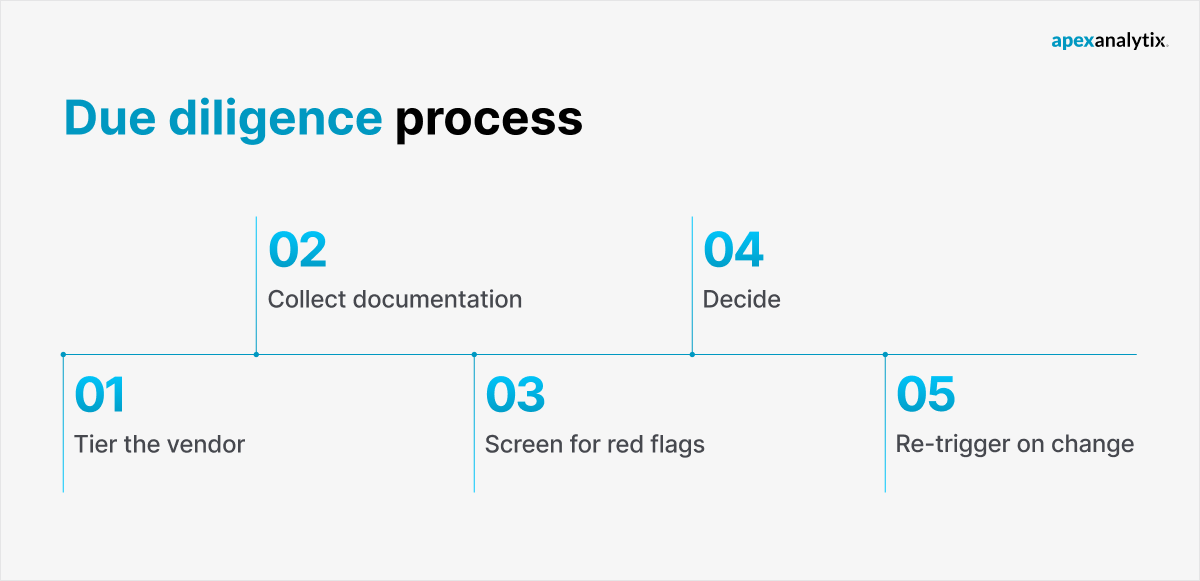
Due diligence starts with tiering and ends with a decision, and everything in between exists to make that decision well-informed.
1. Determine investigation depth by vendor tier
Before any check begins, classify the level of scrutiny by what the vendor will touch, focusing on sensitive data, significant spend, or a critical operational function. A vendor who doesn’t check any of these boxes requires a lighter check than one that will have access to payments or customer records.
2. Collect and verify core documentation
Gather the vendor’s legal registration, financial statements, insurance certificates, and any required licenses. A structured supplier onboarding process captures this documentation consistently, rather than chasing it down via email, vendor by vendor.
3. Screen for legal, financial, and reputational red flags
Check the vendor and their known affiliates against sanctions lists, litigation records, and adverse media. This is the step where a vendor who might’ve looked clean on paper can surface a real problem from underneath.
4. Make a decision
Turn the findings into one of three outcomes: proceed as planned, proceed with added conditions, or decline the vendor entirely. A vendor risk management checklist defines in advance which findings trigger each outcome, so the decision doesn’t depend on individual judgment on a case-by-case basis.
5. Re-trigger diligence on material change or renewal
Due diligence checks might happen multiple times for the same vendor. A merger, an ownership change, or a contract renewal should prompt the same investigation to be conducted again, since the vendor that passed the first checks wouldn’t necessarily still do so a year later.
Best Practices for Vendor Management Due Diligence
For a due diligence process that actually catches problems instead of just producing paperwork, make sure to:
- Verify against outside sources, not the vendor’s self-reporting: A vendor’s own paperwork can be outdated or altered, so registration, financials, and certifications should be cross-checked against government and regulatory records rather than accepted at face value.
- Match the depth of investigation to what’s at stake: Applying the same level of scrutiny to every vendor wastes effort on low-risk ones and underinvestigates the ones that matter most. A vendor handling sensitive data or significant spend warrants a deeper look than one that doesn’t.
- Document the decision, not just the findings: A finding with no recorded decision behind it leaves no defensible record if the vendor later becomes a problem. What matters isn’t only what the investigation turned up, but why the vendor was engaged, conditioned, or declined based on it.
- Set a re-investigation trigger list in advance: Without a defined list, re-investigation only happens if someone remembers to initiate it. Risk event monitoring helps catch these changes as they occur rather than waiting for a scheduled review. Events worth defining in advance include ownership changes, mergers, contract renewals, or significant gaps between scheduled reviews.
How apexanalytix Supports Vendor Management Due Diligence
Investigation quality depends entirely on the data it’s checked against. A vendor’s own submitted paperwork can look complete and still not match what a government registry or a watchlist would actually show.
apexanalytix validates every vendor record against 1,200+ trusted data sources at the point of entry, giving investigators something independently verified to work from rather than taking a vendor’s submission at face value.
The platform offers:
- Legal entity and ownership verification: Validates registration, tax ID, and beneficial ownership through supplier management controls applied at the point of entry
- Financial health screening: Draws on credit ratings and financial indicators to flag instability before it becomes part of a signed agreement
- Prohibited party and sanctions screening: Checks the vendor and known affiliates against watchlists and adverse media
- Cybersecurity vulnerability assessment: Continuously monitors a supplier’s security posture, including exposure surfaced through dark web activity
- Insurance coverage verification: Replaces a manual collection process that can take weeks with automated insurance coverage monitoring
- Bank account ownership validation: Confirms payment details belong to the entity actually being engaged, not a third party
Real-World Results
Vendor management due diligence catches a legitimacy or identity problem before it becomes a payment problem. Here are examples of it in practice:
- apexanalytix identified 82 vendors who were flagged on prohibited entity watchlists. A vendor master cleansing engagement for a specialty biopharmaceutical company used the platform to review more than 16,000 supplier records, surfacing red flags a standard reference check would have missed entirely.
- The platform helped prevent $14 million in losses from attempted fraud before it left the organization. A company with more than $100 billion in annual spend used bank account ownership validation to confirm a payment account actually belonged to the vendor’s legal entity, not a fraudulent one.
Both results trace back to the fundamentals of due diligence: corporate legitimacy and identity, verified against external sources before either vendor ever made it to payment.
How many vendors in your current roster were engaged without the same level of verification?
Get started with apexanalytix to see how validated data strengthens due diligence across your own vendor base.
FAQs
1. Does vendor management due diligence apply to small vendor relationships too?
Yes, though the depth should scale down. A low-spend, low-impact vendor still deserves a basic identity and legitimacy check, even if they don’t warrant the full investigation a critical vendor would.
2. Who should own the due diligence process inside an organization?
Ownership typically spans procurement, finance, and legal, since each function checks a different part of the investigation, but one person or team should be accountable for the process as a whole.
3. How long should a due diligence investigation take?
This depends on vendor tier. A low-risk vendor can clear a basic check in days, while a vendor handling sensitive data or significant spend may take several weeks to fully investigate.
4. What happens if due diligence reveals a red flag after a contract is already signed?
The findings should trigger the same decision process used before engagement: remediate the issue, add a condition to the relationship, or end it, depending on how serious the finding is.