Managing vendors becomes harder as the supplier base grows. More suppliers mean more data to check, more approvals to manage, and more supplier risks to track. When these tasks rely on manual work, delays and errors become harder to control.
According to 2026 research from Ardent Partners, only 12% of organizations have fully automated supplier management processes.
This guide explains how vendor management automation works, which processes it can automate, and what benefits it provides.
Key Takeaways:
- Vendor management automation reduces manual work across core processes: It can streamline supplier onboarding, data validation, approvals, monitoring, record changes, and reporting while keeping human review for complex decisions.
- Supplier data quality shapes automation results: Accurate and current supplier information supports stronger risk decisions, payment controls, and vendor management workflows.
- Risk-based automation strengthens supplier oversight: External validation, risk-based reviews, monitoring, and escalation rules can support greater oversight for higher-risk suppliers.
- Connected systems improve control across the enterprise: ERP, procurement, accounts payable, risk, and supplier-facing systems need connected supplier information to reduce duplicate entry, conflicting records, and disconnected workflows.
- apexanalytix supports enterprise vendor management automation: apexanalytix connects validated supplier data, supplier and third-party risk management, fraud and payment controls, and Accounts Payable Recovery Audit across complex supplier populations.
What Is Vendor Management Automation?
Vendor management automation uses software to manage repeatable vendor tasks through defined rules and workflows. It can collect supplier information, validate key data, route records for approval, update connected systems, and monitor supplier changes after onboarding.
Vendor management often requires several teams to work with the same supplier record. Procurement teams may collect supplier data, risk teams may assess supplier risk, and finance or accounts payable teams may verify payment details.
Automation moves this information through the required checks and approvals without repeated emails, spreadsheets, or manual data entry.
The process can also change based on supplier type, location, criticality, or risk level. A low-risk supplier may require fewer checks, while a critical or high-risk supplier may need additional validation, risk review, and approval.
Vendor Management Automation vs. Manual Vendor Management
Manual vendor management relies on employees to collect information, follow up on missing items, route approvals, monitor risk, update records, and prepare reports. Automated vendor management uses defined workflows and rules to handle many of these repeatable tasks and route exceptions or higher-risk cases to the appropriate teams.
Automation does not replace human judgment. Teams still approve complex cases, make risk decisions, and resolve exceptions that fall outside defined rules.
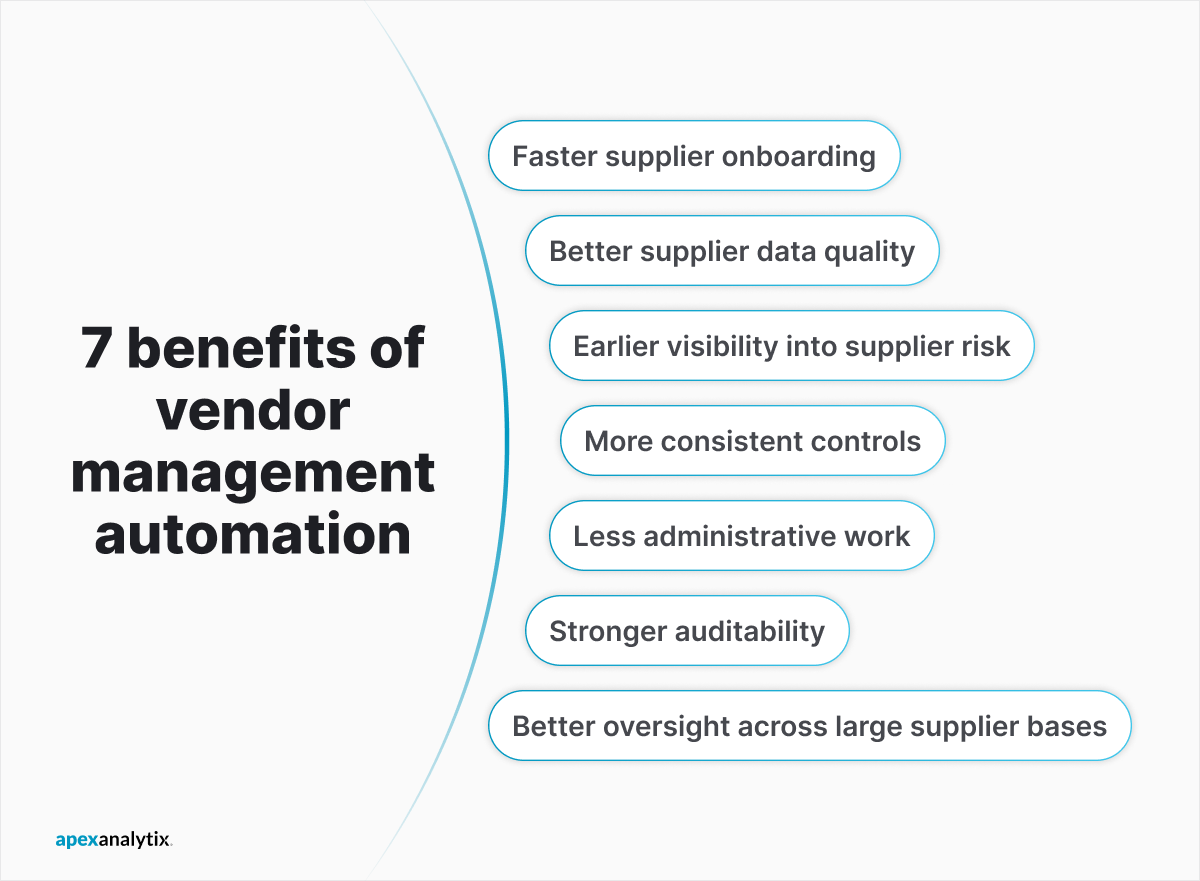
7 Benefits of Vendor Management Automation
Vendor management automation can improve the quality, consistency, and visibility of supplier processes across the organization.
The main benefits of vendor management automation include:
1. Faster supplier onboarding
Manual follow-ups and missing information can delay supplier setup.
Automation can reduce onboarding delays by flagging missing information, sending automated reminders, routing approvals to the required reviewers, and escalating overdue tasks.
2. Better supplier data quality
Supplier records become less reliable when the same information is entered in several systems. Repeated data entry can create typos, duplicate records, and conflicting versions of supplier details.
In KPMG’s 2026 survey, 52% of organizations with high-quality third-party data reported the highest confidence level in their TPRM decisions.
Automated checks can flag missing, duplicate, or inconsistent information before supplier records are approved or updated, giving procurement, finance, and risk teams more reliable data.
3. Earlier visibility into supplier risk
Supplier risk can change after the initial review.
Automated monitoring can surface new risk signals sooner, giving teams more current information for supplier risk management and follow-up decisions.
4. More consistent controls
Manual processes can vary between teams, business units, or supplier types.
Defined rules make it easier to apply review and approval requirements consistently, while routing higher-risk suppliers through additional checks or approvals.
5. Less administrative work
Collecting missing information, tracking approvals, checking routine data, and following up on standard requests can take time away from supplier reviews, exception handling, and risk decisions.
Automation reduces repetitive work so teams can spend more time on tasks that require judgment.
6. Stronger auditability
Vendor management decisions may need to be reviewed later.
Automated workflows create clearer records of data changes, approvals, risk reviews, and exceptions, making it easier to understand what happened and who took action.
7. Better oversight across large supplier bases
Large supplier bases are harder to track through disconnected records and manual updates.
Automated workflows can capture supplier updates, approvals, risk alerts, and open tasks in one place, giving procurement, finance, and risk teams a clearer view of supplier status and unresolved issues across the organization.
How Vendor Management Automation Strengthens Supplier Risk Management
Automation gives risk teams a more structured way to collect and assess supplier risk information and respond when risk changes.
The main ways automation can strengthen supplier risk management include:
1. More complete supplier risk profiles
Supplier risk spans financial, cyber, compliance, and operational factors. Different risk signals can otherwise remain spread across separate assessments or systems.
Automation can combine questionnaires, internal data, and external risk signals into a single supplier profile.
2. External validation of supplier information
Supplier-provided data may be incomplete or outdated. Relying only on self-reported information can leave important gaps in a risk assessment.
Key details can be checked automatically against government records, sanctions data, prohibited-party lists, and business information, with discrepancies flagged for review.
3. Risk-based review requirements
Not every supplier needs the same level of review. A critical or higher-risk supplier may require more detailed assessments, additional approvals, or more frequent reviews than a lower-risk supplier.
Automation can apply these requirements based on supplier criticality and risk level, giving risk teams a more consistent way to match oversight to supplier exposure.
4. Clearer escalation when risk changes
A new risk signal may require reassessment, specialist review, or additional approval. Defined thresholds can determine when further action is needed and which team should review the issue.
Automation guided by escalation rules can send the issue to the required reviewer once a defined threshold is met.
How Vendor Management Automation Supports Third-Party Risk Management
Supplier risk management focuses on risks linked to suppliers, while third-party risk management (TPRM) covers a wider group of external organizations such as vendors, service providers, contractors, and other external organizations.
Vendor management automation can connect supplier records, risk reviews, and decisions with broader third-party oversight. Procurement, finance, compliance, cybersecurity, and risk teams can work from consistent records while each team remains responsible for its required reviews and decisions.
Automation can also maintain evidence of due diligence, approvals, risk decisions, and follow-up actions throughout the relationship. These records show how each third party was reviewed and how identified risks were handled.
How Vendor Management Automation Connects with Enterprise Systems
Vendor management automation can move supplier information between the systems used for onboarding, purchasing, payments, and risk oversight. Instead of requiring teams to re-enter the same information, automated connections can pass approved data and updates to the systems that need them.
The main system connections include:
| System or data source |
What vendor management automation does |
| ERP and vendor master systems |
Sends approved supplier records and updates after required validation and review |
| Procurement systems |
Synchronizes supplier status and approved data with sourcing and purchasing workflows |
| Accounts payable systems |
Passes validated supplier and payment information into invoice and payment processes |
| Supplier portals |
Collects supplier information and documents, then routes submissions through the required workflow |
| Risk and compliance systems |
Feeds supplier data and risk signals into assessments, monitoring, and escalation workflows |
| External data sources |
Checks supplier information against external records and adds relevant risk data to supplier profiles |
Enterprise environments may use several ERP, procurement, accounts payable, and risk platforms at the same time.
Vendor management automation can use APIs and scheduled data transfers to move approved supplier information between those systems, reducing duplicate entry and conflicting records.
Vendor Management Automation, AP Controls, and Recovery Audit
Vendor management automation can strengthen preventive AP controls before payment. Automated workflows can validate supplier and bank details, route sensitive changes for approval, and flag duplicate records or unverified updates before they reach payment systems.
Accounts Payable Recovery Audit serves a different purpose. Recovery audit technology analyzes historical supplier and payment data to identify duplicate payments, missed credits, and other recoverable losses that preventive controls did not catch.
Audit analytics can also identify recurring errors and control gaps behind those losses. Finance teams can use those findings to strengthen the processes and controls that allowed the errors to occur.
Common Vendor Management Automation Challenges
Automation becomes less effective when processes are inconsistent, supplier information is missing, or responsibilities are unclear.
The main challenges include:
1. Inconsistent processes
Different business units or regions may follow different onboarding, approval, or review requirements. Automation can carry those differences forward when the underlying process lacks clear standards.
Similar suppliers may then face different controls depending on the business unit or region managing them.
2. Incomplete supplier participation
Automated workflows still depend on suppliers providing the required information and documents. Missing documents, unanswered questionnaires, or delayed updates can hold up assessments even when the internal workflow is automated.
Incomplete records can also limit the information available for approval and risk decisions.
3. Too many low-value alerts
Continuous monitoring can produce more alerts than teams can review effectively. Poorly defined thresholds can make minor changes compete with higher-risk signals that need faster attention.
Time spent reviewing routine changes can reduce the attention available for higher-priority issues.
4. Unclear ownership
Automation can flag and route a risk issue, but clear ownership is still needed for action. Gartner found that 95% of third-party relationship owners had seen a red flag in the previous 12 months, yet only around half escalated it to compliance teams.
Unclear responsibility can leave important supplier issues unresolved even when technology identifies them.
5. Changing requirements
Risk criteria, approval rules, and compliance requirements can change over time. Automated workflows may continue applying outdated checks or review paths if those changes are not reflected in the system.
The challenge is keeping automated rules current as requirements change, so suppliers continue to receive the appropriate checks, approvals, and reviews.
How apexanalytix Supports Enterprise Vendor Management Automation
Enterprise vendor management automation is more than replacing manual tasks with workflows. Supplier data also needs to stay accurate, current, and consistent across systems.
The value of that automation can also be measured in time saved. A Forrester Total Economic Impact study commissioned by apexanalytix found that automating vendor discovery, onboarding, and banking validation saved up to 60% of the time spent on those activities.
apexanalytix connects supplier onboarding, supplier data, risk management, fraud controls, and Accounts Payable Recovery Audit within its enterprise supplier management platform. Its data foundation includes 1,200+ validated data sources used to support supplier validation, enrichment, and ongoing monitoring.
Key capabilities include:
- Automated supplier onboarding: Supplier Registration supports configurable registration, data validation, approval workflows, and integration with ERP and procure-to-pay systems.
- Connected supplier risk oversight: Risk Management brings risk scoring, assessments, monitoring, and follow-up workflows together to support ongoing supplier oversight.
- Stronger fraud and payment controls: Fraud Prevention uses supplier validation and payment-data checks to strengthen controls around sensitive supplier information.
- AP recovery and root-cause insight: AP Recovery Audit identifies overpayments and missed credits while helping uncover the control gaps behind them.
A connected approach keeps supplier data, risk decisions, payment controls, and recovery findings aligned instead of managing each area through separate workflows.
Get started with apexanalytix to strengthen vendor management automation with trusted supplier data, risk oversight, and financial controls.
FAQ
1. How should enterprises decide which vendor management processes to automate first?
Enterprises should prioritize high-volume, repetitive processes with clear rules. Supplier onboarding, data validation, approvals, and routine risk checks are common starting points.
2. What KPIs should companies use to measure vendor management automation?
Measure speed, data quality, exceptions, and control performance. Useful KPIs include onboarding time, approval time, error rates, exception volumes, and manual-review rates.
3. How do you calculate the ROI of vendor management automation?
Compare automation costs with measurable savings and avoided losses. Consider labor savings, faster onboarding, fewer errors, and avoided financial losses where measurable.
4. How long does vendor management automation take to implement?
A typical enterprise implementation takes about 3 to 6 months, although simpler phased rollouts may go live sooner and complex multi-system deployments can take longer. The timeline depends on process complexity, ERP and other system integrations, supplier data quality, business units, and regional requirements.
5. Can vendor management automation support global suppliers across different regions?
Yes. It can apply different workflows, risk rules, and data requirements by region, provided the platform supports the relevant systems, data sources, and compliance needs.