Managing a vendor does not end once onboarding is complete. Supplier information can change, new risks can emerge, and performance can decline, making ongoing monitoring important throughout the relationship.
Technology and automation across core vendor oversight activities remain limited. EY’s 2025 Global Third-Party Risk Management Survey found that only 13% of companies have optimized technology and automation within their third-party risk management (TPRM) programs. The survey identifies opportunities for automation across vendor identification, due diligence, onboarding, and ongoing monitoring.
This guide explains the seven stages of the vendor lifecycle and the controls enterprises can use to manage supplier data, performance, and risk more effectively.
Key Takeaways:
- Vendor lifecycle management covers the full vendor relationship: It spans vendor selection, due diligence, onboarding, monitoring, renewal, and offboarding.
- Supplier data and risk require ongoing oversight: Vendor information, performance, compliance status, and risk can change after onboarding, so teams need current data and ongoing monitoring.
- Fragmented processes weaken lifecycle control: Siloed systems, manual workflows, duplicated assessments, and unclear ownership make consistent vendor oversight harder across large enterprises.
- Strong governance and measurement improve control: Standardized processes, clear ownership, connected systems, audit trails, and lifecycle metrics support more consistent vendor decisions.
- apexanalytix supports enterprise vendor lifecycle management: apexanalytix connects validated supplier data, supplier and third-party risk management, payment controls, and Accounts Payable Recovery Audit to strengthen oversight across complex vendor populations.
What Is Vendor Lifecycle Management?
Vendor lifecycle management is the process of overseeing a vendor from initial evaluation and onboarding through ongoing management, renewal, and offboarding.
For large enterprises, vendor lifecycle management gives teams a shared view of each vendor relationship. Procurement may manage the commercial side, while finance, accounts payable, risk, and compliance use the same supplier information to make their own decisions.
That information needs to stay accurate as the relationship changes. From due diligence through offboarding, teams need current supplier data, risk information, and performance records to make consistent decisions at each stage of the lifecycle.
Vendor lifecycle management vs. vendor management vs. supplier lifecycle management
The three concepts overlap, but they differ mainly in scope and structure:
- Vendor lifecycle management organizes vendor oversight around the stages of the relationship, from initial evaluation through offboarding.
- Vendor management is the broader discipline of overseeing vendors, including performance, communication, risk, service levels, and other relationship activities.
- Supplier lifecycle management follows a similar end-to-end structure but uses supplier-focused terminology. In many enterprises, vendor lifecycle management and supplier lifecycle management cover many of the same processes.
The table below compares the three approaches:
| Area |
Vendor lifecycle management |
Vendor management |
Supplier lifecycle management |
| Primary focus |
Managing each stage of the vendor relationship |
Managing vendor relationships and performance |
Managing each stage of the supplier relationship |
| Typical scope |
Evaluation, onboarding, monitoring, renewal, and offboarding |
Performance, communication, risk, issue management, and commercial oversight |
Qualification, onboarding, supplier data, monitoring, requalification, and offboarding |
| Main purpose |
Applying consistent controls across vendor lifecycle stages |
Overseeing the ongoing vendor relationship |
Applying consistent controls across supplier lifecycle stages |
| Risk oversight |
Risk assessment, monitoring, and requalification |
Risk management as part of broader vendor oversight |
Supplier risk assessment, monitoring, and requalification |
The distinction is not universal. Many organizations use vendor and supplier interchangeably, and vendor lifecycle management and supplier lifecycle management can describe nearly the same end-to-end process.
In this guide, vendor management refers to the broader discipline, while vendor lifecycle management organizes that work around defined stages.
The 7 Stages of the Vendor Lifecycle Management Process
Each stage plays a different role in vendor evaluation, risk management, data management, oversight, and closure.
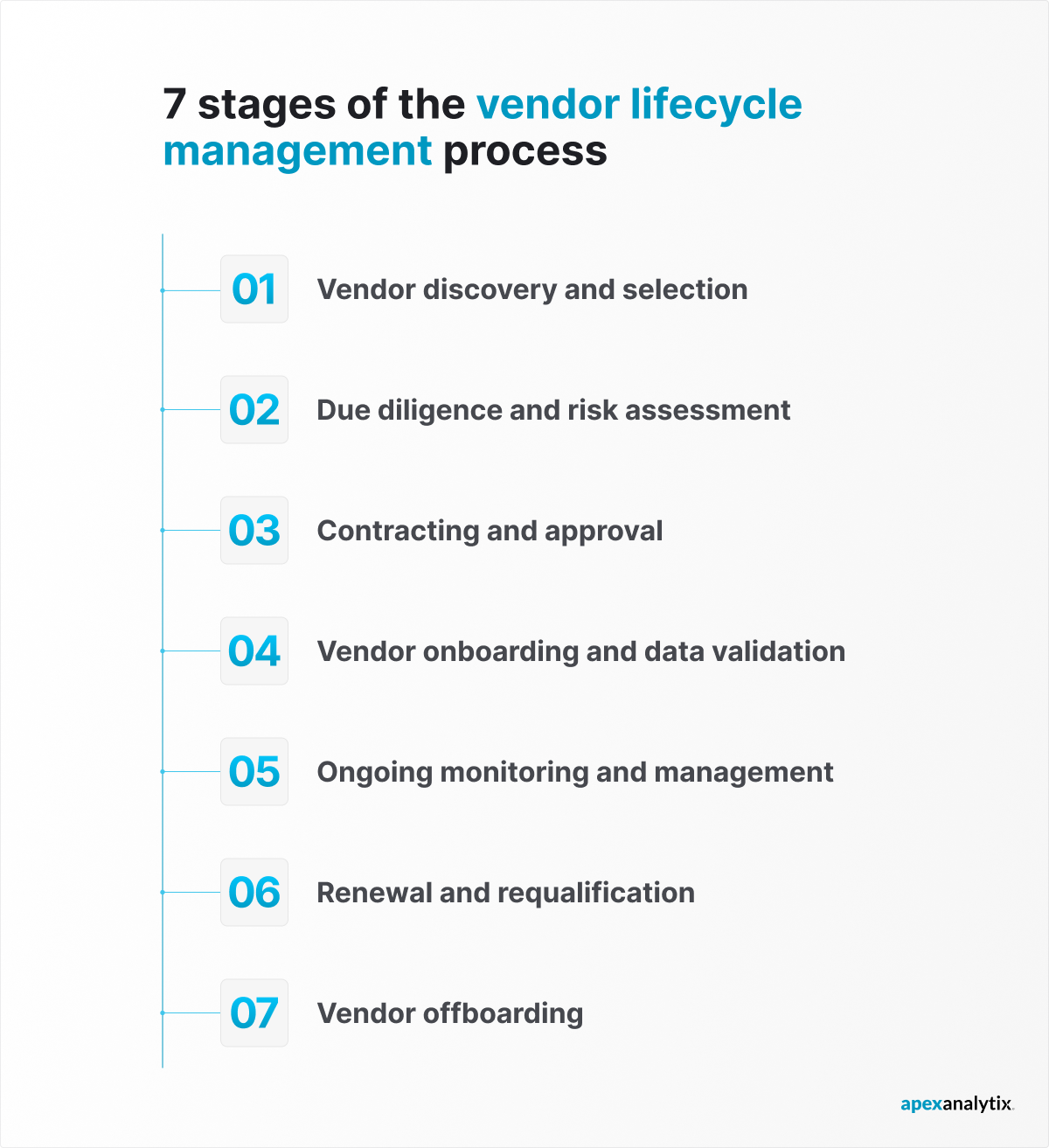
Organizations may structure the vendor lifecycle differently, but these seven stages cover the main points from initial evaluation through offboarding:
1. Vendor discovery and selection
The first stage identifies vendors that can meet a defined business need. Procurement may compare capabilities, capacity, geographic coverage, service requirements, and business criticality before deciding which vendors should move forward.
A vendor supporting a critical operation, handling sensitive data, or providing a hard-to-replace service may require more oversight later in the lifecycle.
2. Due diligence and risk assessment
Due diligence examines the risks a vendor could introduce before approval. Depending on the relationship, the assessment may cover:
Supplier questionnaires, company information, prohibited-list checks, and external risk data can contribute to the initial risk profile.
The initial assessment creates a baseline for supplier risk management and third-party risk management, with higher-risk or more critical vendors often requiring deeper assessment.
3. Contracting and approval
Contracting defines the obligations that govern the relationship. These can include performance expectations, service levels, security requirements, compliance responsibilities, data handling, incident reporting, business continuity, and termination conditions.
Internal approval confirms that the vendor has cleared the required reviews before activation. The approval path may differ based on supplier type, geography, criticality, or risk.
4. Vendor onboarding and data validation
Onboarding creates the approved supplier record used across procurement, finance, accounts payable, and risk processes.
The record may include legal entity details, tax information, addresses, contacts, bank account information, certifications, and other required business data.
Validation can identify duplicate records, invalid tax information, suspicious bank details, or prohibited-list matches before they enter downstream systems.
The data-quality gap remains significant. KPMG’s 2026 Global Third-Party Risk Management Survey found that only 17% of organizations reported the highest level of TPRM data quality. KPMG also found that weak data quality can hinder automation in risk analysis, due diligence, supplier questionnaires, risk scoring, and continuous monitoring.
For large enterprises, vendor master data quality therefore affects far more than onboarding. The same information supports later risk, payment, and compliance decisions.
5. Ongoing monitoring and management
Once active, the vendor enters the longest stage of the lifecycle.
Monitoring usually covers 5 areas:
- Supplier risk: Changes in financial, cyber, geopolitical, and other risk factors
- Compliance: Expired documents, certifications, and new requirements
- Performance: Service levels, quality, delivery, and other agreed measures
- Supplier data: Bank account, ownership, contact, and location changes
- Payment activity: Errors, anomalies, and issues linked to the vendor record
The aim is to maintain a current view of the supplier rather than rely only on information collected during onboarding.
6. Renewal and requalification
Renewal creates a formal point to review the vendor before the relationship continues.
Requalification can consider current risk, performance history, compliance status, updated supplier information, open remediation issues, and continued business need. The review may support renewal, additional controls, remediation, or replacement.
7. Vendor offboarding
Offboarding closes the relationship and removes connections that should no longer remain active.
It can include:
- Final invoices, payments, and outstanding credits
- Vendor master deactivation
- Removal of system or facility access
- Closure of open obligations
- Data retention or deletion
- Transition to another supplier where needed
A contract ending does not automatically remove system access, active vendor records, or other operational connections, which is why formal offboarding matters.
Common Vendor Lifecycle Management Challenges
Vendor lifecycle management becomes harder when supplier data, systems, and ownership are fragmented across the enterprise.
Deloitte’s 2025 Global Chief Procurement Officer Survey found that 57% of surveyed chief procurement officers (CPOs) ranked siloed ways of working among the top barriers to value delivery.
These silos can create six common vendor lifecycle challenges:
| Challenge |
What creates the problem |
Impact on the vendor lifecycle |
| Fragmented vendor data |
Procurement, finance, risk, and other teams maintain supplier information in separate systems |
Teams may work from different records, making vendor status and risk harder to track |
| Inconsistent lifecycle processes |
Business units or regions use different requirements for similar vendors |
Due diligence, approvals, monitoring, and requalification can vary across the enterprise |
| Manual workflows |
Supplier information, documents, reviews, and approvals move through email or spreadsheets |
Updates can take longer to reach the teams and systems that depend on them |
| Duplicated risk assessments |
Different functions assess the same vendor separately across risk areas |
Suppliers may receive repeated requests while internal teams lack a consolidated risk view |
| Unclear ownership |
Responsibility is divided across procurement, finance, risk, compliance, and business teams |
Vendor changes or risk issues can remain unresolved when ownership is unclear |
| Difficulty scaling controls |
Large vendor populations span different risk levels, regions, and business units |
Consistent risk-based oversight becomes harder across the vendor population |
Vendor Lifecycle Management Best Practices
Effective vendor lifecycle management depends on clear governance, connected systems, and consistent controls across teams.
The following recommendations can strengthen vendor lifecycle management across the enterprise:
1. Standardize lifecycle controls across business units
Large enterprises often manage vendors across different regions, functions, and systems. Without common requirements, similar vendors can face different approval, review, or documentation standards.
Standardized controls create a shared baseline for vendor oversight while still allowing differences based on geography, supplier type, regulatory requirements, or risk level.
2. Define clear ownership and handoffs
Vendor responsibility can shift between procurement, risk, compliance, finance, accounts payable, and business owners throughout the lifecycle.
Clear ownership matters most when responsibility moves between teams. Defined handoffs reduce the chance that vendor changes, exceptions, or risk issues remain unresolved because each function assumes another team owns the next action.
3. Connect lifecycle data across enterprise systems
Vendor information often exists across ERP, procurement, risk, accounts payable, and supplier management platforms.
Connecting those systems gives teams a more complete view of the relationship. Vendor master data, risk information, approvals, performance records, and payment activity can then support the same supplier profile instead of remaining in separate records.
4. Give exceptions additional review
Most vendor activity follows standard rules, while some events require closer review.
Examples include failed validations, significant risk changes, sensitive bank updates, compliance exceptions, or unresolved remediation. Giving these events additional review keeps attention on issues that require judgment or escalation.
5. Maintain a clear audit trail
Vendor decisions can affect procurement, finance, compliance, and risk long after they are made.
A clear audit trail records important lifecycle events such as:
- Vendor approvals
- Changes to supplier information
- Risk status changes
- Approved exceptions
- Remediation activity
- Requalification or deactivation
This history gives teams a reliable record of what changed, when it changed, and who approved it.
6. Use lifecycle findings to improve upstream controls
Vendor lifecycle data can expose recurring weaknesses across procurement and finance processes.
Duplicate vendor records, repeated supplier-data errors, payment issues, and findings from an Accounts Payable Recovery Audit can point to gaps in vendor setup, purchasing, invoicing, or payment controls. This pattern can show where upstream controls need improvement.
How to Measure Vendor Lifecycle Management
Vendor lifecycle management metrics should show how consistently required controls are completed and where gaps remain. Looking at speed alone can hide problems with supplier data, risk coverage, or unresolved issues.
Six useful measurement areas include:
| Metric |
What it measures |
Why it matters |
| Vendor onboarding cycle time |
Time between the defined start of onboarding and vendor activation |
Shows where registration, validation, or approvals may be slowing onboarding |
| Supplier data validation rate |
Share of required vendor information that passes validation |
Indicates the quality of data entering the vendor master and downstream systems |
| Risk assessment coverage |
Share of in-scope vendors that have completed required risk assessments |
Identifies gaps in required supplier risk reviews |
| Overdue high-risk issues |
Risk findings or remediation items unresolved beyond their target date |
Shows where material risk issues are not being resolved on schedule |
| Requalification completion rate |
Share of scheduled vendor reassessments completed on time |
Shows whether existing vendors receive required lifecycle reviews |
| Offboarding completion rate |
Share of vendor exits with required closure activities completed |
Identifies gaps in vendor deactivation, access removal, and final lifecycle controls |
Metrics are more useful when viewed by vendor criticality, risk level, business unit, or region rather than only as enterprise-wide averages. This can reveal lifecycle gaps that a single overall result may hide.
How apexanalytix Supports Vendor Lifecycle Management
apexanalytix gives large enterprises a more connected way to manage supplier information, risk, and financial controls across the vendor lifecycle.
The platform combines supplier onboarding, vendor data validation, supplier risk management, third-party risk management, fraud prevention, and Accounts Payable Recovery Audit capabilities for procurement and finance teams managing complex supplier populations.
That foundation is backed by 280M+ supplier golden records and 1,200+ validated data sources used to support supplier validation, enrichment, and risk assessment. The same data can strengthen vendor master data quality and ongoing supplier risk visibility throughout the relationship.
Key apexanalytix capabilities that support vendor lifecycle management include:
- Supplier onboarding and data: Supplier Registration supports configurable onboarding, supplier data validation, approvals, and integration with enterprise resource planning (ERP) and procure-to-pay systems.
- Supplier and third-party risk: Risk Management supports supplier assessments, risk scoring, ongoing monitoring, and remediation so teams can maintain visibility into risk after onboarding.
- Fraud and payment controls: Validated supplier identity and bank account information support stronger procurement and accounts payable controls before payment.
- Accounts Payable Recovery Audit: AP Recovery Audit identifies overpayments and payment errors while uncovering root causes that can point to weaknesses in upstream controls.
These capabilities give procurement and finance teams more consistent supplier information and risk visibility when making vendor decisions.
Get started with apexanalytix to strengthen supplier data, risk oversight, and financial controls across the vendor lifecycle.
FAQ
1. How often should vendors be reassessed?
Reassess vendors based on their risk and criticality. Higher-risk or business-critical vendors may need more frequent reviews, while lower-risk vendors can follow a longer cycle unless a material change triggers reassessment.
2. What does vendor lifecycle management software do?
Vendor lifecycle management software centralizes vendor data and supports workflows across the relationship. It can support onboarding, approvals, data validation, risk monitoring, remediation, requalification, and offboarding.
3. How should fourth-party risk be managed across the vendor lifecycle?
Enterprises can manage fourth-party risk by identifying critical vendor dependencies, assessing the risks those relationships create, and monitoring them for change.
Due diligence can establish which subcontractors, technology providers, or other external companies support critical vendors, while ongoing monitoring can track changes that may increase operational, cybersecurity, compliance, or financial risk.
4. How does vendor lifecycle management support regulatory compliance?
Vendor lifecycle management supports compliance by keeping required supplier information, approvals, and documentation connected across the relationship. It can also support ongoing screening, certification tracking, audit trails, and remediation when compliance issues arise.
5. What is the difference between vendor lifecycle management and contract lifecycle management?
Vendor lifecycle management covers the full vendor relationship, while contract lifecycle management focuses on the contract itself. VLM includes onboarding, supplier data, risk, performance, requalification, and offboarding, while CLM centers on contract creation, approval, execution, renewal, and termination.