Transaction risk refers to the financial exposure that arises between the moment a transaction is initiated and the time it settles.
Most enterprise finance teams think of transaction risk as a foreign exchange problem. In practice, it covers a much wider set of threats, including payment fraud, duplicate invoices, sanctions violations, and vendor data errors.
The 2026 AFP Payments Fraud and Control Survey found that 76% of U.S. organizations were hit by attempted or actual payments fraud in 2025, which reflects how widespread the broader exposure has become. According to the 2026 ACFE Report to the Nations, the average detection window is 12 months, long enough for losses to accumulate well before anyone identifies the problem.
This article examines what transaction risk is, how it appears in enterprise AP and procurement environments, and what effective controls look like in practice.
Key Takeaways:
- Compliance transaction risk can happen without intent: A vendor can be sanctioned after contract execution, and a payment released in good faith still triggers regulatory exposure. Automated screening before every payment is the control that closes this window.
- Bank account change requests are the highest-risk event in the AP lifecycle: A single unauthorized change can redirect an entire payment run. Real-time bank account ownership validation is the control that stops it.
- ERP migrations create a transaction risk window: System migrations reset payment terms, disrupt matching logic, and introduce supplier data inconsistencies. Duplicate payments and processing errors often multiply during this period.
- Fragmented ownership of transaction risk creates blind spots: FX hedging sits with treasury, supplier validation with AP and procurement, and sanctions screening with compliance. Without a shared data foundation, no single team has full visibility into what the organization is actually paying and to whom.
- apexanalytix connects the controls that most organizations run separately: Bringing together supplier data validation, bank account verification, fraud monitoring, and AP recovery audit into one platform, apexanalytix helps organizations protect $10T+ in spend annually.
What Is Transaction Risk?
In traditional financial theory, transaction risk refers to the foreign exchange exposure created by the delay between entering into a cross-border contract and settling it. When the exchange rate moves unfavorably during this interval, the company pays more in its home currency than planned at signing.
Today, enterprise AP and procurement teams apply the term more broadly, using it to describe any situation where a payment doesn’t reach the right recipient, in the right amount, for the right reasons.
Transaction risk is specific to individual transactions and the settlement window around them, not to market conditions, long-term competitive positioning, or the broader financial health of a counterparty.
Types of Transaction Risk
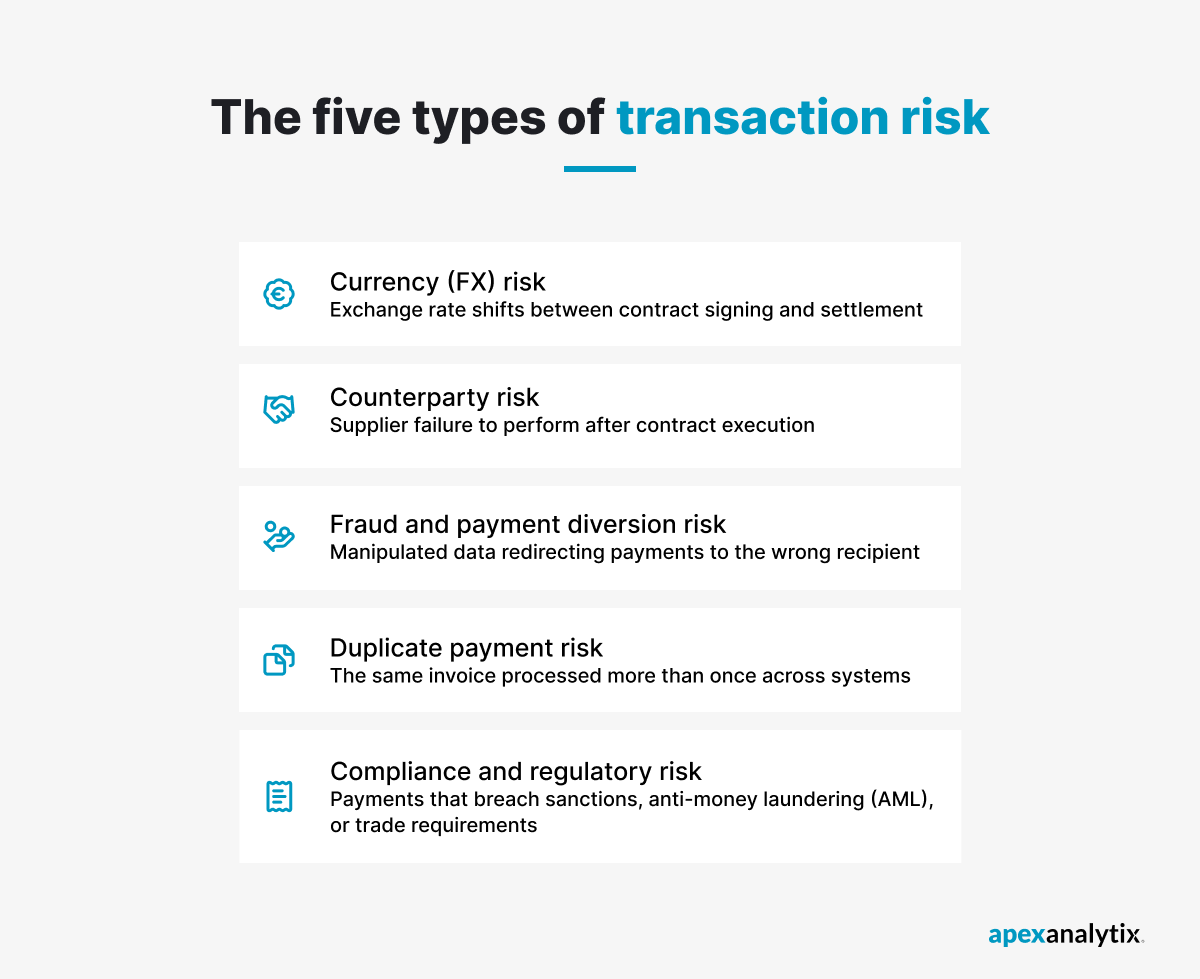
Transaction risk doesn’t have the same characteristics across every payment scenario. Below are the six main categories.
Currency (foreign exchange) transaction risk
Currency transaction risk is the exposure created when an exchange rate movement between contract signing and payment settlement changes the actual cost of a transaction. It applies to any organization making or receiving payments in a foreign currency, and the exposure grows with the length of time between the contract date and the settlement date.
For example, a U.S.-based company that agrees to pay a European supplier €2 million in 90 days carries FX transaction risk throughout the entire 90-day period. If the euro strengthens against the dollar before settlement, the company pays more in USD than budgeted at signing, with no change to the underlying goods or services.
The IMF’s working paper on exchange rate risk management classifies this as a direct cash flow risk, different from the accounting and strategic risks that exchange rate movements also create.
Organizations typically manage this exposure through:
- Forward contracts: Lock in an exchange rate at the time of contract signing, removing rate uncertainty before settlement
- Currency options: Provide the right, without obligation, to exchange at a predetermined rate
- Natural hedging: Matches revenue and expenses in the same currency to reduce conversion exposure
- Netting: Offsets payables and receivables in the same currency to lower the volume of conversions needed
Counterparty risk
Counterparty risk is the possibility that the other party to a transaction won’t fulfill its obligations, whether by failing to deliver goods, defaulting on a refund, or refusing to honor the agreed pricing.
This risk can develop after a contract is signed and controls are in place. A supplier that passed onboarding checks can later face financial pressure, regulatory scrutiny, or operational disruption. When that happens, the organization may find itself holding a payment commitment to a counterparty no longer able or willing to perform.
Structured due diligence at contract execution and active monitoring throughout the supplier relationship reduce this exposure significantly.
Read more: Supplier Risk Assessment Guide | Real-World Data & Results
Fraud and payment diversion risk
Fraud and payment diversion risk covers scenarios where payments reach the wrong recipient because supplier data, invoice details, or banking information has been manipulated before payment release.
The FBI’s IC3 recorded $3.04 billion in BEC losses in 2025, making it the second-costliest crime category after investment fraud. It becomes clearer just how much individual incidents contribute to the overall losses.
The most common schemes in AP environments include:
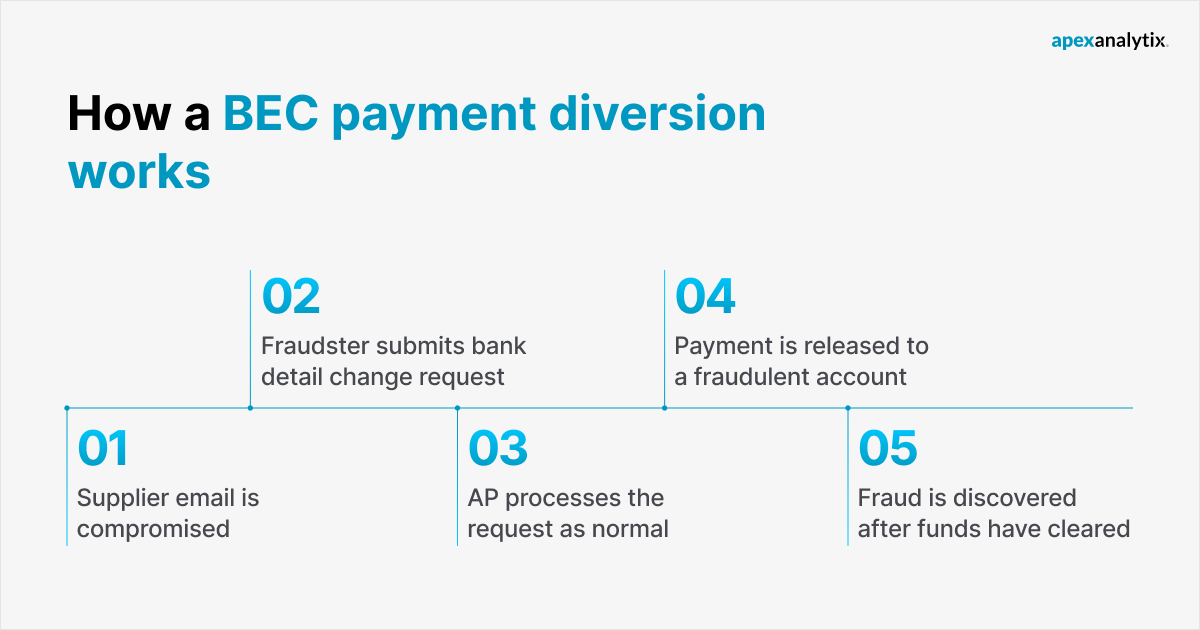
- Business email compromise (BEC), where a fraudster impersonates a supplier or internal employee to request a payment to a new account
- Fake invoice fraud, where invoices are submitted by fictitious vendors or inflated by legitimate ones
- Bank account change fraud, where criminals intercept or spoof bank detail update requests to divert payments
What makes these schemes effective is that they work within normal AP workflows rather than against them. When supplier data has been tampered with upstream, approval processes and audit trails don’t flag the payment as suspicious. The transaction looks legitimate at every checkpoint.
Read more: The Hidden Heist: How BEC Fraud Targets Your AP Team
Case study: Fraud to Zero
Duplicate payment risk
Duplicate payment risk arises when the same invoice is processed more than once across different payment runs, systems, or entities. Common causes include:
- Suppliers submitting the same invoice through multiple channels
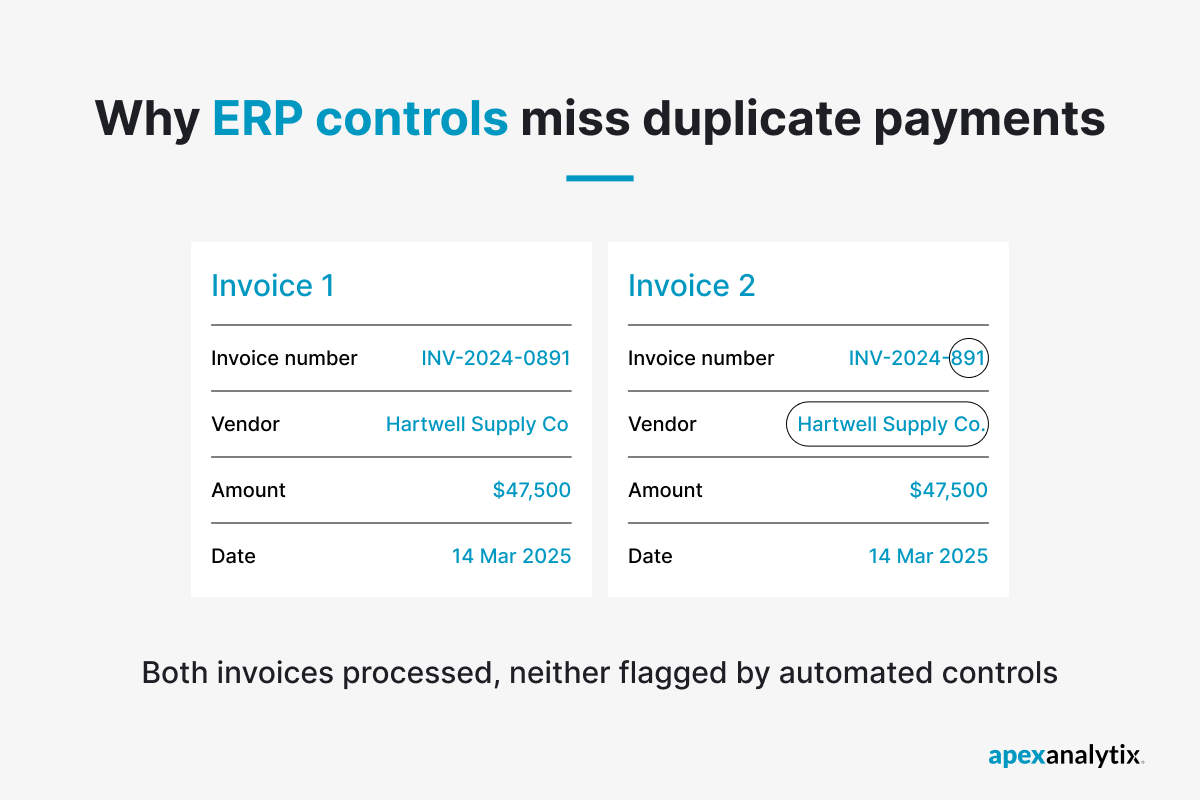
- Suppliers entering minor variations in invoice numbers or amounts that defeat deduplication logic
- Organizations operating multiple ERP platforms with inconsistent matching standards
Standard ERP controls aren’t designed to catch every variation. A duplicate with a slightly changed invoice number, a transposed digit, or a vendor name formatted differently can move through automated checks undetected.
Research cited in our vendor risk management checklist estimates that approximately $2 million in duplicate payments goes undetected for every $1 billion in spend. Catching the duplicates requires additional controls that standard payment systems don’t run by default, primarily fuzzy matching logic and supplier statement reconciliation.
Compliance and regulatory transaction risk
Compliance and regulatory transaction risk occurs when a payment fails to meet legal, regulatory, or contractual requirements, often without any deliberate wrongdoing. Common scenarios include:
- Payments that reach vendors on sanctions or restricted-party watch lists
- Transactions that violate anti-money laundering (AML) regulations
- Payments that breach trade restrictions or export controls
- Tax identification mismatches that trigger reporting and penalty exposure
Two regulatory frameworks define the core obligations. The Bank Secrecy Act, administered by FinCEN, requires organizations to maintain AML programs, monitor transactions for suspicious activity, and file reports with regulators when red flags appear. Meanwhile, the U.S. Office of Foreign Assets Control (OFAC) requires screening every counterparty against its sanctions lists before funds are released.
Penalties apply even when a violation is unintentional, which is why automated pre-payment screening belongs in every AP control environment.
Processing and operational transaction risk
Processing and operational transaction risk covers financial losses stemming from human error and system failures, with no fraud or regulatory intent involved. Common sources include:
- Payment gateway failures from duplicate or failed transactions
- Incorrect payment amounts from data entry errors or unit price mismatches
- Bank routing errors from outdated or inaccurate vendor master data
- Timing failures from system outages during payment runs
Unlike fraud, these errors carry no warning signs like suspicious behavior or anomalous patterns. The financial impact accumulates when they affect high-value transactions or go undetected across multiple payment cycles.
The U.S. Government Accountability Office (GAO) reported $186 billion in improper federal payments in FY 2025, reflecting the scale of operational payment failure even in well-resourced environments with established controls.
How to Manage Transaction Risk
Each type of transaction risk requires a different control, applied at the right point in the payment lifecycle.
Validate supplier data before payment
Most AP transaction risk originates in supplier master data. Unverified bank accounts, inaccurate tax IDs, and outdated vendor records create the perfect conditions for payment diversion, duplicate entries, and compliance failures. Continuous supplier information validation at onboarding and during every data change is the most direct preventive control available.
Screen against sanctions and prohibited lists
Every payment involving an external party should be screened against OFAC sanctions lists, watch lists, and trade restriction databases before release. This check needs to run at the point of payment, not on a monthly schedule.
Automated screening provides consistent coverage across high transaction volumes, where periodic manual reviews create windows in which a newly sanctioned vendor can receive payment before the next check runs.
Apply controls at the point of bank account change
Bank account change requests rank among the highest-risk events in the AP lifecycle. A single unauthorized change can redirect an entire payment run. Controls should include real-time validation against bank records, identity verification, and ownership confirmation.
In 2024, Nacha introduced new ACH Network rules requiring risk-based fraud monitoring procedures across all organizations sending ACH payments, giving these controls formal regulatory backing.
Use deduplication logic and pre-payment checks
Duplicate payment controls should be embedded in the ERP and applied before funds are released. Key checks include matching invoice numbers, amounts, and payment dates across systems, as well as routing exceptions for manual review before transactions clear. The goal is to stop the same obligation from being paid twice before it reaches the ledger.
Hedge currency transaction exposure
Organizations with significant cross-border supplier payments can reduce FX transaction risk through hedging instruments. Forward contracts lock in an exchange rate at contract signing, removing the uncertainty created by the settlement delay. Natural hedging, or matching revenue and expense currency, can reduce exposure without derivative instruments.
Run AP recovery audits to catch what controls miss
AP recovery audits review settled transactions to identify overpayments, duplicate payments, missed credits, and pricing discrepancies that weren’t caught at the time of payment. Recovered funds return directly to the bottom line. They also reveal where controls consistently fail, which is often more valuable than the recovery itself.
How apexanalytix Helps Reduce Transaction Risk
apexanalytix addresses transaction risk across the full payment lifecycle, connecting supplier data validation, pre-payment controls, and AP recovery into one platform.
Key capabilities include:
- Bank account validation: Validates bank accounts in more than 30 countries at onboarding and monitors continuously for unauthorized changes
- Fraud detection: Monitors supplier profiles and transaction data around the clock, alerting teams to suspicious activity before payments clear
- Duplicate payment prevention: Flags duplicate invoices and anomalous payment patterns before funds are released
- AP recovery audit: Identifies overpayments, missed credits, and billing errors, recovering funds that passed through controls
Across those capabilities, apexanalytix has prevented or recovered $9B in yearly overpayments and continues to help companies protect $10T+ in spend annually.
Want to secure your supplier payments in the same way?
Contact apexanalytix to see how it addresses transaction risk to lower financial exposure.
FAQ
1. Can transaction risk be fully eliminated?
Not entirely, but layered controls reduce it significantly. Pre-payment validation, continuous monitoring, and recovery audits together address all risk types.
2. How does transaction risk affect supplier relationships?
Payment errors and fraud incidents create disputes and damage trust, even when unintentional. Resolving them quickly and transparently is what keeps supplier relationships intact.
3. What is the difference between transaction risk and settlement risk?
Settlement risk is specifically about one party fulfilling its side of a transaction while the other doesn’t. Transaction risk is broader, covering fraud, errors, compliance failures, and currency movements that affect the payment itself.
4. How do ERP migrations increase transaction risk?
Migrations often reset payment terms, disrupt matching logic, and introduce supplier data inconsistencies. Controls that worked in the old system don’t always transfer cleanly, which increases exposure to duplicate payments and processing errors during the transition.
5. Is transaction risk covered by cyber insurance?
BEC losses may be covered under cyber or crime policies, but coverage is rarely automatic. Sublimits and exclusions are common, so organizations should review their policy terms specifically for payment fraud before assuming they’re protected.