What Is Third-Party Fraud? Everything You Need to Know
Learn what third-party fraud is, which five forms it takes in enterprise AP, where each enters the procure-to-pay cycle, and how to detect and prevent it.
September 10, 2026
Third-party fraud happens when someone outside your organization poses as a legitimate supplier, hijacks a vendor’s identity, or diverts a payment to an account they control.
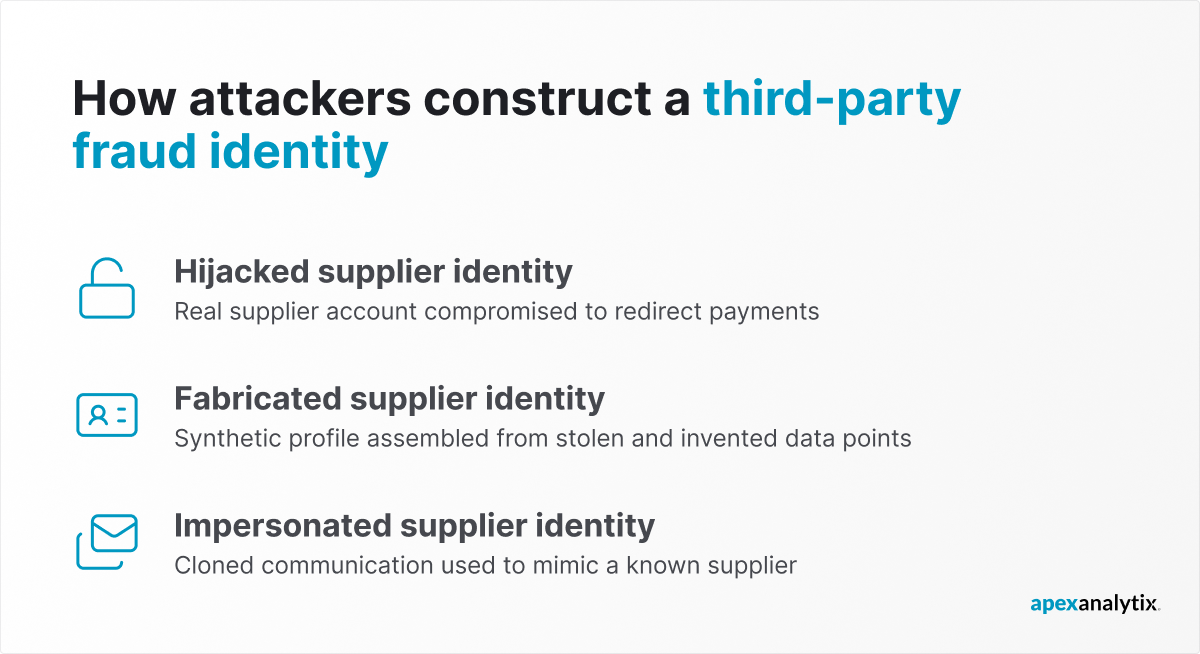
Unlike internal fraud, the attacker has no authorized access to your systems, employee badge, or approved vendor record. What they do have is a convincing impersonation: a spoofed supplier email, a cloned onboarding profile, or a bank change request engineered to pass standard AP review.
This guide breaks down the main types of third-party fraud, maps where each one enters the procure-to-pay cycle, and outlines what effective detection and prevention look like for enterprise AP and procurement teams.
Key Takeaways:
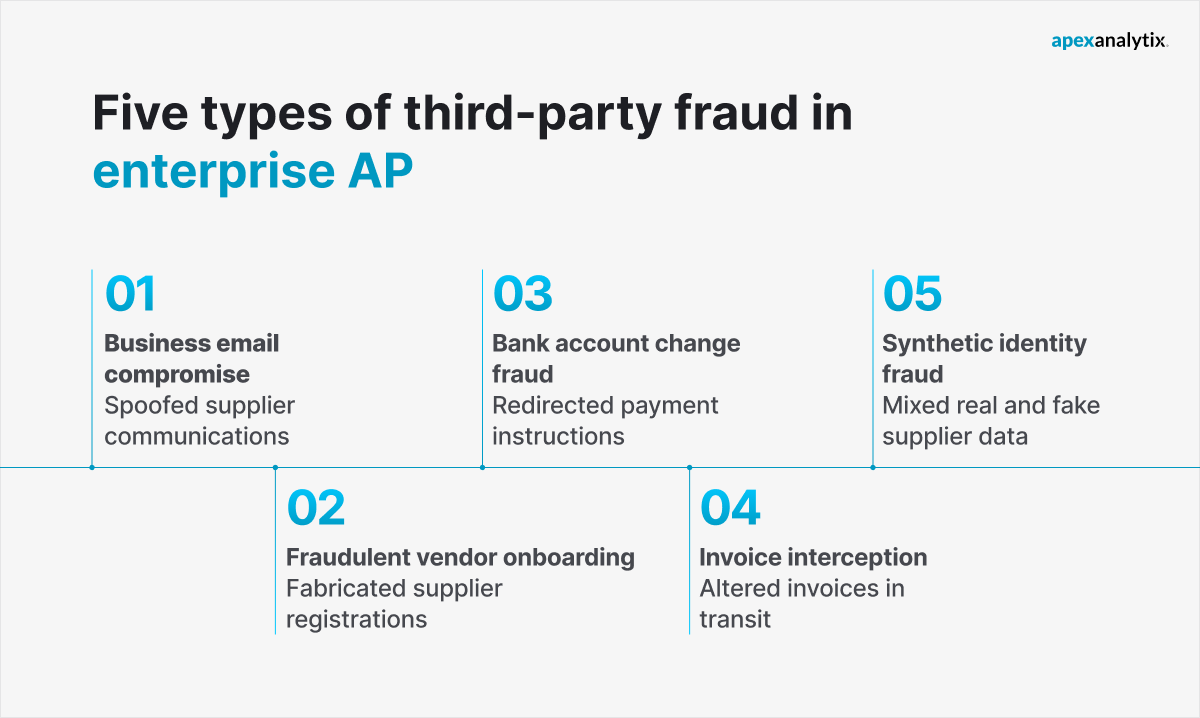
Third-party fraud takes five distinct forms in enterprise AP: Business email compromise, fraudulent vendor onboarding, bank account change fraud, invoice interception, and synthetic identity fraud all exploit different vulnerabilities in enterprises’ supplier onboarding, payment, and communication systems.
Warning signs appear at both onboarding and payment stages: Mismatched tax IDs, residential addresses, urgently submitted registrations, and bank change requests that arrive without prior portal notification are all signals that can be acted on before a payment is released.
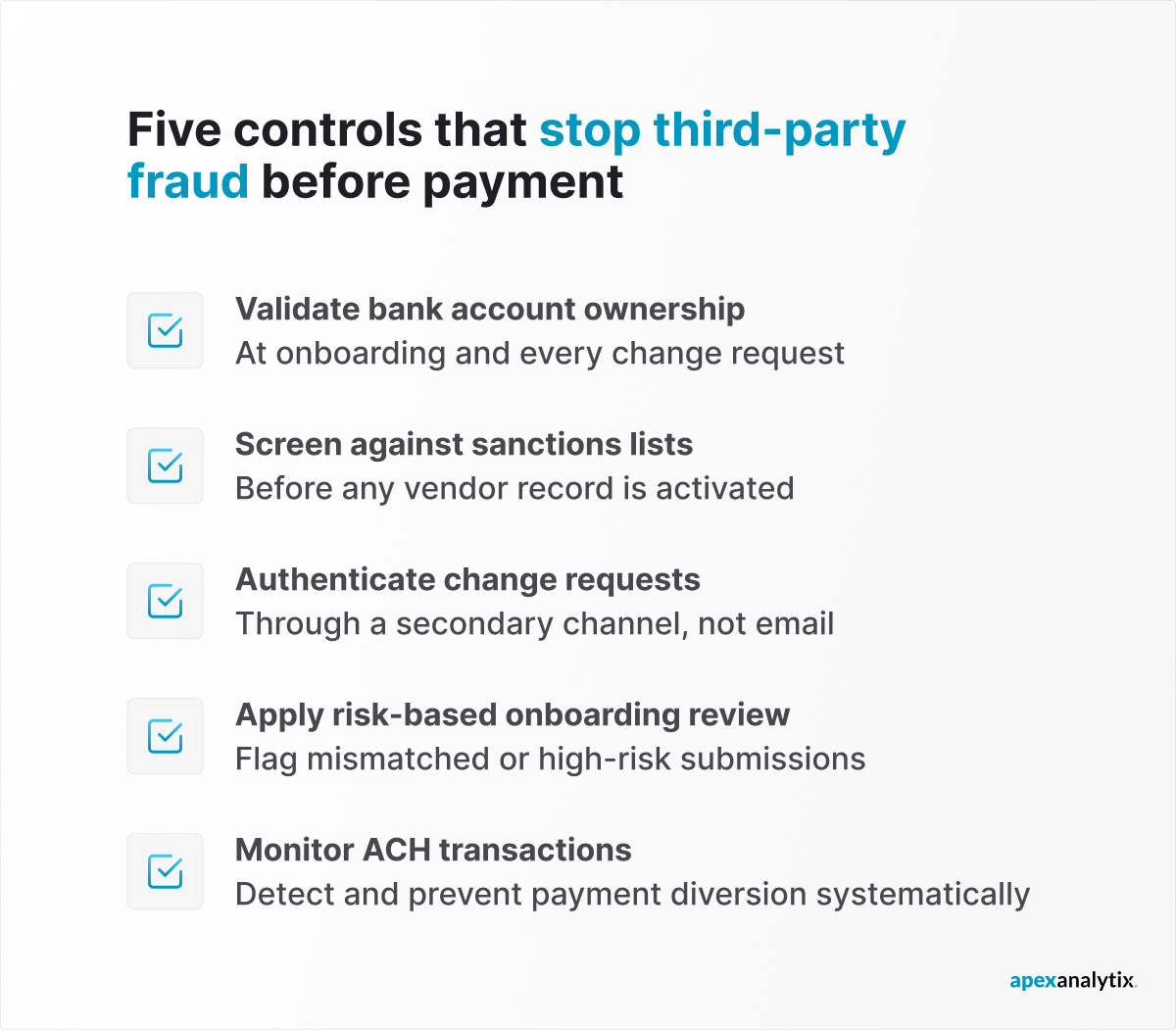
Stopping third-party fraud is a pre-payment discipline: Bank account ownership validation, sanctions screening, out-of-band authentication, risk-based onboarding review, and ACH fraud monitoring all work at the point of entry, not after funds have moved.
Regulatory requirements now make fraud monitoring mandatory: According to NACHA’s 2026 ACH fraud-monitoring rules, all ACH payment originators must implement risk-based controls to identify and stop fraudulent payment entries before they clear.
apexanalytix covers both entry points where third-party fraud concentrates: With its fraud detection features, the platform flags suspicious supplier and transaction signals before payments clear. apexanalytix also independently verifies bank account ownership at onboarding and on every change request to secure common fraud entry points.
What Is Third-Party Fraud?
Third-party fraud is fraud committed by an external actor with no authorized access to your systems or supplier records. Rather than breaking in, the attacker manufactures the appearance of a legitimate supplier interaction through identity fabrication, impersonation, or interception to redirect funds or extract value from your accounts payable environment.
The key difference from insider fraud is that the external attacker has nothing real to work with. Every record they touch belongs to someone else, whether that’s a real supplier whose identity has been hijacked or a shell entity assembled from stolen data to clear standard approval workflows.
First-, Second-, and Third-Party Fraud: What Is the Difference?
Understanding where third-party fraud stands relative to other fraud types helps clarify which controls apply and who bears the exposure.
The table below maps each fraud type by who commits it, which identity they use, and how it appears in an enterprise AP environment.
Fraud type
Who commits it
Identity used
Enterprise AP example
First-party fraud
Insider: employee, supplier, or both
Real, authorized identity
An employee creates a shell vendor and submits invoices for undelivered goods
Second-party fraud
Colluding parties, one internal
Real, willingly shared identity
An AP team member and an external contact collude to approve inflated invoices and split the proceeds
Third-party fraud
External attacker with no authorized access
Stolen, spoofed, or fabricated identity
A fraudster impersonates a known supplier and submits a bank account change request
To determine the kind of fraud they’re dealing with, procurement and finance teams only need to confirm whether the attacker has had any authorized access to their environment. If the answer is no, the threat is third-party fraud.
Common Types of Third-Party Fraud in Enterprise AP
Third-party fraud in the procure-to-pay environment can take several distinct forms, each exploiting a different vulnerability in how enterprises onboard, pay, and communicate with suppliers.
Business email compromise (BEC)
BEC is the most prevalent and financially damaging form of third-party fraud targeting enterprise payments. Fraudsters either spoof a supplier’s email domain or compromise the vendor’s actual account, and then use that position to submit fraudulent payment instructions directly to your AP team.
Supplier registrations are a common entry point when identity validation is weak. Fabricated credentials, stolen business identities, or synthetic combinations of real and fake information can all clear standard onboarding checks if tax IDs, legal entity names, and bank account ownership go unverified.
Once inside the vendor master, the fraudulent supplier can submit invoices for goods or services that were never delivered, with each payment appearing as a legitimate transaction in your records.
Payment details change requests are among the highest-risk touchpoints in the supplier payment cycle. Fraudsters contact AP or procurement teams by email, requesting that future payments be redirected to an account they control and framing the request as a routine supplier update.
According to the FBI’s help guide on business email compromise, payment diversion through fraudulent bank change requests is one of the most financially damaging BEC-related schemes. Wire transfer and ACH diversion are the most common outcomes.
Invoice interception
While bank account change fraud involves the attacker contacting AP directly, invoice interception targets the document itself. When a supplier’s email account is compromised, the fraudster intercepts an outbound invoice and alters the bank account details before it reaches the AP team. The payment goes to a controlled account, while the buyer’s records show a normal transaction against a legitimate supplier.
Synthetic identity fraud
Supplier profiles built from a mix of real and fabricated information are designed to defeat automated screening that checks data points individually. A genuine tax ID may be paired with a fictitious business name, or a legitimate address attached to a shell entity, and no single element flags as false in isolation.
The profile as a whole looks credible enough to clear approval workflows that rely on point-in-time data checks. What catches it is cross-validation across multiple authoritative sources, which is whythe quality of supplier data management directly determines how exposed an organization is to this type of attack.
How Third-Party Fraud Enters the Procure-to-Pay Cycle
External attackers concentrate on the stages where new, unverified information enters your environment. Supplier onboarding and bank account change requests carry the highest risk because both require your systems to evaluate external data they have no prior record of.
The breakdown below shows where each threat enters the P2P cycle, and which control weakness makes it possible.
Fast movement of funds through intermediary accounts
Most third-party fraud can be stopped before a payment clears, but only when validation controls are consistently applied at the stages where external data enters the system.
Warning Signs of Third-Party Fraud
Third-party fraud rarely arrives without signals. According to Europol’s IOCTA 2026, online payment fraud schemes are growing in both sophistication and scale, and AP and procurement teams with consistent validation practices can identify suspicious activity before a payment is released.
Red flags at onboarding include:
Mismatched tax IDs that don’t correspond to the registered legal entity
Residential addresses submitted as a supplier’s business address
Email domains that resemble, but don’t match, a known supplier’s domain
Bank accounts opened recently, held by individuals and not by registered businesses
Supplier registrations submitted urgently, with pressure to bypass standard review
Red flags at the payment and change request stages include:
Bank account change requests arriving via email, with no prior phone or portal notification
Requests to redirect payments to a new account shortly after a supplier relationship begins
Invoice details that differ from prior submissions in format, payment terms, or account information
Payment instructions arriving outside normal business hours or from a slightly altered email address
Communications that discourage verification or pressure AP staff not to contact the supplier directly
How to Prevent Third-Party Fraud
Effective prevention requires controls at the specific stages where third-party fraud enters. The measures below address the highest-risk points in the procure-to-pay cycle.
1. Validate bank account ownership at every entry point
As part of your supplier onboarding checklist, confirm that the legal entity in the bank record matches the vendor master before you onboard any supplier. Do the same before processing any change requests.
Email confirmation alone isn’t enough. Validated supplier information that covers tax IDs, bank account ownership, and legal entity data is the foundation of a reliable check.
2. Screen every new supplier against sanctions and prohibited party lists
The OFAC Specially Designated Nationals List is updated multiple times per week, alongside Interpol and UN lists that track designated entities globally. Registration-stage screening captures a supplier’s status at one point in time. Ongoing monitoring catches designations that occur after approval.
3. Authenticate bank change requests through a secondary channel
Call the supplier using a phone number already on file, not one provided in the change request, and confirm the instruction independently before updating any payment details.
Bank change requests that arrive without prior notification through the supplier portal or a known contact should be held pending direct confirmation.
4. Apply risk-based scrutiny to onboarding submissions
New supplier registrations warrant closer review when they include recently registered domains, mismatched entity data, residential addresses, or bank accounts that don’t match the supplier’s business profile. A structured supplier risk assessment process helps teams standardize how risk is scored at the point of entry.
5. Implement systematic ACH fraud monitoring
NACHA’s ACH fraud-monitoring rules, rolled out in phases throughout 2026, impose a compliance obligation on ACH payment originators to build risk-based controls that identifyand stop fraudulent payment entries, including those targeting vendor payment instructions. The EBA-ECB 2025 joint report on payment fraud reinforces this rule, confirming that strong authentication significantly reduces fraud rates.
Connecting risk controls to a broader vendor risk management program helps procurement teams treat payment security as part of their wider supplier risk framework.
Catching third-party fraud requires controls that operate during supplier onboarding and bank account change requests, the two points at which it consistently enters enterprise systems. apexanalytix addresses both dangers through a connected set of capabilities backed by data compiled from 280M+ golden records.
Fraud Detectcontinuously analyzes supplier profiles and transaction data, drawing on behavioral signals and intelligence from the apexanalytix global fraud monitoring network. When combinations of signals cross a defined risk threshold, including sudden bank detail changes, mismatched entity data, and escalating invoice patterns, the platform flags the supplier and alerts your team before a payment is released.
Meanwhile, BankPro confirms that the bank account holder on record is the same legal entity in your vendor master, both at onboarding and at every subsequent change request. The check runs through direct integrations with banking authorities and government databases across more than 30 countries.
Together, the two capabilities close the window that third-party fraud depends on, intercepting fraudulent instructions before a payment clears.
Want to see how apexanalytix stops third-party fraud before it reaches your AP team?
Contact apexanalytix to see in action how Fraud Detect and BankPro protect enterprise AP teams from vendor impersonation, payment diversion, and fraudulent supplier registrations.
FAQ
Who is responsible for preventing third-party fraud in an enterprise?
Responsibility is shared across AP, procurement, and IT teams. While AP owns payment verification and bank change authentication, procurement owns supplier onboarding validation, and IT owns system access controls.
Does third-party fraud increase during ERP migrations or supplier onboarding surges?
Yes. These periods create windows during which supplier data is being re-entered or re-validated, and fraudsters deliberately target them. Temporary manual workarounds and decentralized onboarding processes are among the most frequently exploited conditions.
How does third-party fraud affect cyber insurance claims?
Some insurers require specific controls, such as out-of-band bank authentication, to have been in place at the time of the incident. Organizations without documented validation processes may face reduced or denied claims even when the fraud is clearly external.
What is the difference between BEC and third-party fraud?
BEC is one delivery method within the broader category of third-party fraud. Third-party fraud encompasses any scheme in which an external actor fabricates or hijacks a supplier identity to divert payments, including fraudulent onboarding, invoice interception, and synthetic identity submission.
How long does it take to detect third-party fraud?
With bank account validation and real-time monitoring in place, fraudulent instructions can be flagged before a payment clears. Without those controls, detection often happens only after a supplier reports a missed payment, sometimes weeks after the fact.
Related Resource
Media Mentions
Tariff Volatility and the Reality of Restructuring Supply Chains
Explore our ROI calculator, developed in partnership with Forrester, by navigating to the link below and selecting “configure data” on the right-hand side.