A supplier can keep the same name and price while changes in ownership, manufacturing locations, or materials alter the information behind a trade compliance decision. Tariff changes add another moving part: the rate and legal authority applicable to a shipment can differ from those used in an earlier sourcing assessment.
The WTO’s December 2025 trade monitoring report found that new measures affecting imports, primarily tariffs, covered $2.64 trillion, or 11.1% of world imports, between mid-October 2024 and mid-October 2025. That coverage was more than four times the previous reporting period’s level.
This guide explains how procurement, AP, supplier risk, and trade teams can keep supplier information connected to tariff decisions, monitor changes, and document follow-up.
Key Takeaways:
- Duty exposure depends on the product and transaction: Classification, origin, customs value, preferences, additional measures, and entry dates can all affect the amount owed.
- The 2026 US landscape requires updated assumptions: The IEEPA ruling, temporary Section 122 surcharge, and subsequent Section 301 measures changed the basis for many tariff assessments.
- Supplier changes can trigger renewed review: Ownership, production locations, sub-tier suppliers, and revised documents can affect earlier decisions.
- Screening supports a broader compliance process: Name matches need investigation, and ownership-related sanctions exposure can exist without a supplier appearing on a list.
- apexanalytix supports supplier data and risk controls: Validation, screening, monitoring, and remediation workflows provide inputs for trade specialists’ determinations.
What Changed in US Tariffs in 2026?
Regulatory context checked October 15, 2026.
Three developments matter when reviewing US tariff exposure:
- IEEPA tariff authority was rejected: On February 20, 2026, the Supreme Court held that IEEPA does not authorize presidential tariffs. The decision concerned the challenged reciprocal and drug-trafficking tariffs imposed under that statute.
- A temporary surcharge followed: A Section 122 proclamation imposed a 10% import surcharge, subject to exceptions, effective February 24, 2026. Its 150-day period ended July 24, 2026.
- Section 301 measures followed in July: The administration directed tariff action concerning 60 economies’ forced-labor import prohibitions. The implementing annex made the relevant tariff provisions effective July 24, 2026, with product and transit exceptions. Rates and their interaction with ordinary duties vary by economy and product.
For each purchase or entry, confirm the applicable tariff schedule, additional measures, exemptions, and effective date. An earlier rate assumption should be reviewed when the legal basis or shipment timing changes.
How Supplier Changes Affect Trade Compliance
Supplier records connect the commercial relationship to the entities, locations, and supporting information used in compliance reviews. Changes after onboarding can leave those inputs outdated.
Ownership changes
Under OFAC’s 50 Percent Rule, entities owned 50% or more, directly or indirectly in the aggregate, by one or more blocked persons are considered blocked. A supplier can therefore have sanctions exposure even if its own name does not appear on a sanctions list.
Trade and legal teams should determine what ownership evidence is needed and investigate relevant changes. Basic identity validation and name screening provide only part of that assessment.
Production and product changes
Moving production, changing a contract manufacturer, or substituting materials can affect the facts supporting classification, origin, or preferential treatment. Ask suppliers to notify the relevant team and provide updated product specifications, manufacturing details, or origin declarations when necessary.
A supplier’s registered address is useful for identifying the business, but it does not establish where a product was made. Origin determinations require product- and process-specific evidence.
Sub-tier and documentation changes
New upstream parties can introduce restricted-party or sourcing risks. Expired or revised declarations may no longer support an earlier assessment. Define triggers for renewed review, assign an owner, and retain the updated evidence and approval before relying on the earlier decision.
What Determines Tariff Treatment?
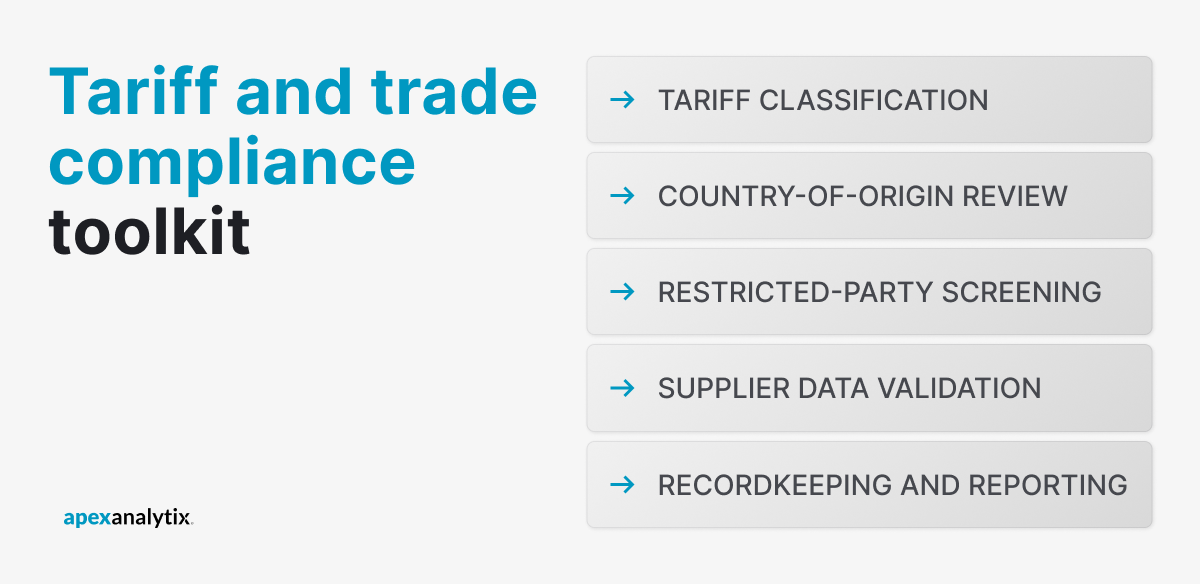
Tariffs are customs duties on imported goods. The final treatment depends on several linked inputs, and trade compliance also covers export controls, sanctions, licensing, screening, and recordkeeping.
| Input |
What teams need to confirm |
| Product classification |
The applicable tariff code based on the goods’ characteristics and the destination market’s schedule |
| Country of origin |
The origin rules and manufacturing evidence relevant to the transaction |
| Customs value |
The valuation method and required additions or adjustments |
| Preferential treatment |
Whether the goods satisfy the relevant agreement’s origin and documentation rules |
| Additional measures |
Applicable Section 301 or other additional duties, trade remedies, exclusions, and effective dates |
Classification and origin
The Harmonized System provides a common six-digit classification structure; national tariff schedules can add further digits. Product composition, function, and processing can affect the code. Teams should use sufficiently detailed specifications when requesting classification advice.
Preferential origin determines eligibility for benefits under a trade agreement or preference program. Non-preferential origin supports other customs purposes, including trade remedies and marking. Buying from a supplier in an agreement country does not establish that its goods qualify for preferential treatment.
Valuation and preferences
Under the WTO customs valuation framework, transaction value is the primary method when its conditions are met. Required adjustments can include certain packing costs, assists, commissions, royalties, or licence fees. The supplier’s invoice amount can therefore differ from customs value.
For preferential treatment, retain the evidence required by the relevant agreement. Qualifying rules may involve changes in tariff classification, regional value content, or specified manufacturing processes. If transaction value cannot be used, other valuation methods apply in the prescribed order, subject to the applicable rules.
Additional duties and trade remedies
Ordinary duty rates may be supplemented by additional measures. Trade specialists should check whether duties overlap, exclusions apply, or transitional treatment changes the result for a particular entry.
Anti-dumping duties address imports sold below normal value that cause or threaten material injury to domestic industry. Countervailing duties address injurious subsidized imports. Safeguards address increased imports causing or threatening serious injury. Ad valorem duties use customs value; specific duties use a quantity-based amount; compound duties combine both.
Which Requirements Apply Beyond Tariffs?
Export controls and sanctions
Export controls can depend on the item, destination, end use, or end user. Under the US Export Administration Regulations, even EAR99 items may require a licence for certain restricted end users, end uses, or destinations.
Sanctions can restrict dealings involving designated parties, countries, sectors, assets, or activities. Teams need to assess the applicable regime and transaction facts before approving a restricted activity or relying on an authorization.
Restricted-party screening
The US Consolidated Screening List brings together several export-related lists maintained by Commerce, State, and Treasury. A potential match requires investigation; a confirmed match may indicate a prohibition, licensing requirement, or other restriction.
Document the identity comparison, the relevant listing, and the resulting decision. Check the official source and restrictions associated with a match before proceeding. Screening does not replace ownership due diligence or end-use review.
Authorizations and records
A licence or authorization may cover only specified items, parties, destinations, activities, or end uses. Keep approvals, screening results, supplier declarations, product details, and transaction records together so the basis for a decision can be reconstructed. Retention and reporting requirements depend on the applicable regime.
How Tariff Changes Affect Sourcing and Cash Flow
Compare alternatives using total landed cost and operational risk. A lower supplier price can be offset by duties, freight, longer lead times, inventory requirements, or insufficient capacity. Switching suppliers can also introduce financial, geographic, and compliance risks.
The 2025 IMF working paper Supply Chain Diversification and Resilience examines how diversification can improve resilience while creating efficiency trade-offs. Its authors emphasize that supply chains cannot be reconfigured immediately and that the benefits depend on exposure to shocks and adjustment constraints.
Procurement can support scenario planning with current supplier and manufacturing information. Finance should distinguish expected duty costs from potential refunds, since timing and eligibility affect cash forecasts.
What Happens When Tariff or Trade Compliance Decisions Are Wrong?
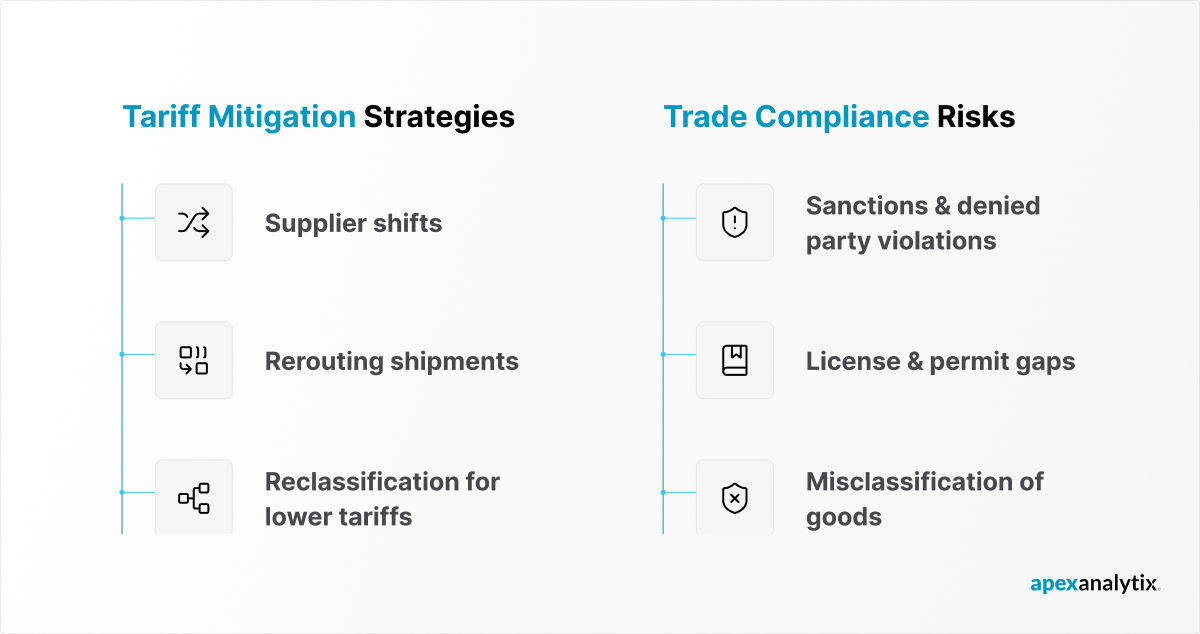
Incorrect classification, origin, or valuation can create underpayments or overpayments, corrections, and possible interest or penalties. Missing records can make customs treatment harder to support. Sanctions or export-control violations can lead to transaction restrictions or enforcement action.
Overpaid duties may be recoverable through the relevant correction, protest, or refund procedure. Requirements and deadlines depend on the jurisdiction, entry status, and legal basis for the refund.
For US IEEPA duties, CBP has introduced Consolidated Administration and Processing of Entries (CAPE) within the Automated Commercial Environment (ACE) to process valid refund requests pursuant to court orders or applicable law. Importers and brokers should follow CBP’s current eligibility and submission instructions, including applicable electronic-refund requirements. Court orders and implementation guidance can affect which entries qualify and how requests are handled.
Customs refunds belong within the importer’s trade and customs process, with support from its broker or legal advisers as needed.
Who Owns Each Part of the Process?
| Team or party |
Core contribution |
| Trade compliance or customs |
Classification, origin, valuation, licensing, and entry-specific requirements |
| Legal |
Regulatory interpretation, sanctions issues, and higher-risk decisions |
| Procurement and supplier risk |
Supplier identity and risk information, sourcing changes, and escalation of relevant findings |
| Finance and AP |
Invoice, payment, and transaction records supporting cost and duty reviews |
| Supply chain and logistics |
Shipment facts and coordination with brokers and carriers |
| Suppliers |
Product, manufacturing, origin, and other supporting information |
| Customs brokers and specialists |
Filing support and trade expertise within the scope of their engagement |
Define handoffs when supplier or product information changes. The team maintaining a supplier record should know which changes require trade review and which transactions need to be held pending a decision.
How apexanalytix Supports Supplier Data and Risk Controls
Accurate supplier identity, location, and risk information helps teams connect findings to the correct supplier and route changes for review. apexanalytix supports these inputs through Supplier Management, Supplier Risk Management, and its data capabilities. Customs, legal, and trade specialists make determinations about classification, origin, valuation, licensing, and ownership-related restrictions.
The platform’s capabilities include:
- Supplier onboarding: Configurable workflows collect supplier identity, location, and other information relevant to the organization’s review process.
- Data validation: Validation and enrichment draw on 1,200+ trusted government, regulatory, and third-party sources to support supplier record checks.
- Restricted-party screening: Compliance Risk integrates 100+ prohibited entity lists and 200+ politically exposed person lists. PEP information supports risk assessment and does not itself establish a trade prohibition.
- Risk assessment: Automated scores and signals help teams prioritize suppliers and changes requiring investigation.
- Continuous monitoring: Ongoing monitoring surfaces relevant risk changes after onboarding for follow-up.
- Remediation and reassessment: Workflows engage stakeholders and track remediation. The compliance capability can halt payments to affected suppliers where necessary.
In a global testing company engagement, apexanalytix’s Vendor Master Cleansing Service, part of its Data offering, cleaned and vetted more than 35,000 supplier records stored in nearly 30 databases. Reported results included 15,000 street addresses corrected, nearly 900 duplicate records removed, and almost 6,000 suppliers identified with invalid bank information.
Consistent identities and addresses help teams link trade-related documents and ownership-review findings to the correct supplier. Origin evidence and ownership determinations still require the appropriate specialist review; the engagement demonstrates supplier data quality improvements.
How quickly do supplier changes reach the team responsible for your trade compliance decisions?
Contact apexanalytix to explore how supplier validation, screening, and risk workflows can support your broader trade compliance process.
FAQs
1. How can procurement teams forecast tariff exposure before choosing a supplier?
Work with trade specialists to confirm classification, origin, customs value, and the expected entry date. Check preferences, additional duties, exclusions, and announced changes before comparing landed costs. Use scenarios when rates or shipment dates are uncertain, and update the calculation when manufacturing details, materials, or supplier locations change.
2. Can supplier contracts address tariff increases?
Contracts can allocate tariff costs and establish price-review, tariff-adjustment, or change-in-law procedures. Define notice requirements, supporting evidence, effective dates, and how decreases or refunds are treated. Procurement and legal teams should align these provisions with the agreed delivery terms and the parties’ actual ability to complete import formalities.
3. Who pays tariffs under different Incoterms?
Under Incoterms 2020, the buyer generally handles import clearance and duties under every rule except Delivered Duty Paid (DDP), where the seller takes that responsibility. These terms allocate obligations between the parties; local customs law determines who can act as importer and remains relevant when a foreign seller cannot complete import formalities.
4. How do tariff changes affect working capital and cash flow?
Higher duties increase the cash required to import goods, often before those goods generate revenue. Lower duties and approved refunds can reduce that burden. Forecast duty payments and potential refunds separately, using expected entry dates, refund eligibility, processing requirements, and realistic timing rather than assuming a disputed amount will be returned immediately.
5. How should companies track tariff changes across multiple countries?
Track classification, origin, destination, entry date, and the legal measure supporting each rate. Assign owners to official-source monitoring and route changes to affected products, suppliers, and purchase commitments. Keep the decision and effective date with supporting records so teams can distinguish historical treatment from the requirements for the next shipment.