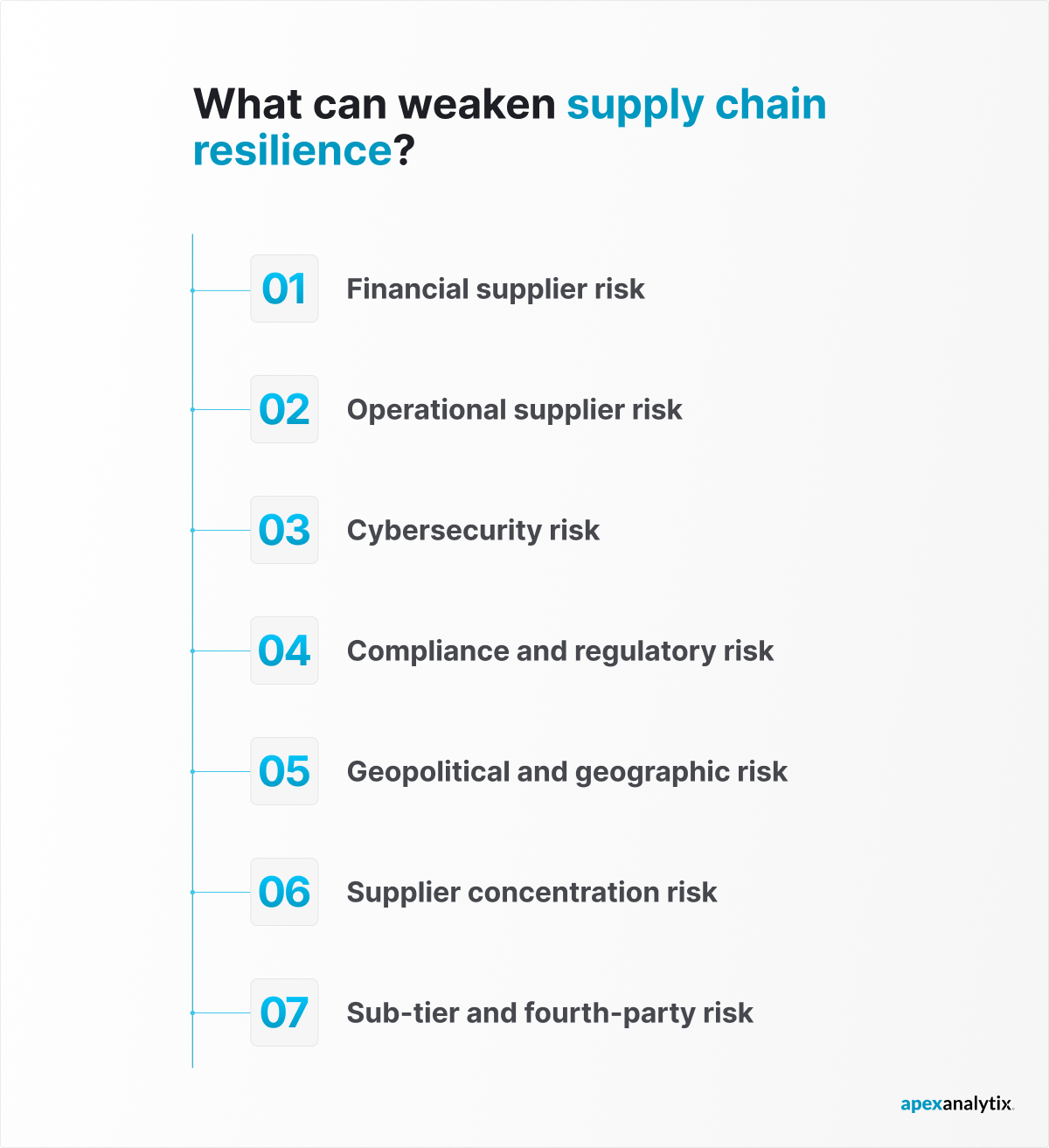
The main sources of exposure include:
Financial supplier risk
Financial pressure can weaken a supplier’s performance well before the supplier fails.
Liquidity problems and financial distress may limit the supplier’s ability to maintain staffing, production, or service levels.
Operational supplier risk
A supplier doesn’t need to be in financial trouble to cause disruption.
Operational supplier risk, including supplier performance problems, can appear as production delays, capacity constraints, quality problems, logistics issues, or service outages.
Cybersecurity risk
Supplier relationships can introduce cyber exposure through software, connected systems, products, and digital services.
A vulnerability at a technology provider or one of its own vendors can disrupt or expose systems and services used by the organization.
Compliance and regulatory risk
A supplier may become restricted or require additional review when sanctions, ownership, certifications, legal requirements, or other compliance conditions shift.
Beneficial ownership, the countries involved in a transaction, and the goods or services supplied can all change a supplier’s compliance status. If an ownership change makes a critical supplier restricted, the organization may need to suspend purchases before a replacement is ready.
Geopolitical and geographic risk
Conflicts, trade restrictions, natural hazards, transport disruptions, and restricted access to critical resources represent geopolitical and geographic risks that can change where suppliers operate and how goods move between markets.
Supplier concentration risk
Concentration risk develops when an organization depends heavily on a small number of suppliers, locations, routes, or critical inputs.
Several seemingly separate suppliers may also depend on the same region, transport route, facility, or material source, allowing one disruption to reach multiple relationships at once.
Sub-tier and fourth-party risk
Direct (or Tier 1) suppliers often depend on manufacturers, technology providers, logistics companies, and other businesses further upstream. Tier 2 and deeper relationships create sub-tier risk, while a direct supplier’s own vendors or service providers can create fourth-party risk.
A disruption at one of those indirect suppliers can still interrupt a product or service delivered by the Tier 1 supplier.
How to Build Supply Chain Resilience in 8 Steps
The steps below help strengthen supply chain resilience by improving visibility, creating alternatives, coordinating decisions, and establishing clear controls.
The process involves eight steps:
1. Map the supplier network
Create a current record of suppliers, operating locations, products or services provided, and known sub-tier relationships. Link that information to the business processes each supplier supports so teams can see key dependencies.
Complete multi-tier mapping may not be possible from the start. Begin with Tier 1 suppliers and known sub-tier dependencies, then use the criticality assessment in the next step to decide where deeper mapping is needed.
2. Determine critical suppliers
Spending and supplier size alone don’t show how difficult a supplier would be to replace. A smaller supplier may still be highly critical if it provides a specialized product or service with few alternatives.
Criticality should reflect the role the supplier plays and possible consequences if that relationship became unavailable. Here are some examples of factors to take into account:
| Factor |
What to consider |
| Operational dependency |
Which products, services, or processes rely on the supplier? |
| Replacement time |
How long would another source take to qualify? |
| Replacement options |
What suitable alternatives are already available? |
| Business impact |
What revenue, customer commitments, regulatory obligations, or critical services would be at risk? |
Risk and criticality are related but different. Risk reflects potential adverse events and their effects, while criticality reflects how much the organization depends on the supplier. A supplier can therefore have a low current risk rating and still be highly critical.
3. Assess the risks relevant to each relationship
A vendor risk assessment should adjust to the relationship rather than apply the same review to every supplier. A technology provider with access to important systems may require review of access controls and incident response, while a manufacturer supplying a hard-to-replace component may require closer review of capacity, financial stability, and backup production options.
Supplier-provided information can also be checked against external data when identity, ownership, financial condition, sanctions status, or another key detail requires independent verification. Highly critical suppliers may require a deeper review than low-criticality suppliers.
4. Validate and maintain supplier data
Risk decisions depend on accurate supplier records. Legal identity, ownership, locations, certifications, contacts, and relationship details may change after onboarding.
Validation should continue throughout the supplier lifecycle so risk information stays linked to the correct entity and ownership changes are captured.
Data maintenance keeps supplier records current. Meanwhile, risk monitoring tracks new events and developments that can change the supplier’s risk profile.
5. Address concentration where the impact is high
Not every single-source relationship needs another supplier. Use the criticality factors from step 2 to identify dependencies where disruption would have a high business impact and replacement options are limited.
Supplier sourcing and discovery can identify potential alternatives. Organizations may then qualify a backup supplier, split volume across locations, or prepare a backup route for specific disruptions.
Document the chosen contingency option for each critical dependency so you can test it later.
6. Monitor material changes over time
Monitoring tracks developments that may change a supplier’s financial, operational, cyber, compliance, or geopolitical risk profile.
Signals can include changes in financial condition or ownership, sanctions updates, cyber incidents, adverse news, and operational performance. Monitoring frequency and depth should reflect supplier criticality and how quickly the relevant risk can change.
A material change, meaning one that could alter the supplier’s risk level or ability to deliver, can trigger a review without waiting for the next scheduled assessment.
7. Define response and escalation rules
A flagged risk can stall if ownership is unclear.
A supplier management framework can assign review, escalation, response, and follow-up responsibilities across procurement, finance, compliance, and risk teams.
Clear rules connect the finding to a decision across the following elements:
- Trigger: What type or level of change requires review?
- Owner: Who’s responsible for evaluating it?
- Escalation: When and to whom should the issue move if severity increases?
- Response: What actions can be taken?
- Follow-up: How will remediation or another decision be tracked?
- Closure: What needs to happen before the issue is considered resolved?
Once a trigger is met, the issue can move through owner review → escalation when needed → response → follow-up → closure.
8. Test scenarios and update the plan
Once contingency plans are documented for critical dependencies, testing can expose weaknesses that are hard to see on paper. Simulating the loss of a critical supplier, route, or service may reveal outdated contacts, slow approval paths, missing alternatives, or assumptions that no longer hold up.
Teams can use findings from tests and real incidents to update response rules, contingency options, and monitoring priorities.
Strengthen Supply Chain Resilience With apexanalytix
apexanalytix’s supplier risk management software brings supplier data, risk intelligence, continuous monitoring, and response workflows into one solution.
apexanalytix draws on 1,200+ risk data sources to identify emerging supplier risks. Configurable scoring allows organizations to evaluate financial health, compliance, performance, capacity, cybersecurity, geopolitical exposure, and other relevant risk areas.
Validated supplier data supports assessment and maintenance, while external risk intelligence supports ongoing monitoring. The Risk Resolution Engine can trigger response plans based on company policies and involve the relevant stakeholders when a risk signal requires action.
A global financial services firm used apexanalytix to strengthen vendor risk oversight. After implementation, the company managed to:
- Continuously monitor 6,000+ vendors for changing risk
- Cut supplier onboarding from 45 days to four
- Replace a manual 600-question survey with automated validation
- Report no supplier risk issues for three years, according to its Head of Vendor Risk Management
Contact apexanalytix to learn how its supplier risk management capabilities can support your supply chain resilience.
FAQ
1. How do you measure supply chain resilience?
Measure supply chain resilience using metrics such as recovery time, percentage of critical supply maintained during disruption, supplier concentration, and time required to activate an alternative source. The exact KPIs should reflect the suppliers and business processes that matter most.
2. How do you calculate the ROI of supply chain resilience?
Calculate supply chain resilience ROI as (expected financial benefit − resilience investment cost) ÷ resilience investment cost × 100.
Expected benefits can include avoided or reduced losses from downtime, lost sales, emergency sourcing, expedited transport, and other disruption costs the organization can reasonably estimate.
3. What contract terms can improve supply chain resilience?
Contracts with critical suppliers can include business continuity obligations, incident-notification requirements, information or audit rights, subcontractor requirements, and exit or transition provisions. Match the clauses to the supplier’s role, criticality, and potential cost of disruption.
4. How far down the supply chain should companies assess resilience?
There’s no fixed tier depth for every supply chain. Assessment should extend far enough to identify critical dependencies that could disrupt the business. Deeper reviews are most useful where Tier 2, Tier 3, or other indirect suppliers support critical products, services, or inputs.
5. What is the difference between supply chain resilience and business continuity?
Business continuity focuses on keeping critical organizational functions running during disruption, while supply chain resilience focuses on the suppliers, dependencies, and flows that support those functions. A critical supplier can affect both supply chain resilience and the continuity plan for the business process depending on it.