Profit recovery is the process of finding and reclaiming funds lost through overpayments, duplicate payments, missed supplier credits, pricing discrepancies, and contract non-compliance. It helps finance and procurement teams bring money back to the bottom line without generating new revenue.
Industry benchmarking puts the average invoice exception rate at 14%, and 53% of AP professionals identify exceptions as the single biggest drain on their team’s capacity. Even well-run AP functions let errors through at scale, leaving duplicate payments undetected, credits sitting on supplier accounts, and contract overbillings unchallenged.
This guide explains what profit recovery is, why payment errors persist despite existing controls, and how organizations can recover funds while building better defenses against future leakage.
Key Takeaways:
- Profit recovery covers more than AP recovery audits: It also includes contract compliance, sales and use tax, unclaimed property, and retail audits, each targeting a different source of financial leakage.
- Payment errors survive standard controls because they look like normal transactions: Duplicate payments, unapplied credits, and contract overbillings clear payment systems without triggering alerts, which is why they require a dedicated post-payment review.
- Timing a profit recovery audit directly affects how much you recover: Recoverable value keeps declining every year an audit is delayed, with the highest-return windows following ERP migrations, mergers, and contract renegotiations.
- Recovery programs produce control improvements, not just cash: Every confirmed finding points to a specific failure in the procure-to-pay process, giving teams concrete evidence for tightening controls at the source.
- apexanalytix combines recovery, prevention, and root-cause intelligence in one program: Running over 200 active audits across trillions of dollars in annual client spend, apexanalytix covers AP recovery, overpayment prevention, contract compliance, and supplier statement review.
What Is Profit Recovery?
Profit recovery is a structured review of a company’s financial transactions to find and reclaim money that shouldn’t have left the business, including overpayments, duplicate payments, uncollected credits, pricing errors, and contract overbillings.
While the term is sometimes used interchangeably with “recovery audit,” profit recovery has a wider scope.
A recovery audit focuses on AP transactions such as paid invoices, applied credits, and reconciled supplier statements. Profit recovery extends that review to any area where a company has paid too much or failed to collect what it was owed. This includes sales and use tax overpayments, unclaimed property, and retail pricing and promotional allowance discrepancies.
The Main Types of Profit Recovery Audit
Each profit recovery type targets a unique source of financial leakage and requires different data, expertise, and supplier engagement, so the right starting point depends on where a company’s exposure is highest.
The table below shows how the five main audit types differ in scope and what each tends to uncover in practice:
| Audit type |
What it reviews |
Common findings |
| AP recovery audit |
AP transactions: invoices, payments, supplier statements, credits |
Duplicate payments, unapplied credits, pricing errors, overbillings |
| Contract compliance audit |
Supplier contracts: pricing terms, discounts, rebates, allowances |
Incorrect pricing, missed volume discounts, uncollected rebates, non-compliant billing |
| Sales and use tax audit |
Tax payments on purchases: exemptions, tax rates, classifications |
Overpaid tax, incorrectly applied rates, missed exemption certificates |
| Unclaimed property audit |
Aged credits, voided checks, dormant supplier balances |
Supplier-held funds not yet returned or applied against open balances |
| Retail merchandise audit |
Pricing, sales, inventory charges, and deal terms |
Vendor non-compliance with promotional terms, incorrect deductions, markdown discrepancies |
Most enterprise programs begin with an AP recovery audit and add contract compliance or tax recovery as the program matures.
Unclaimed property is usually treated separately, as it follows its own reporting requirements governed by state-level frameworks set by NAUPA.
What Causes Profit Leakage?
Even organizations with mature AP systems and strong pre-payment controls experience profit leakage. Four structural weaknesses account for most of the leakage seen in enterprise AP environments:
- Duplicate vendor records: When the same supplier exists under multiple entries in the vendor master, AP may process the same invoice under different records and pay it twice. Because the two payments appear to reference different vendors, standard duplicate-detection rules don’t flag them.
- Unapplied supplier credits: Credits issued for returns, rebates, canceled orders, or overbillings frequently sit on supplier accounts without being netted against future invoices. They build up over time until a targeted review identifies and recovers them.
- Contract terms not loaded into the ERP: Pricing amendments, volume discounts, and rebate agreements negotiated by procurement don’t always reach the system AP uses to process invoices. Suppliers bill at the rate they have on file, which may no longer reflect what was agreed.
- High invoice volume and limited review bandwidth: AP teams processing thousands of invoices per month can’t manually examine every line item for contract compliance or pricing accuracy. Errors that fall below the threshold of automated controls pass through unchallenged.
The 2026 AFP Payments Fraud and Control Survey found that 76% of organizations faced attempted or actual payment fraud in 2025. Payment leakage from non-fraudulent errors is even more widespread, precisely because it looks identical to every other processed transaction and doesn’t trigger fraud alerts.
How the Profit Recovery Process Works
While the specific data and supplier engagement vary by audit type, the underlying process is consistent across all profit recovery programs.
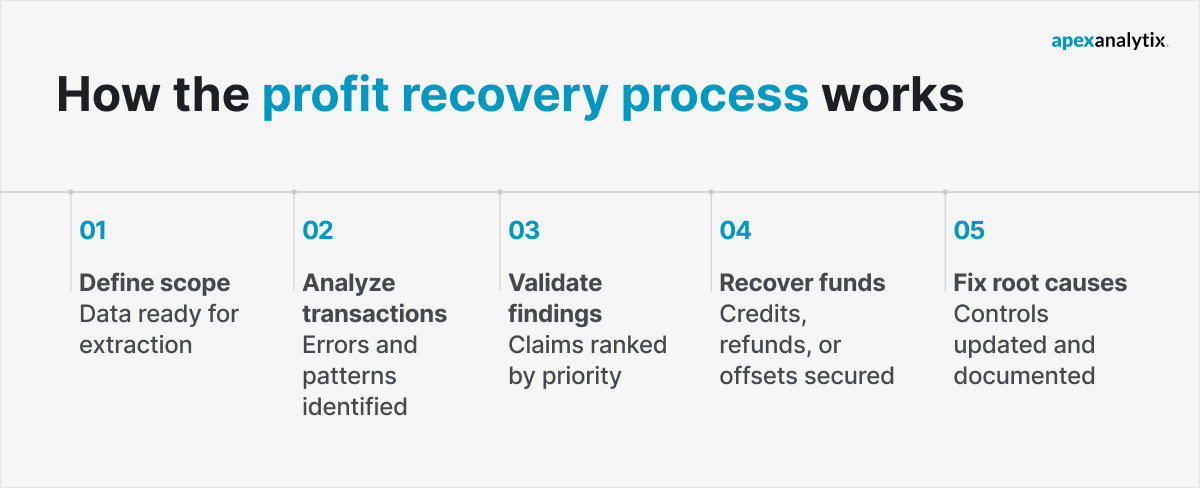
1. Define the scope and gather the data
The audit begins by defining the scope, or which business units, time periods, ERP systems, and supplier populations will be reviewed. This decision determines which data sets need to be pulled and how far back the review will go.
Auditors then extract the relevant transaction data from the systems that cover the defined scope, pulling invoices, payment files, supplier master records, credit memos, contracts, and purchase orders.
2. Analyze transactions against source agreements
Auditors measure paid amounts against contracts, purchase orders, pricing agreements, and supplier statements.
Best-in-class AP teams hold their invoice exception rate at around 9%, while the rest of the market runs at more than twice that figure.
The errors behind these numbers tend to follow the same patterns:
- Duplicate invoices submitted through two channels
- Credit memos that were never applied against open balances
- Pricing updates negotiated by procurement but not reflected in the ERP
- Rebates that accrued but were never collected
3. Validate and prioritize findings
Not every anomaly is a recoverable error. Auditors validate each potential finding by cross-referencing it against supporting documentation (the invoice, the purchase order, the contract, and the supplier statement) to confirm that a real discrepancy exists before presenting it as a claim.
The strongest findings (those with clear evidence, high dollar value, and a direct link to a specific transaction) are prioritized first. Lower-value or ambiguous items are set aside or flagged for further review.
How findings are presented is also important at this stage. A well-documented claim with clear evidence is easier for suppliers to review and faster to resolve. Experienced auditors structure outreach to recover funds efficiently without turning a billing discrepancy into a commercial dispute.
4. Recover the funds
Confirmed findings are shared with suppliers alongside the evidence. Depending on the finding type and the supplier’s response, recovery can take the form of a credit memo applied against a future invoice, a direct refund, or an offset against an outstanding balance.
Resolution timelines vary. Some suppliers respond and resolve claims within weeks, while others require follow-ups, additional documentation, or escalation. The quality of the original claim package (meaning how clearly the discrepancy is documented and how easy it is for the supplier to verify) directly affects how quickly funds come back.
5. Identify root causes and improve controls
Tracing each finding back to its cause is what turns a recovery program into a control improvement. The root cause might be a duplicate entry in the vendor master, an approval workflow that failed to catch a pricing change, an ERP migration that reset default settings, or a contract amendment that was never loaded into the payment system.
Once the root cause is identified, finance and procurement teams can act on it by correcting vendor master data, updating ERP configurations, tightening approval workflows, or flagging a supplier for closer monitoring. Without this step, the underlying weakness remains, and similar errors continue to pass through.
Read more: 10 Most Recommended Process Improvements Following an AP Recovery Audit
The Business Benefits of Profit Recovery
The benefits of profit recovery extend across finance, procurement, and risk functions
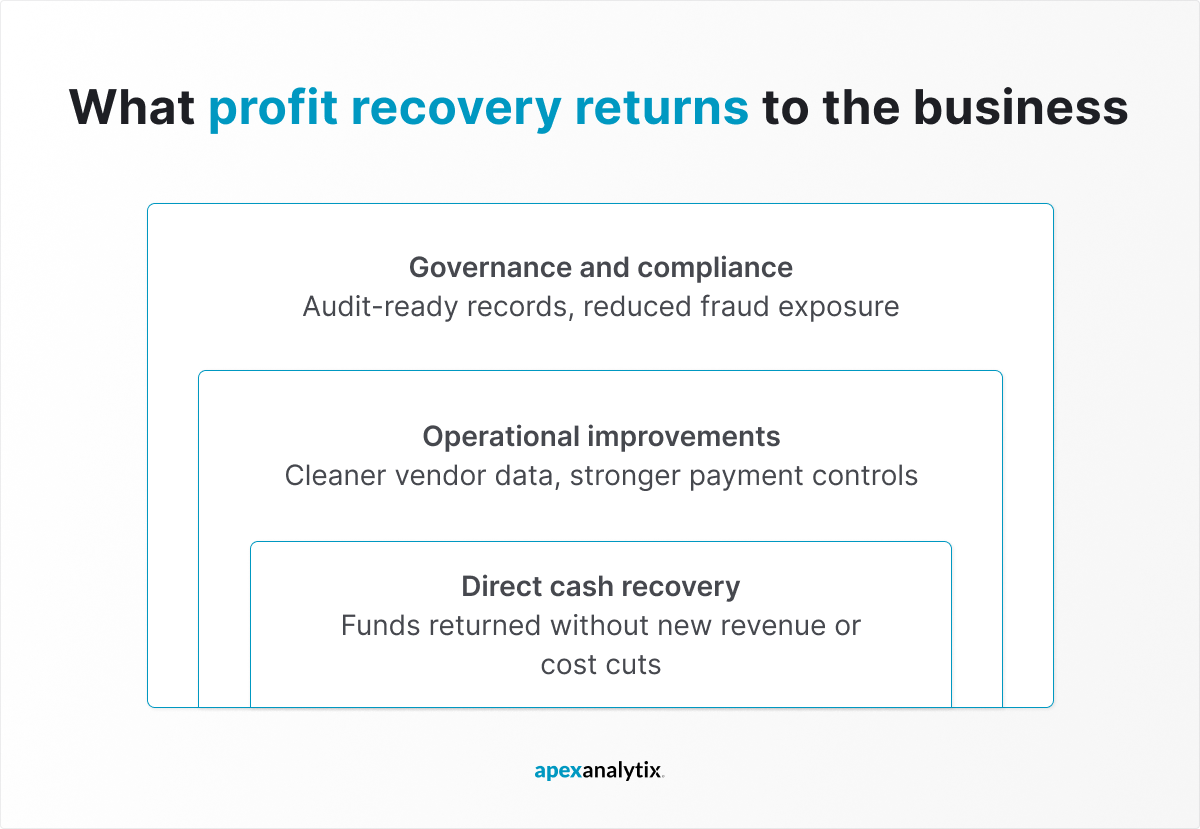
- Direct cash recovery: Funds returned from overpayments, unused credits, and contract non-compliance reach the bottom line without new sales or cost cuts.
- Stronger AP controls: Each confirmed finding identifies a specific control failure. Addressing it reduces how often the same control weaknesses generate new losses.
- Cleaner vendor master data: Many findings trace back to duplicate or inaccurate supplier records. Recovery programs drive data corrections that improve payment accuracy for all subsequent transactions.
- Better contract compliance visibility: Contract compliance audits confirm whether suppliers are honoring agreed pricing, discount structures, and rebate terms, giving procurement teams evidence they can use in renegotiations.
- Reduced fraud exposure: Reviewing payment patterns and supplier records flags anomalies that may signal fraud risk, including unusual bank account changes and billing irregularities.
- Audit-ready documentation: The findings, evidence, and corrective actions produced during a recovery program give finance and risk teams defensible records of control performance. Under Section 404 of the Sarbanes-Oxley Act, public companies must assess and report on the effectiveness of internal controls over financial reporting, and recovery audit findings provide the necessary evidence. The IIA’s Global Internal Audit Standards place the same requirement on internal audit functions.
These benefits strengthen as the program matures.
Read more: What Are the Benefits of an AP Recovery Audit?
Profit Recovery Examples
The following examples are drawn from apexanalytix audit engagements across industries, spend volumes, and organizational contexts.
Global food and beverage manufacturer
An apexanalytix AP recovery audit covering more than $20 billion in disbursements for a global food and beverage company with $14 billion in annual revenue returned over $2.5 million in recoveries.
The review identified recurring drivers of duplicate payments and unclaimed credits. Findings led to standardized invoice coding and improved cancellation controls, reducing future payment leakage across the supplier population.
Global biopharmaceutical company
A global biopharmaceutical company engaged apexanalytix to audit complex, highly regulated supplier spend. The program returned more than $25 million to the bottom line.
The review exposed issues tied to contract changes, pricing execution, and missed credits that had gone undetected through standard AP processing, enabling tighter controls across both procurement and AP.
Shipping and logistics leader
A sustained recovery audit and controls program with a global shipping and logistics leader has delivered more than $80 million in cumulative value across multiple audit cycles.
The engagement extended past single-cycle recoveries. Continuous oversight strengthened payment governance and reduced repeat leakage over time, showing what a long-term audit program produces that periodic reviews can’t.
Global energy company
An AP recovery audit covering 750,000 invoices and $14 billion in spend for a leading energy company recovered more than $750,000 from a single supplier.
The audit also uncovered control weaknesses in ERP data and invoice processing that extended across the broader supplier population, converting a targeted audit into a program-wide review of payment controls.
In each of these examples, the audit returned funds and exposed the control weaknesses that had allowed errors to accumulate undetected.
When to Run a Profit Recovery Audit
Profit recovery delivers the most value when run on a consistent cadence, but certain events provide the perfect timing for performing one.
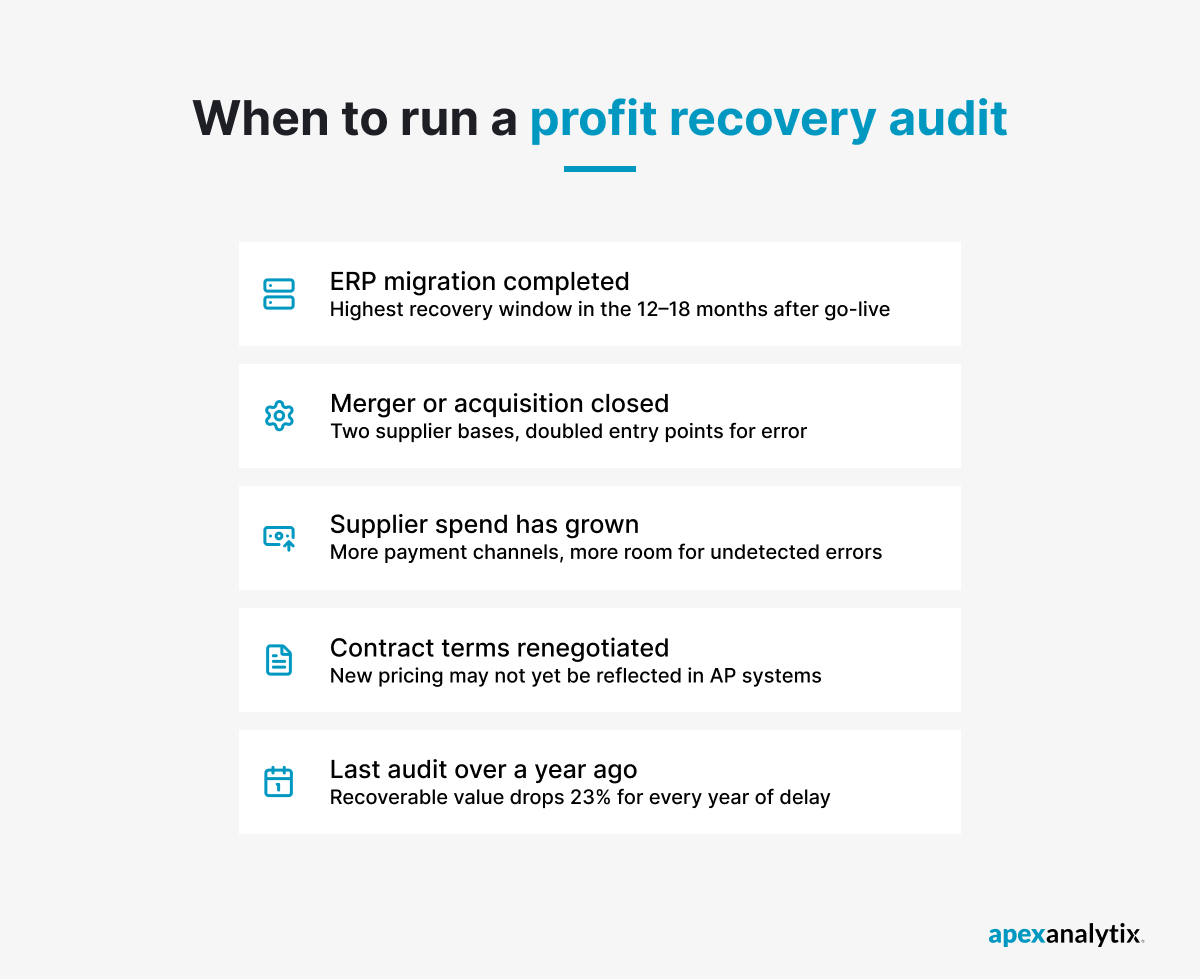
- An ERP migration has recently completed: System changes are among the most common drivers of payment errors. Control configurations reset, invoice routing changes, and data from legacy systems don’t always transfer cleanly. The 12–18 months following a migration represent one of the highest-return windows for recovery.
- An acquisition or merger has closed: Integrating two supplier bases, two AP teams, and two sets of ERP configurations creates significant leakage risk. Duplicate vendor records, inconsistent payment terms, and overlapping supplier relationships all create exposure that standard controls weren’t built to catch.
- Supplier spend has grown significantly: As organizations add suppliers, invoice volumes, and payment channels, the likelihood of errors increases. A recovery program helps establish a new baseline of control accuracy before those errors accumulate.
- A contract renegotiation cycle has passed: If pricing, discount structures, or rebate terms have changed, a contract compliance audit confirms whether the new terms are reflected in actual payments.
- A periodic audit is overdue: According to apexanalytix data drawn from $4.5 trillion in client spend, each year without an audit costs organizations 23% of what they could have recovered. Older payment data is harder to validate, and supplier contacts become more difficult to reach.
Organizations that treat profit recovery as a recurring program rather than a reactive one tend to recover more and spend less time on each cycle as controls improve.
Read more: Running a Recovery Audit After an ERP Migration
How apexanalytix Drives Profit Recovery at Enterprise Scale
apexanalytix has operated as the world’s largest commercial AP recovery audit firm for more than 35 years, running over 200 active audits at any given time across trillions in annual client spend.
Every audit pairs recovery work with root-cause analysis and a corrective action workshop, so organizations leave with both recovered funds and a concrete plan for closing the control failures that allowed the errors in the first place.
Key capabilities include:
- Enterprise-scale AP recovery audit: Post-payment review across multiple ERPs, regions, currencies, and supplier populations, with predictive models built on 35 years of audit data that forecast which suppliers are most likely to carry hidden credits or duplicate payments
- Overpayment prevention: AI-driven analysis of invoices and payment data before disbursement, identifying high-risk transactions before money leaves the business
- Contract compliance audit: Review of commercial agreements to confirm that suppliers are billing against negotiated terms: pricing, discounts, rebates, and allowances
- Sales and use tax recovery: Identification and recovery of overpaid tax across purchases, including missed exemption certificates and incorrectly applied rates
- Unclaimed property audit: Recovery of aged credits, dormant balances, and voided disbursements held on supplier accounts across multiple jurisdictions
- Supplier-facing workflows: AI-powered outreach that identifies the right supplier contact, selects the optimal communication channel and language, and scales across thousands of active claims simultaneously, without requiring additional internal resources
Ready to see what profit recovery could return to your organization?
Get in touch with apexanalytix to learn how AP recovery audits, overpayment prevention, and contract compliance reviews work in practice.
FAQ
1. How is profit recovery priced?
Most profit recovery programs operate on a contingency basis, meaning the audit firm takes a percentage of recovered funds with no upfront cost to the organization. This makes the program self-funding: if no recoveries are found, there’s no fee.
2. Can profit recovery be handled internally?
Internal teams can catch some errors, but most organizations lack the supplier contact networks, specialized data tools, and industry benchmarks that external audit firms bring, which is why external programs consistently recover more.
3. What data does a profit recovery audit require?
Auditors need ERP transaction data, including invoices, payment files, credit memos, supplier master records, purchase orders, contracts, and supplier statements. Most enterprise audit firms support certified extracts for SAP, Oracle, and PeopleSoft.
4. Who should own profit recovery within the organization?
Profit recovery usually sits at the intersection of AP and procurement, with AP managing supplier outreach and procurement supplying contract data. Senior finance leadership usually sponsors the program.
5. Is profit recovery only relevant for large enterprises?
It delivers the highest returns at scale, but mid-sized organizations with complex supplier relationships or recent ERP migrations can also benefit, particularly from contract compliance and supplier statement reviews.