First-Party Fraud vs. Third-Party Fraud: Key Differences, Detection, and Prevention
Compare first-party fraud vs third-party fraud, including where each enters your payment cycle, which controls catch them, and how to detect and prevent both.
September 10, 2026
First-party fraud and third-party fraud both result in financial loss, but they differ in who commits the attackand what it takes to stop it.
The threat in first-party fraud comes from inside your supplier relationships. It could be an employee manipulating vendor records, a supplier inflating invoices, or the two working together through a shell company. Third-party fraud comes from outside, with an attacker impersonating a legitimate supplier, intercepting a payment, or hijacking a bank account change request.
To help guard against each threat more effectively, this guide looks at first-party fraud vs. third-party fraud, including where in your procure-to-pay process they enter, which controls catch them, and who’s responsible for the response.
Key takeaways:
Each fraud type enters the payment cycle at a different stage: Third-party fraud is concentrated during onboarding and bank change requests, when new information enters the system. First-party fraud occurs in approved vendor records, invoices, and payment approvals that have already cleared all upfront checks.
The controls that stop one type won’t catch the other: Pre-payment validation intercepts third-party fraud before funds move. Post-payment review is what catches first-party schemes, often months after the fact.
Most organizations run separate controls for both types, adding exposure: A connected approach that covers supplier identity validation and continuous transaction monitoring reduces both fraud risks.
apexanalytix detects both fraud types through one platform: With composite scoring, the platform’s fraud detection features continuously monitor supplier identity and transaction signals. Meanwhile, bank account validation verifies ownership in real time, helping apexanalytix prevent third-party payment diversion and surface first-party patterns before losses grow.
First-Party Fraud vs. Third-Party Fraud at a Glance
The table below maps who commits each type of fraud, where it enters, and what stops it, covering the three questions that determine which controls your organization needs to prioritize.
Bank account validation, prohibited list screening
Financial recovery
Partial: funds may already be spent
Sometimes possible if caught before payment clears
What Is First-Party Fraud?
First-party fraud in accounts payable is fraud committed by someone withauthorized access to your systems, supplier records, or payment workflows, not by an outsider who has broken in. Access to the vendor master, the invoice approval queue, or the ERP is real and granted, and every record involved looks exactly as it should, which is what makes these schemes so difficult to catch.
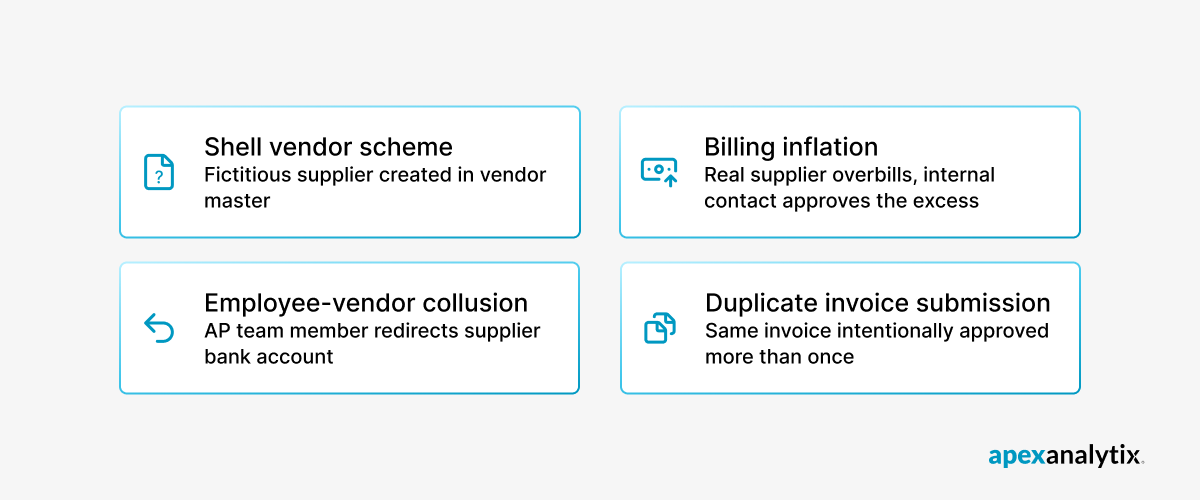
In practice, first-party fraud in AP takes several forms:
Shell vendor schemes, where a fictitious supplier is created in the vendor master and invoices are submitted for goods or services never delivered
Billing inflation, where a real supplier overbills, and an internal contact deliberately approves the discrepancy
Employee-vendor collusion, where an AP team member redirects an active supplier’s bank account to a personal or third-party account
Duplicate invoice submission, where the same invoice is intentionally approved more than once
These schemes clearstandard pre-payment controlswithout triggering alerts because the supplier record, the tax ID, and often the bank account all check out. They come to light through post-payment review, or through a report from someone inside the organization who noticed something was off.
Among the most frequently detected fraud types in AP, billing schemes fall under asset misappropriation, which the ACFE’s Fraud Tree identifies as the most prevalent occupational fraud category, appearing in 90% of the cases studied in the 2026 report.
What Is Third-Party Fraud?
Third-party fraud in supplier payments is fraud committed by someone outside your organization who fabricates a supplier relationship to intercept payments. It falls under the broader discipline of third-party risk management.
The attacker has no access to your systems. Instead, they construct the appearance of a legitimate supplier interaction designed to pass through AP without triggering review.
In practice, third-party fraud in AP takes several forms:
Business email compromise (BEC), where a fraudster spoofs or compromises a supplier email account to submit fraudulent bank change requests
Vendor impersonation, where a fraudster poses as a known supplier through phone, email, or a cloned portal to redirect a payment
Fraudulent vendor onboarding, where an attacker submits a supplier registration using fabricated or stolen credentials
Invoice interception, where an attacker alters legitimate invoices before they reach the buyer’s AP team
Of the schemes above, BEC is the most prevalent: in a 2026 AFP survey, 70% of respondents named it the leading avenue of attempted and actual payments fraud. Its effectiveness comes not from technical sophistication but from how closely it mirrors normal AP processes, which is why stopping it requires controls that independently verify supplier identity regardless of the communication channel.
Key Differences Between First-Party Fraud and Third-Party Fraud
The differences below show where each type enters your payment cycle, how it behaves once inside, and why the controls that stop one type won’t catch the other.
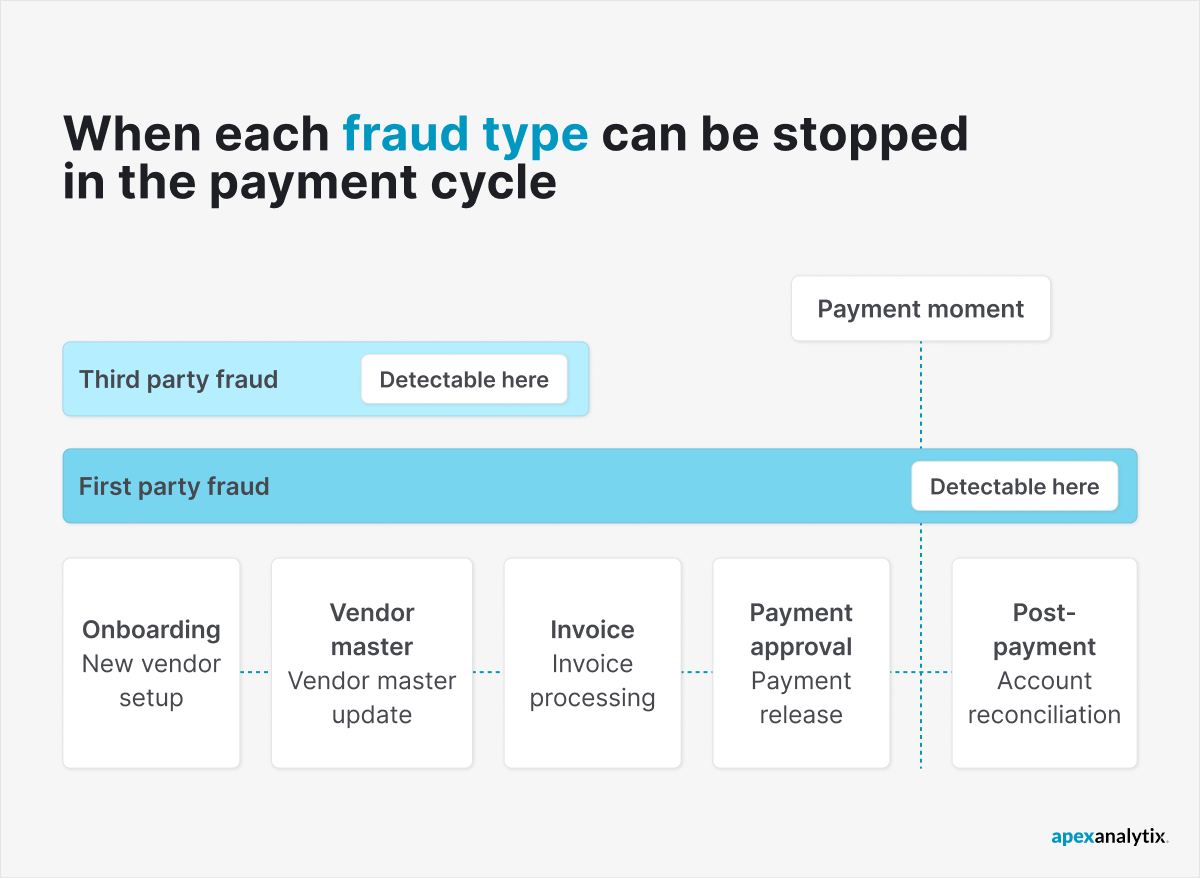
Where each type enters the procure-to-pay cycle
The entry point isn’t the same for both types, and neither is the stage at which controls can realistically intervene.
First-party fraud exploits existing access and primarily enters through approved channels at the vendor master, invoice, and payment stages.
Third-party fraud, on the other hand, has to manufacture access, which means it concentrates most heavily at the points where new information enters the system: onboarding and bank change requests.
That said, neither type is confined to a single stage. The table below maps the specific risks each type can introduce across all five P2P stages.
Third-party fraud is a pre-payment problem. When the right validation controls are in place, it can be caught before funds move, typically at the point a bank change request or new supplier registration is submitted. Without them, the fraudulent request looks identical to a legitimate one and clears without review. Asupplier risk assessment that scores new suppliers by risk level at onboarding also helps determine how much scrutiny each request warrants.
With first-party fraud, detection happens in the post-payment stage. Every approval in the chain looks correct because the access behind it is real. In billing fraud, this means multiple payment cycles have cleared before any discrepancy is caught.
AP recovery auditsare the most systematic tool for surfacing duplicate payments and overbilling patterns that pre-payment controls won’t catch. Unlike reactive investigation, they run on a schedule rather than waiting for a tip.
How to Detect and Prevent Each Type of Fraud
What works at onboarding won’t help catch a billing scheme that’s been running for six months, and post-payment review won’t stop a bank account redirect that was cleared yesterday.
Detecting and preventing first-party fraud
Successful detection means looking beyond the record to find patterns across transactions and relationships. This involves:
Reviewing vendor master records for employee-vendor data matches, such as shared addresses, phone numbers, or bank accounts between suppliers and staff
Running duplicate invoice detection across all payment history, not just within a single ERP instance
Auditing approval workflows for invoices that consistently land just below authorization thresholds
Conducting structured post-payment reviews to identify overbilling and missed credits that have already cleared
Enforcing segregation of duties so no single person can create a vendor record, approve an invoice, and release a payment
Most first-party schemes depend on weak vendor master governance, where billing and compliance risks accumulate without triggering controls. A structuredvendor risk management process formalizes the controls that prevent this.
The GAO’s 2025 Green Book provides the authoritative framework for designing and documenting the payment and procurement controls that address those weaknesses, with specific guidance on fraud and improper payments.
Effective controls need to intercept third-party fraud before a payment clears. The following are the key validation and authentication controls that catch it at the entry points identified above, all built around treating every external request that touches a bank account or supplier identity as unverified until proven otherwise:
Validating bank account ownership in real time at onboarding and at every change request to confirm the account belongs to the legal entity on file, not to an individual or unrelated third-party
Screening every new supplier against prohibited and sanctions lists (OFAC, Interpol, and the UN) before any vendor record is activated.
Verifying bank change requests through a secondary channel outside the email thread, applying authentication tactics like phone or out-of-band verification to a number already on file, not one provided in the request
Reviewing onboarding submissions for high-risk indicators: mismatched tax IDs, residential addresses, burner phone numbers, or email domains that don’t match the supplier’s registered business
A sanctions risk assessment framework keeps AP and compliance teams current on prohibited party updates. Where diversion has already occurred, the DOJ’s Justice Manual on mail and wire fraud covers the criminal liability framework, which is worth understanding before an incident, not during one.
How apexanalytix Detects First-Party and Third-Party Fraud
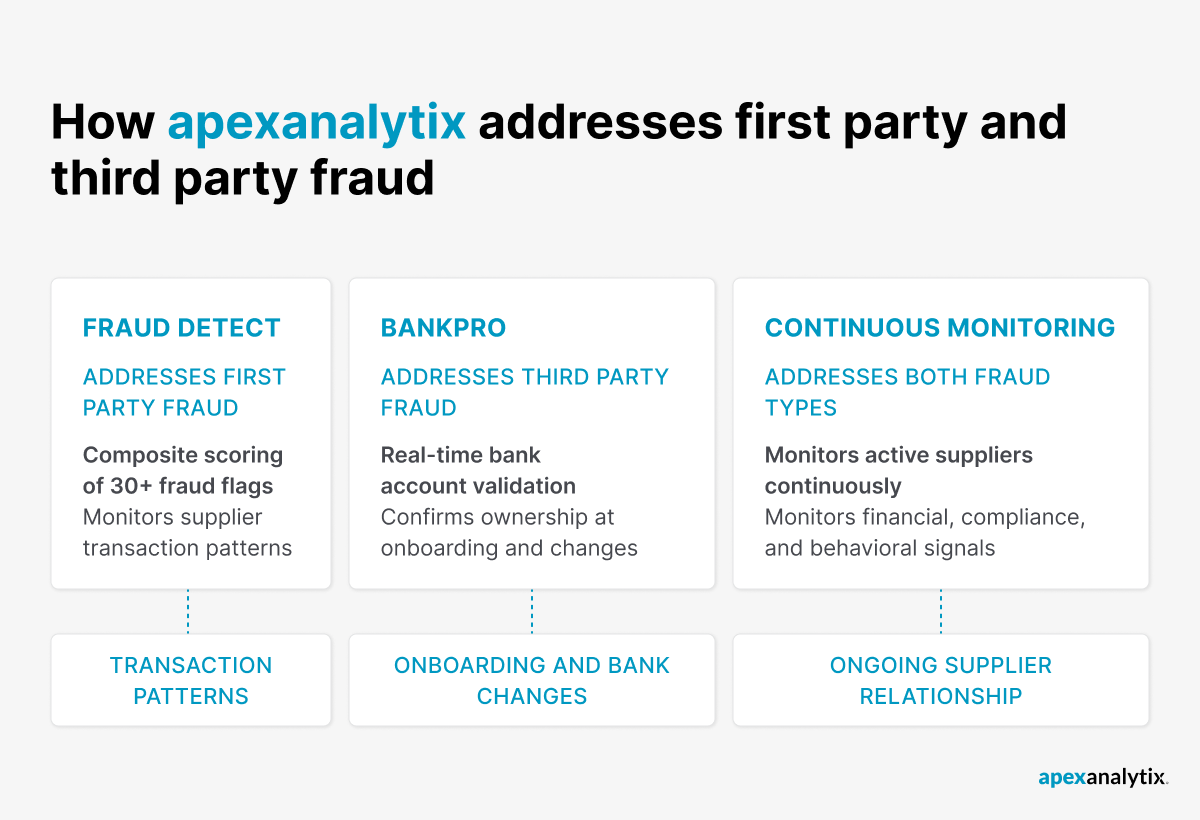
apexanalytix addresses both types of fraud through a connected set of controls that work across the full supplier lifecycle, from the moment a supplier is registered through every subsequent transaction and change request.
Fraud Detect: composite scoring across supplier identity and transactions
Fraud Detectmonitors supplier profiles, transaction data, and signals from the apexanalytix global fraud monitoring community to catch what individual controls miss.
Its AI-driven composite scoring engine evaluates 30+ fraud flags, including employee-vendor address matches, escalating invoice amounts, sudden bank account changes, and more. When the combination crosses a threshold, the platform flags the supplier, alerts your team, and holds the payment for review.
BankPro: real-time bank account ownership validation
BankProvalidates bank account ownership directly against banking authority data at onboarding and at every subsequent change request. It confirms the legal entity on the bank record matches the legal entity in your vendor master before any payment is released.
Here’s how the platform has performed in practice:
Fraud to Zero: After a fraudster compromised a supplier’s email and redirected a $1.4M payment, a global enterprise deployed BankPro and has since recorded zero payment fraud incidents, with four additional attempts blocked.
State agency modernization: A large U.S. state government found decentralized onboarding across multiple agencies had left the door open to both supplier impersonation and unauthorized internal changes. After deploying apexanalytix, the state reduced fraud risk through automated supplier data validation and gave its finance team visibility across all departments without adding headcount.
Continuous monitoring across the supplier lifecycle
A supplier that cleared onboarding today may have its email account targeted tomorrow or start overbilling next quarter through a colluding contact. To prevent similar scenarios, apexanalytix monitors every active supplier across financial, compliance, and behavioral dimensions throughout thesupplier lifecycle, not just at onboarding.
Ready to see how apexanalytix detects first-party and third-party fraud across your supplier base?
Contact apexanalytix to get started, or request a demo of Fraud Detect and BankPro to see how both fraud types are covered through a single connected platform.
FAQ
1. What is second-party fraud and how does it relate to first- and third-party fraud?
Second-party fraud involves a real person who knowingly participates in a scheme, typically recruited by an external actor. In AP contexts, it most often appears as employee-vendor collusion, sharing characteristics of both occupational fraud and external attack.
2. Can first-party fraud and third-party fraud occur at the same time?
Yes. A known scenario is an employee creating a shell vendor while an external actor separately impersonates a legitimate supplier, both targeting the same AP environment. Weak vendor master governance and no bank account validation leave organizations exposed to both.
3. Does cyber insurance typically cover third-party payment fraud losses?
Coverage varies by policy. Some insurers require having specific controls, such as out-of-band payment verification, at the time of the incident. Failure to meet those conditions can result in claims being denied.
4. How does first-party fraud affect AP recovery audit findings?
First-party fraud inflates overpayment and duplicate-payment figures, making it harder to distinguish genuine billing errors from intentional schemes. Audits that include behavioral analysis alongside duplicate detection surface patterns that transactional matching alone would miss.
5. What is the difference between payment fraud and accounts payable fraud?
Payment fraud is the broader category covering any scheme that diverts funds during a transaction. Accounts payable fraud is a subset specific to the procure-to-pay process, encompassing both insider manipulation of vendor records and external impersonation of suppliers.
Related Resource
Media Mentions
Tariff Volatility and the Reality of Restructuring Supply Chains
Explore our ROI calculator, developed in partnership with Forrester, by navigating to the link below and selecting “configure data” on the right-hand side.