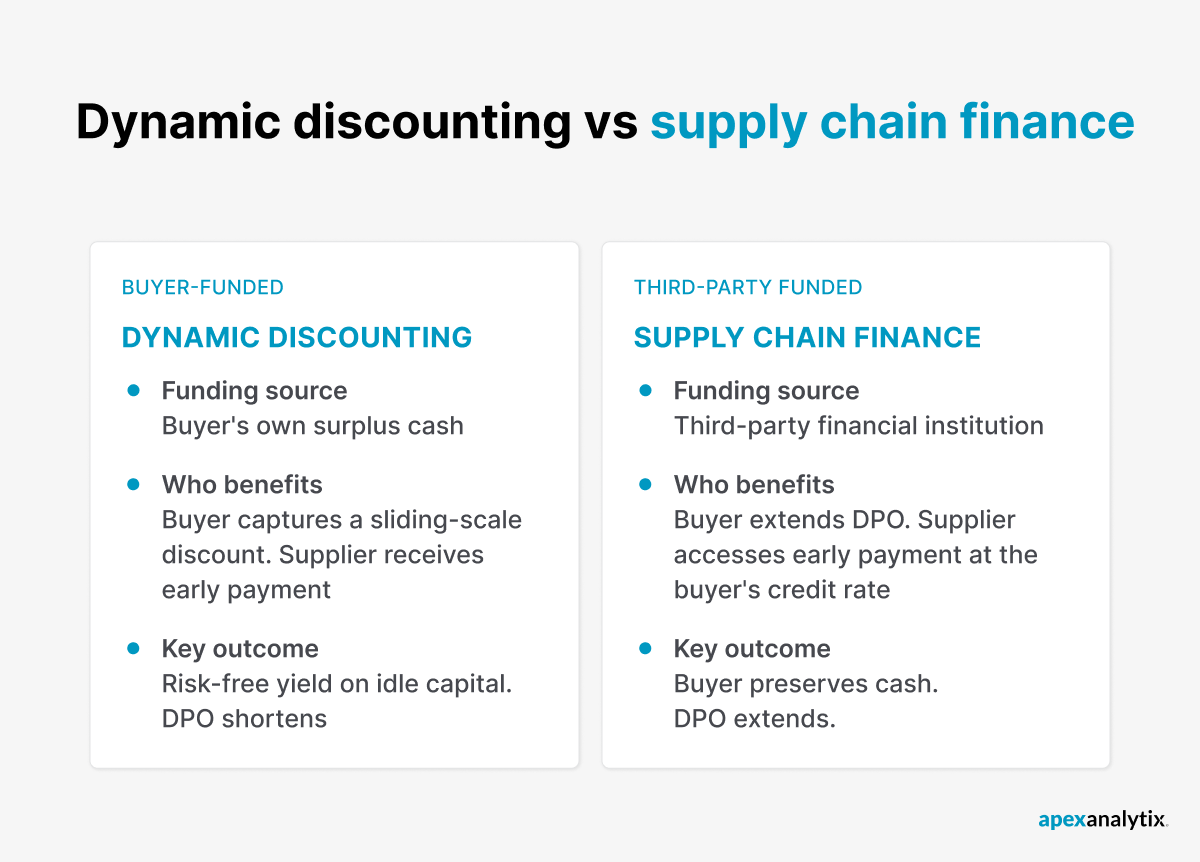
Dynamic discounting and supply chain finance both give suppliers faster access to payment, but they work differently and serve distinct strategic purposes. Dynamic discounting uses the buyer’s own cash to pay suppliers early in exchange for a sliding-scale discount. Supply chain finance uses a third-party funder, with the buyer repaying on the original or extended due date.
The choice between these two programs shapes your balance sheet impact and your working capital position, and it depends on which one best fits your organization at a given time.
To help you make the right call, this article covers how dynamic discounting and supply chain finance work, how they compare, and how to choose between them.
Key Takeaways:
- Dynamic discounting and supply chain finance solve the same problem from opposite sides: Both give suppliers earlier access to payment, but dynamic discounting deploys the buyer’s own cash while supply chain finance draws on external funding.
- Dynamic discounting earns a return on surplus cash: Buyers capture a sliding-scale discount that functions as a risk-free yield on idle capital, making it most effective for organizations with strong liquidity.
- The right financing strategy depends on a business’ available funds, supplier financing needs, and operational capabilities: Many enterprises ultimately use both, but starting with the best-fit solution helps speed up adoption and get results faster.
- apexanalytix supports both through one platform: apexanalytix’s Dynamic Discounting module uses predictive analytics to maximize discount capture and integrates supply chain financing for buyers who need third-party funding flexibility at any point in the program.
Dynamic Discounting vs. Supply Chain Finance at a Glance
The table below shows how dynamic discounting and supply chain finance compare across the dimensions that matter most for finance and procurement teams.
|
Dynamic discounting |
Supply chain finance |
| Funding source |
Buyer’s own cash |
Third-party funder |
| Balance sheet impact |
Reduces cash, improves return on idle capital |
Off-balance sheet preserves buyer cash |
| DPO impact |
Shortens days payable outstanding |
Extends days payable outstanding |
| Buyer benefit |
Captures a sliding-scale discount |
Extends payment terms without cash outlay |
| Supplier cost |
Discount offered to the buyer |
Financing fee based on buyer’s credit rating |
| Timing control |
Buyer initiates; supplier accepts |
Supplier requests; funder pays |
| Best fit |
Cash-rich buyers seeking working capital yield |
Buyers managing liquidity or extending terms |
What Is Dynamic Discounting?
Dynamic discounting is an early payment arrangement where the buyer pays a supplier before the invoice due date in exchange for a sliding-scale discount. The buyer funds every early payment with their own cash, capturing a return on capital that would otherwise sit idle.
Both parties benefit. Buyers put surplus cash to work at an attractive yield. Suppliers access liquidity faster, reducing their need to draw on bank credit lines or external financing.
What Is Supply Chain Finance?
Supply chain finance, also called reverse factoring, is an early payment program funded by a third-party financial institution. The buyer then repays the funder on the original or extended due date.
Because the buyer doesn’t deploy their own cash, supply chain finance extends days payable outstanding while giving suppliers access to early liquidity at rates lower than what they could access independently.
According to Research and Markets, the global supply chain finance market is valued at $14.55 billion in 2026, reflecting growing enterprise adoption of early payment programs to optimize working capital.
Key Differences Between Dynamic Discounting and Supply Chain Finance
Understanding the key differences between the two programs helps finance and procurement teams choose the right strategy for their current position.
Funding source
Dynamic discounting is self-funded. With no third-party involved, the buyer retains full control over which invoices to target and when to deploy capital.
Meanwhile, supply chain finance is third-party funded, as a financial institution pays the supplier on the buyer’s behalf once the invoice is approved.
Pricing and discount structure
In dynamic discounting, the discount slides based on payment timing. The earlier the payment, the higher the discount the buyer captures. Both parties agree to a rate that reflects the value of the timing and adjusts proportionally as the payment date moves closer to the due date.
In supply chain finance, pricing works differently:
- The supplier pays a financing fee to the funder rather than offering a discount to the buyer.
- That fee is priced against the buyer’s credit rating, which is typically stronger than the supplier’s own.
- The cost of early payment access is lower than what the supplier could secure independently through invoice factoring or a bank credit line.
Instead of capturing a direct financial return, the buyer gains extended terms and a financially stronger supply base. Following best practices for early payment programs helps finance teams structure pricing that maximizes participation across both program types.
Effect on buyer liquidity
Dynamic discounting consumes buyer liquidity. Every early payment reduces the buyer’s cash balance and shortens days payable outstanding because the payment leaves before the invoice due date. For buyers with surplus cash earning low returns, that trade-off is favorable since the captured discount represents a risk-free yield that outperforms most short-term cash alternatives.
Supply chain finance preserves and can extend buyer liquidity. Because the funder pays the supplier and the buyer repays on extended terms, the buyer’s cash balance doesn’t decrease at the time of supplier payment.
Effect on supplier cash flow
Both programs accelerate supplier cash flow, but they also shape supplier relationship management in different ways:
- In dynamic discounting, suppliers choose which invoices to discount and at what rate. The decision is invoice-by-invoice, giving suppliers flexibility to discount when their cash flow needs justify the cost.
- In supply chain finance, suppliers request early payment from the funder once the buyer approves the invoice. The financing cost is fixed at a rate tied to the buyer’s credit, benefiting suppliers whose own credit rating would result in significantly higher borrowing costs.
Supplier lifecycle management that tracks supplier financial health helps procurement teams identify which suppliers face the most acute liquidity pressure and are most likely to engage with either program.
Eligibility and program complexity
Dynamic discounting is simpler to implement. No third-party funder is involved, so the program doesn’t require bank relationships, credit assessments, or legal agreements beyond the buyer-supplier arrangement. The main requirements are:
- Surplus cash available to deploy
- Approved invoices ready for early payment offers
Supply chain finance requires more setup. Onboarding a financial institution involves legal documentation, credit review of the buyer, and a platform connecting buyer, supplier, and funder in one workflow. Suppliers also need structured communication to understand the financing arrangement and ways to request early payment.
That complexity is offset by scalability. Once the funder relationship is in place, the program can extend to mid-tier and long-tail suppliers who wouldn’t participate in dynamic discounting because they can’t afford to offer discounts on thin margins.
How Each Early Payment Model Works
The steps below show how each model operates, from invoice approval to payment settlement. Payment fraud prevention controls should be in place before either program launches, since early payment workflows create additional bank account changes and payment redirection risk.
How dynamic discounting works
Dynamic discounting starts once supplier onboarding is complete. The process involves these steps:
- The supplier submits an invoice, and the buyer approves it in their ERP or AP system.
- The buyer’s platform identifies the invoice as eligible for early payment and generates a discount offer based on how many days remain before the due date.
- The offer is communicated to the supplier through the vendor portal, email, or text, showing the discount rate and the early payment amount.
- The supplier accepts or declines the offer. If accepted, the buyer releases payment from their own cash and the discount is applied automatically.
- The buyer’s system updates the payment record and closes the invoice at the discounted amount.
If the platform is configured with automated offer generation and one-click acceptance, the entire process can run without manual intervention once contact and payment details are current.
How supply chain finance works
Supply chain finance requires a legal and operational relationship between the buyer and the funder before the first transaction. A vendor risk management checklist helps confirm that suppliers meet the compliance standards funders require before approving participation.
When the conditions are met, the workflow follows these steps:
- The supplier submits an invoice, and the buyer approves it, confirming the obligation to pay on the original due date.
- Once approved, the supplier can request early payment from the funder through a connected platform or portal.
- The funder pays the supplier the invoice amount minus a financing fee, which is based on the buyer’s credit rating rather than the supplier’s.
- The buyer repays the funder on the original or extended due date, without having deployed any cash at the time the supplier was paid.
- The buyer’s system records the payable to the funder rather than to the supplier, and DPO reflects the extended repayment timeline.
How to Choose Between Dynamic Discounting and Supply Chain Finance
The right program depends on your cash position, your suppliers’ financial needs, and the state of your operational infrastructure. Most enterprises eventually run both, but starting with the right one makes adoption faster and results easier to measure.
Available buyer liquidity
If your organization holds surplus cash earning low returns, dynamic discounting puts that capital to work through captured discounts.
If cash is constrained or earmarked for growth, supply chain finance supports suppliers without requiring the buyer to deploy capital while simultaneously improving DPO.
Supplier funding needs
Dynamic discounting works best when suppliers have enough margin to offer a discount without damaging their profitability. Larger, financially stable suppliers typically fall into this category.
Supply chain finance suits mid-tier and long-tail suppliers who need working capital but can’t afford to give a discount. Because the financing cost ties to the buyer’s credit rating, these suppliers access liquidity at rates they couldn’t secure independently.
Understanding types of vendor risks across your supply base helps identify which suppliers face the most acute financial pressure and are most likely to benefit from supply chain finance participation.
Program size and supplier participation
Dynamic discounting scales well when preferred suppliers are already onboarded, and their invoice approval workflows are clean. Participation tends to be highest among suppliers with predictable cash flow needs and a history of accepting early payment terms.
Supply chain finance scales better across a large, diverse supplier base because it doesn’t require suppliers to offer discounts. Once the funder framework is established, the program can extend to suppliers across multiple regions, spend categories, and risk profiles without renegotiating terms supplier by supplier.
Operational readiness
Launch timelines differ sharply. Dynamic discounting can go live once cash allocation rules and invoice eligibility criteria are set. Since no funder onboarding or credit review sits between approval and payment, it usually takes just a few weeks. Meanwhile, supply chain finance typically takes longer because the funder must complete credit underwriting and structure the legal repayment agreement first.
A phased pilot lowers this timeline gap. The idea is that you start with one spend category or 10–20 suppliers, run a full payment cycle, and measure participation rate and discount capture before expanding. Piloting also surfaces data gaps, such as outdated contact details, before they affect a larger rollout.
Clear supplier communication during the pilot drives adoption. Suppliers who understand why they were selected participate at higher rates than those who receive an unexplained change to payment terms.
Risks and Controls Before Approving Early Payments
Early payment programs move money faster than standard AP workflows, which means fraud and data quality risks need to be addressed before the first offer goes out, not after the first incident.
Key risks to address before launching include:
- Unverified bank account details, as they create payment fraud exposure on every early payment, particularly when change requests arrive through email or phone
- Inaccurate supplier contact data, which makes offers reach the wrong people and results in accepted payments that create reconciliation gaps
- Duplicate invoices in the early payment queue, because they accelerate erroneous payments rather than legitimate ones without upstream duplicate detection
- Lapsed supplier compliance status, since it compounds exposure when non-compliant suppliers receive early payment without a prior review
Clean supplier data management practices and validated payment and contact details must be in place before any program launches, since offers reaching the wrong contact stall participation regardless of terms.
How apexanalytix Supports Dynamic Discounting and Supply Chain Finance
Early payment programs only generate returns when the right suppliers receive offers they’re likely to accept. apexanalytix connects your program to validated supplier data and predictive intelligence before the first offer goes out.
The platform’s Dynamic Discounting module supports buyer-funded and third-party-funded programs from one place, giving your finance team flexibility to run dynamic discounting, supply chain finance, or both as working capital conditions change.
The platform:
- Predicts which suppliers will accept early payment offers and at what rate using cash discount likelihood (CDL) scoring across 80+ data points, including supplier behavior, payment history, and spend patterns
- Verifies bank account ownership against banking authority data before any early payment is processed
- Supports dynamic discounting, supply chain financing, and hybrid arrangements without requiring separate platforms or provider relationships
- Reaches suppliers through portal, email, and text using a database of 280M+ validated supplier records
- Connects with existing ERP, e-invoicing, source-to-pay, and vendor management systems so accepted offers update payment terms automatically
Real-world results
After implementing apexanalytix, a nationwide restaurant operator managing 50,000 active suppliers now captures $200,000 in early payment discounts every month while extending payment terms without straining supplier relationships. The Associate Manager for Accounts Payable noted: “Dynamic discounting is a big win. When you consider all that, the portal’s making us money.”
If your program is underperforming, the CDL scoring model is specifically designed to close that gap before the next offer cycle.
Ready to put your working capital to work?
Contact apexanalytix to see how the Dynamic Discounting module uses CDL predictive analytics to maximize early payment discount capture across your supplier base.
FAQs
1. Is dynamic discounting an off-balance-sheet arrangement?
No. Dynamic discounting uses the buyer’s own cash, so it reduces the cash balance and shortens days payable outstanding. Supply chain finance can be structured off-balance-sheet depending on the accounting treatment applied.
2. Can a buyer run dynamic discounting and supply chain finance at the same time?
Yes. Buyers typically direct dynamic discounting toward suppliers who can offer competitive discounts and use supply chain finance for suppliers who need working capital but can’t afford to offer discounts.
3. Does supply chain finance create debt for the buyer?
Not automatically. The buyer commits to repaying the funder on the due date, but whether that obligation counts as debt depends on the program structure and applicable accounting standards.
4. How does dynamic discounting affect supplier relationships?
Suppliers choose which invoices to discount and when, which gives them control over their cash flow without creating an ongoing obligation.