What Is Duplicate Payment Recovery?
Duplicate payment recovery is the process of identifying payments made more than once for the same invoice or obligation, validating the overpayment, and recovering funds through a refund, credit, or approved offset.
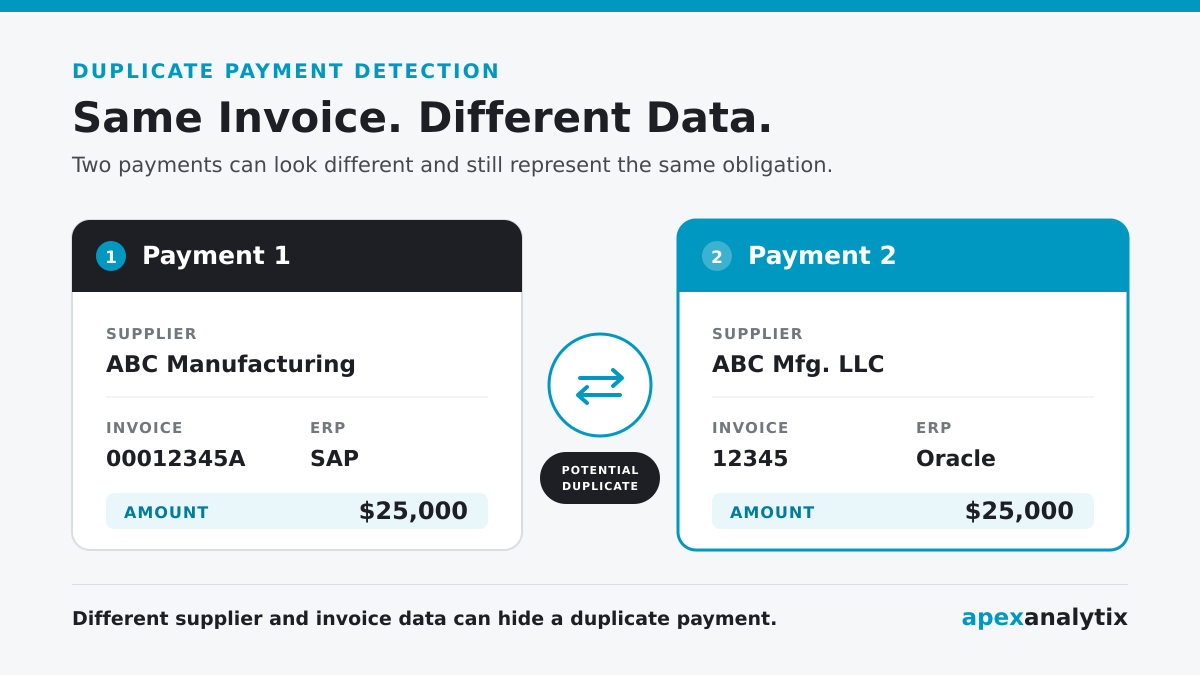
Duplicate payments are not always exact matches. Differences in invoice numbers, supplier records, business entities, or ERP systems can make them difficult to detect through standard controls.
Effective recovery requires identifying these less obvious duplicates, confirming the overpayment, and returning the funds to the organization.
What Qualifies as a Duplicate Payment?
A duplicate payment occurs when the same invoice or obligation is paid more than once. While some duplicates contain identical supplier, invoice, and payment information, others are disguised by differences in the transaction data.
Common examples include:
- Exact duplicates: The same supplier, invoice, and amount are processed twice.
- Data variations: Invoice formatting differences or duplicate supplier records prevent an exact match.
- Cross-system duplicates: The same invoice is processed across different ERP systems, subsidiaries, or business units.
Detecting these payments requires connecting supplier identities, invoices, payments, entities, and systems rather than relying only on exact matches.
Detection vs. Recovery
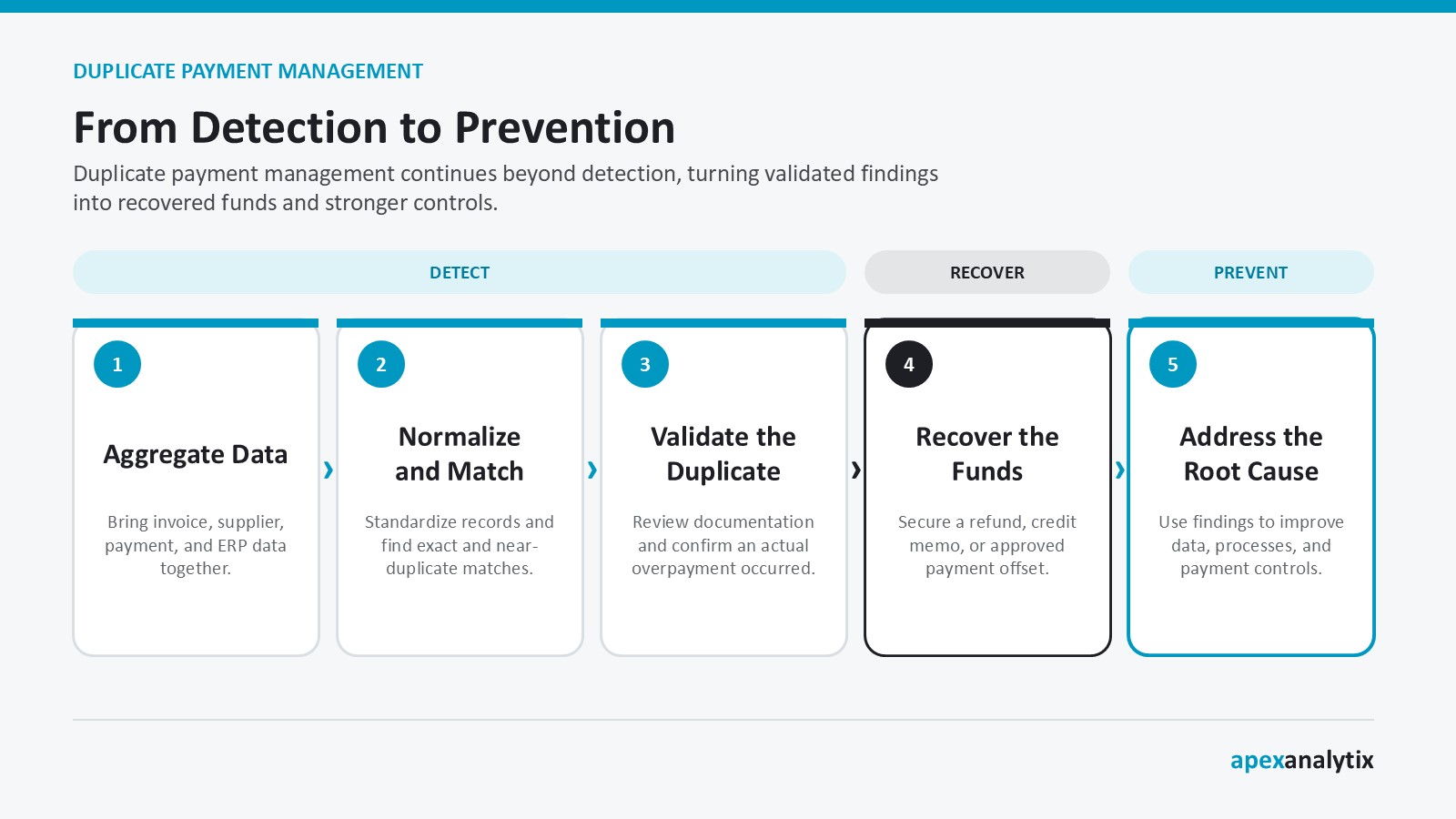
Duplicate payment detection and duplicate payment recovery are related parts of the same process, but they serve different purposes.
Detection identifies suspected duplicate transactions. Recovery validates the finding and returns the money to the organization. Prevention addresses the underlying control failure so the payment is not duplicated again.
Detection begins with analyzing accounts payable and payment data for transactions that could represent duplicates. This can include exact matches as well as less obvious relationships involving invoice-number variations, duplicate supplier records, different ERP systems, or other inconsistencies.
Recovery begins once a potential duplicate has been identified. The transaction must be validated to confirm that an overpayment actually occurred. From there, the organization can work with the supplier to recover the funds through a refund, credit, or another appropriate method.
Prevention takes the process further by determining why the duplicate occurred in the first place. Identifying root causes, such as supplier master data issues, process gaps, or disconnected systems, gives AP teams an opportunity to strengthen controls and reduce the likelihood of similar payments occurring again.
Together, detect, recover, and prevent create a continuous approach to duplicate payment management: uncover existing financial leakage, return recoverable funds to the business, and use what was learned to reduce future overpayments.
Why Do Duplicate Payments Happen?
Duplicate payments often result from inconsistencies in supplier and invoice data, manual processes, disconnected systems, and limited visibility across AP operations. Forrester’s interviews with apexanalytix customers found that manual processes and limited invoice visibility made timely duplicate-payment detection more difficult.
Common causes include:
- Multiple invoice submission methods: Multiple ways for a supplier to submit an invoice might prompt suppliers to submit all three ways to be sure it was sent.
- Invoice resubmissions: Suppliers may resend invoices when payment status is unclear, creating another opportunity for duplicate processing.
- Supplier master data issues: Duplicate or inconsistent vendor records can cause the same invoice to be processed under different supplier IDs.
- Invoice data inconsistencies: Differences in invoice numbers, formatting, or data entry can prevent standard matching rules from recognizing a duplicate.
- Manual processes and exceptions: Urgent payments, non-PO invoices, and transactions outside standard workflows can bypass normal controls.
- Multiple ERP systems and business units: The same invoice may be processed in separate systems or entities without visibility into the other transaction.
- M&A and system migrations: Consolidating supplier records and historical transactions can introduce overlapping data.
How to Detect Duplicate Payments
Detecting duplicate payments requires looking beyond identical supplier names, invoice numbers, and amounts. In complex AP environments, the same invoice can appear differently across supplier records, ERP systems, business entities, and payment processes.
A comprehensive duplicate payment detection process should include these seven steps:
- Capture All Transactional Data Across ERPs
Bring together supplier records, invoices, payments, credits, purchase orders, and historical transactions across ERP systems, subsidiaries, and business units. Detection technology can then assess the source data across systems to uncover potential duplicates that may not appear within a single dataset.
- Identify Exact Duplicate Matches
Use technology to identify transactions where attributes such as supplier, invoice number, amount, and payment details match. Exact matching can quickly uncover straightforward cases where the same invoice was entered or paid twice.
- Find Fuzzy and Near-Duplicate Matches
Apply advanced matching technology to transactions that are similar but not identical. Invoice-number variations, similar amounts and dates, and related supplier records can indicate that two transactions represent the same obligation even without an exact match.
- Prioritize Potential Duplicates
Not every potential match is a true duplicate. Technology can rank findings based on match strength, financial value, supplier relationships, and payment status, helping AP teams focus on higher-risk or higher-confidence transactions.
- Validate Suspected Duplicate Payments
Review the original invoice, payment records, supplier information, credits, purchase orders, and related documentation to confirm whether an overpayment occurred. Check whether a refund or credit has already been issued before beginning recovery.
Once validated, the duplicate can move into recovery while the underlying cause is documented to help prevent recurrence.
How to Recover a Duplicate Payment
Once a duplicate payment is identified, recovery involves validating the overpayment, documenting the transaction, working with the supplier to return the funds, and addressing the root cause.
- Confirm the Duplicate
Verify that both transactions relate to the same invoice or obligation by reviewing supplier information, invoice numbers, amounts, dates, purchase orders, and payment details.
- Gather Supporting Documentation
Collect the original invoice, duplicate transaction, payment records, purchase order, remittance information, and other relevant documentation. A clear audit trail helps support the recovery with the supplier.
- Check for Existing Credits or Refunds
Determine whether the supplier has already issued a credit memo or refund that has not been properly applied. This can reveal recoverable value already available and prevent unnecessary supplier outreach.
- Contact the Supplier
If the overpayment remains outstanding, provide the supplier with the relevant transaction details and supporting documentation. Confirm the duplicate amount and agree on how the funds will be returned.
- Determine the Recovery Method
Duplicate payments are typically resolved through one of three methods:
- Cash refund: The supplier returns the overpayment directly.
- Credit memo: A credit is applied against an outstanding or future obligation.
- Track the Recovery
Monitor outstanding refunds, credits, supplier responses, and recovery status until the value has actually been received or applied. Identifying a duplicate does not mean the money has been recovered.
- Reconcile the Recovered Amount
Once the funds or credit are received, reconcile the recovery against the original duplicate payment and update the appropriate financial records.
- Document the Root Cause
Identify why the duplicate occurred, such as a supplier master data issue, invoice variation, ERP limitation, or workflow exception. Use that insight to strengthen controls and reduce the risk of recurrence.
Duplicate payment recovery should create a continuous cycle: detect, validate, recover, identify the root cause, and strengthen prevention.
How Much Money Can Duplicate Payment Recovery Find?
There is no single benchmark for how much money an organization can recover from duplicate payments. The financial opportunity depends on the size and complexity of the accounts payable environment, the effectiveness of existing controls, and how much historical transaction activity has already been reviewed.
Factors that can influence duplicate payment recovery opportunities include:
- AP spend: Organizations processing greater payment volumes have more transactions where errors and overpayments can potentially occur.
- Invoice volume: High invoice volumes can make it more difficult for AP teams to manually identify duplicate or suspicious transactions.
- Number of suppliers: A large supplier base can increase the complexity of supplier master data and create more opportunities for duplicate or inconsistent vendor records.
- ERP complexity: Multiple ERP systems, instances, and payment environments can make it difficult to identify duplicates across systems.
- Geographic footprint: Global organizations may manage suppliers, payment processes, currencies, entities, and systems across multiple regions.
- M&A activity: Acquisitions and system consolidations can introduce overlapping supplier records, historical transactions, and inconsistent AP processes.
- AP control maturity: Organizations with established pre-payment controls and continuous monitoring may have less historical leakage than organizations relying primarily on manual reviews.
- Historical audit coverage: Companies that have not recently reviewed historical transactions may have a larger pool of previously unidentified overpayments to investigate.
For this reason, organizations should evaluate duplicate payment recovery using their own transaction data rather than applying a universal recovery percentage.
Evidence From Enterprise Organizations
A Forrester Consulting Total Economic Impact™ study commissioned by apexanalytix provides an example of the potential financial impact for a modeled enterprise organization.
Forrester Total Economic Impact™ Study
168% ROI over three years
Forrester built a composite organization from interviews with four apexanalytix customers: a U.S.-based company with $10 billion in annual revenue and global operations.
Payment Recovery Impact
Before apexanalytix
~30%
of overpayments and duplicate payments to suppliers recovered
|
After apexanalytix
70%
of previously unrecoverable duplicate payments now recovered
|
The composite organization also gained greater visibility into invoices and the root causes of overpayments.
Three-Year Financial Impact
$2.1M of this came directly from recovered duplicate payments and increased payment credits and refunds.
168%
Return on investment
Source: A Forrester Total Economic Impact™ study commissioned by apexanalytix, based on a composite organization modeled from interviews with four apexanalytix customers.
How to Prevent Duplicate Payments
Preventing duplicate payments begins with identifying risk before funds are released. AP teams should combine pre-payment analytics with accurate supplier data, cross-system visibility, strong payment workflows, and ongoing control improvements.
Apply Pre-Payment Analytics
Use pre-payment analytics to evaluate invoices, supplier records, and payment data before funds are released. Exact and fuzzy matching can flag potential duplicates for review, helping AP teams stop erroneous payments before they occur.
Strengthen Supplier Master Data
Maintain accurate, standardized supplier records and regularly identify duplicate vendor profiles. Establish controls around supplier creation and changes to reduce the risk of the same invoice being processed under multiple supplier IDs.
Normalize Invoice Data
Standardize invoice numbers and other transaction fields before payment so formatting differences do not bypass duplicate controls. Combine normalized data with exact and fuzzy matching to identify invoices that may represent the same obligation.
Monitor Across ERP Systems
Analyze transactions across ERP systems, subsidiaries, and business units rather than relying solely on controls within individual systems. Cross-system visibility helps identify duplicate invoices that may otherwise appear unique within separate environments.
Review High-Risk Payment Workflows
Apply additional controls to manual invoices, non-PO transactions, urgent payments, and other exceptions that may fall outside standard AP workflows. Regularly review where exceptions occur to identify processes that create greater duplicate-payment risk.
Analyze the Root Cause of Recovered Duplicates
Classify why each confirmed duplicate occurred, such as supplier master data issues, invoice inconsistencies, workflow exceptions, or cross-system processing. Use recurring root causes to prioritize process and control improvements.
Measure Recurrence Over Time
Track duplicate-payment frequency, value, recovery, prevention, and recurrence by root cause, supplier, ERP, or business entity. Monitoring these measures over time helps determine whether corrective actions are reducing duplicate-payment risk.
Why ERP Duplicate Payment Controls Miss Payments
ERP duplicate invoice controls often rely on exact fields and rules within a single system. As a result, they may miss duplicates involving:
- Data variations: Differences in invoice numbers, dates, formatting, or manually entered information.
- Multiple supplier records: The same supplier appearing under different IDs, names, or remit-to addresses.
- Disconnected systems: Payments processed across separate ERP instances, subsidiaries, or business units.
- Payment exceptions: Urgent payments, non-PO invoices, and manual transactions that bypass standard workflows.
A transaction can therefore pass an ERP’s duplicate checks and still be a duplicate payment. Normalized data, cross-system visibility, and exact and near-duplicate analytics can help identify these transactions before and after payment.
| COMPARISON |
Duplicate Payment Recovery Audit |
Continuous Monitoring |
| Primary focus |
Historical transactions |
Ongoing transaction activity |
| Primary goal |
Identify and recover existing overpayments |
Detect potential overpayments and reduce future leakage |
| Timing |
Periodic or retrospective |
Ongoing |
| Analysis |
Primarily post-payment |
Can support pre- and post-payment analysis |
| Recovery opportunity |
Identifies historical recoverable funds |
Identifies issues as they emerge |
| Root-cause analysis |
Reveals why historical errors occurred |
Helps monitor whether identified issues continue |
| Best suited for |
Finding previously unidentified overpayments |
Strengthening ongoing AP controls |
How apexanalytix Helps Detect, Recover, and Prevent Duplicate Payments
apexanalytix helps organizations gain greater visibility into supplier transactions to identify and recover overpayments while uncovering the root causes behind payment errors. These insights can help AP teams strengthen controls and prevent similar issues from recurring.
In a Forrester Consulting study commissioned by apexanalytix, customers reported improved invoice visibility and an increased ability to identify and recover overpayments after implementing apexanalytix.
By connecting detection, recovery, root-cause analysis, and prevention, apexanalytix helps organizations recover financial leakage and strengthen accounts payable controls.
Learn how apexanalytix can help your organization detect overpayments, recover lost funds, and prevent payment errors before they happen.
Frequently Asked Questions
What is duplicate payment recovery?
Duplicate payment recovery is the process of identifying payments made more than once for the same invoice or obligation, validating the overpayment, and recovering the funds. Recovery may take the form of a cash refund, credit memo, or approved offset against a future payment.
How do you recover a duplicate payment?
Recovering a duplicate payment typically involves validating the overpayment, gathering supporting documentation, checking for existing credits or refunds, and contacting the supplier. Once confirmed, the funds can be recovered through a refund, credit memo, or approved offset and reconciled against the original payment.
What causes duplicate payments in accounts payable?
Duplicate payments can result from duplicate supplier records, invoice-number variations, manual errors, resubmitted invoices, payment exceptions, and inconsistent AP processes. Multiple ERP systems, business entities, M&A activity, and system migrations can create additional opportunities for duplicate payments.
How do you detect duplicate payments?
Duplicate payments can be detected by analyzing invoice, supplier, and payment data using exact matching, data normalization, fuzzy matching, and cross-ERP analysis. Potential matches should then be validated to confirm that an actual duplicate payment occurred.
Can ERP systems detect duplicate payments?
ERP systems can detect certain duplicates, particularly when supplier IDs, invoice numbers, and other transaction details match. However, standard controls may miss duplicates involving invoice-number variations, multiple supplier records, separate ERP systems, different business entities, or payment exceptions.
How can companies prevent duplicate payments?
Companies can reduce duplicate payments by maintaining accurate supplier master data, standardizing invoice data, monitoring transactions across ERP systems, strengthening high-risk payment workflows, and applying pre- and post-payment analytics. Root-cause analysis can also help AP teams address recurring control gaps.
What is the difference between duplicate payment detection and prevention?
Duplicate payment detection identifies transactions that may represent an existing or pending duplicate. Prevention addresses the underlying data, process, system, or control issues that allowed the duplicate to occur and uses those insights to reduce recurrence.