A long supplier list doesn’t make sourcing easier when teams still have to verify which companies can meet the sourcing requirements. Procurement teams need reliable data to narrow that pool to suppliers with the right capabilities and acceptable risk levels.
AI can simplify the process by comparing far more supplier data than teams can review manually, matching companies against defined criteria, and surfacing relevant risk signals before qualification begins. A 2025 ProcureCon Insights study found that 77% of surveyed organizations had already implemented AI in supplier discovery and selection.
The guide explains how AI supplier discovery works stage by stage, what it changes for procurement teams, why supplier data quality affects the results, and where human review is still required.
Key Takeaways:
- AI is most useful during research and shortlisting: It can expand the candidate pool and organize potential matches before qualification and final supplier selection begin.
- Supplier data quality shapes AI results: Incomplete, outdated, duplicate, or unverified records can weaken matches and reduce confidence in the shortlist.
- Risk visibility can start earlier: AI can surface financial, regulatory, reputational, geopolitical, and operational signals before suppliers move into full due diligence.
- Human review still matters: AI rankings and recommendations support supplier decisions, but procurement and risk teams still need to verify information and assess trade-offs.
- apexanalytix supports enterprise supplier discovery: apexanalytix connects supplier discovery with trusted supplier data, onboarding, and supplier risk management.
What Is AI in Supplier Discovery?
Implementing AI in supplier discovery means using artificial intelligence to find potential suppliers and compare them against specific sourcing needs.
AI can analyze large amounts of supplier information and identify companies based on factors such as products, services, capabilities, location, or certifications. It can also identify relevant supplier information when companies use different terms from those entered in a search. For example, a supplier describing “temperature-controlled transport” can still match a search for “cold-chain logistics” because the terms describe closely related capabilities. AI can compare information from multiple sources to identify those connections.
An AI-generated match doesn’t mean the supplier is ready for onboarding. A supplier still requires data validation, due diligence, compliance checks, and risk assessment. Supplier risk management extends the review beyond capability fit by identifying risks that need attention before and after approval.
How Does AI Supplier Discovery Work?
AI supplier discovery starts with sourcing requirements and uses supplier data to identify, compare, and organize potential matches.
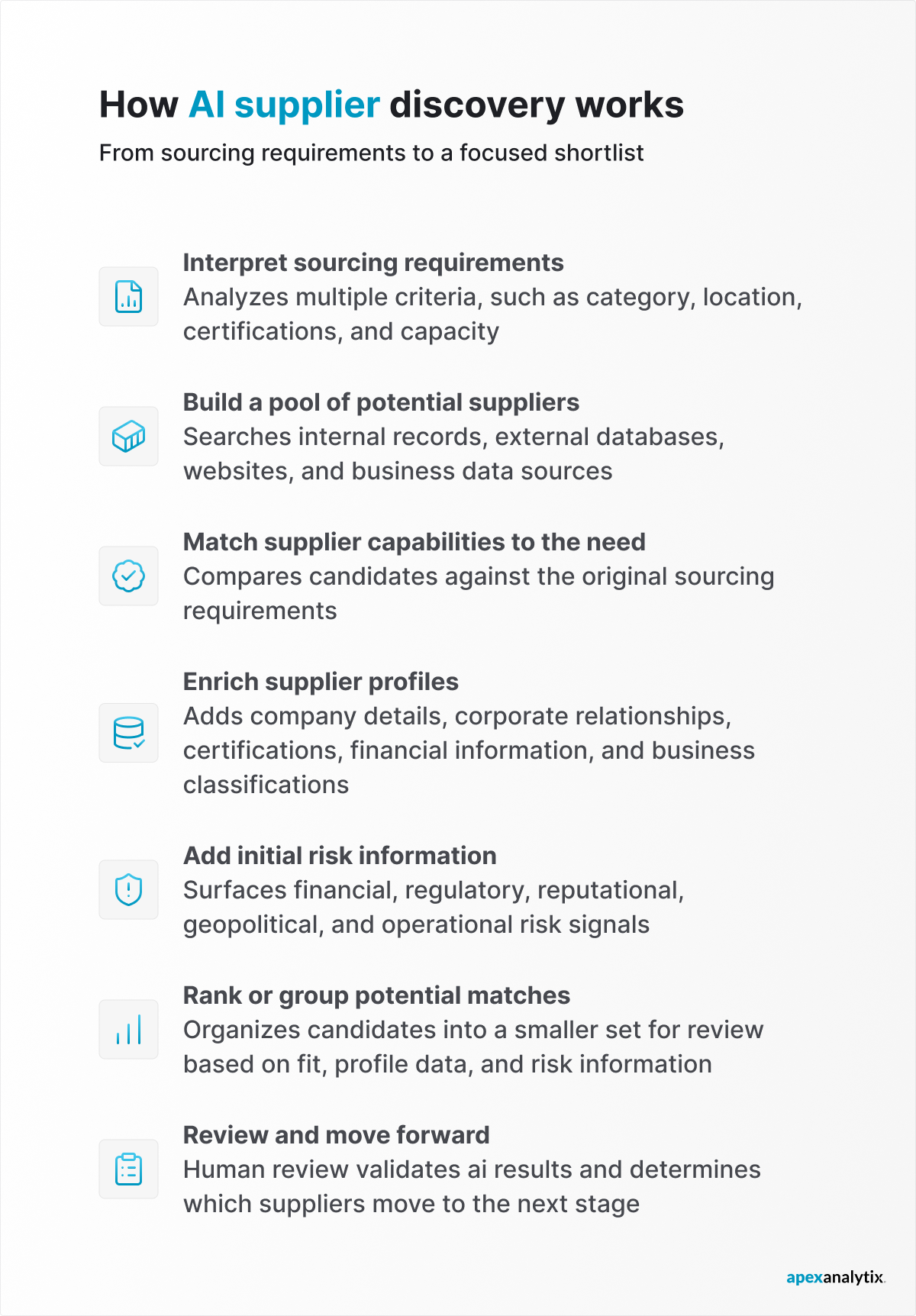
The process can be broken into seven main stages:
1. Interpret sourcing requirements
The requirements behind the search define what counts as a relevant supplier. AI can interpret multiple criteria at once, rather than treating each requirement as a separate keyword.
These criteria may include:
- Product or service category
- Technical specifications
- Location
- Certifications
- Production capacity
Some systems can also extract relevant terms and specifications from sourcing requests, allowing the search to begin without relying only on manually selected keywords.
2. Build a pool of potential suppliers
Once the requirements are clear, the search expands across available supplier information to identify companies that may fit.
Potential matches can be drawn from internal enterprise systems, suppliers’ own published information, and licensed third-party data providers. Some tools also use known suppliers as reference points to find similar companies outside the organization’s supplier network.
3. Match supplier capabilities to the sourcing need
AI compares supplier attributes with the requirements established at the start of the search. Semantic matching can identify related capabilities even when the wording isn’t identical, while scoring rules can give more weight to mandatory requirements than optional preferences.
For example, a supplier that meets required location, certification, and technical criteria can rank above one that matches the product description but misses a mandatory qualification.
4. Enrich supplier profiles
An initial match may contain only enough information to show that a company could be relevant. Additional supplier data can then be added so candidates can be compared in more detail.
Depending on the available sources, enrichment may include:
| Information added |
What it can clarify |
| Company details |
Legal identity, location, and business status |
| Corporate relationships |
Parent companies, subsidiaries, or related entities |
| Certifications |
Current status, expiry date, and issuing body |
| Financial information |
Indicators of financial stability or distress |
| Business classifications |
Industry, category, or supplier attributes |
Some fields may also be checked against external sources before the supplier moves into qualification and risk review.
5. Add initial supplier risk information
Available risk data can be added to the supplier profile before the shortlist is finalized. Depending on the system and available sources, signals may relate to financial health, regulatory exposure, reputation, geopolitical conditions, or operational risk.
Out of 642 procurement executives who participated in the Procurement Survey 2025, 51% identified supplier risk management as an area where AI may have the most impact.
6. Rank or group potential matches
Once supplier fit, profile data, and available risk information have been considered, candidates can be organized into a smaller set for review.
Potential matches may be ranked against defined criteria or grouped by similar capabilities.
7. Pass selected candidates into prequalification and onboarding
Discovery data such as supplier identity, capabilities, source information, and preliminary risk signals can carry into prequalification. Information required for approval still needs to be validated, and fields that weren’t collected during discovery may need to be added during onboarding.
Carrying the usable discovery data forward reduces the need to rebuild the supplier profile from the beginning.
5 Benefits of AI in Supplier Discovery
AI can bring more potential suppliers into consideration without requiring procurement teams to research every company manually.
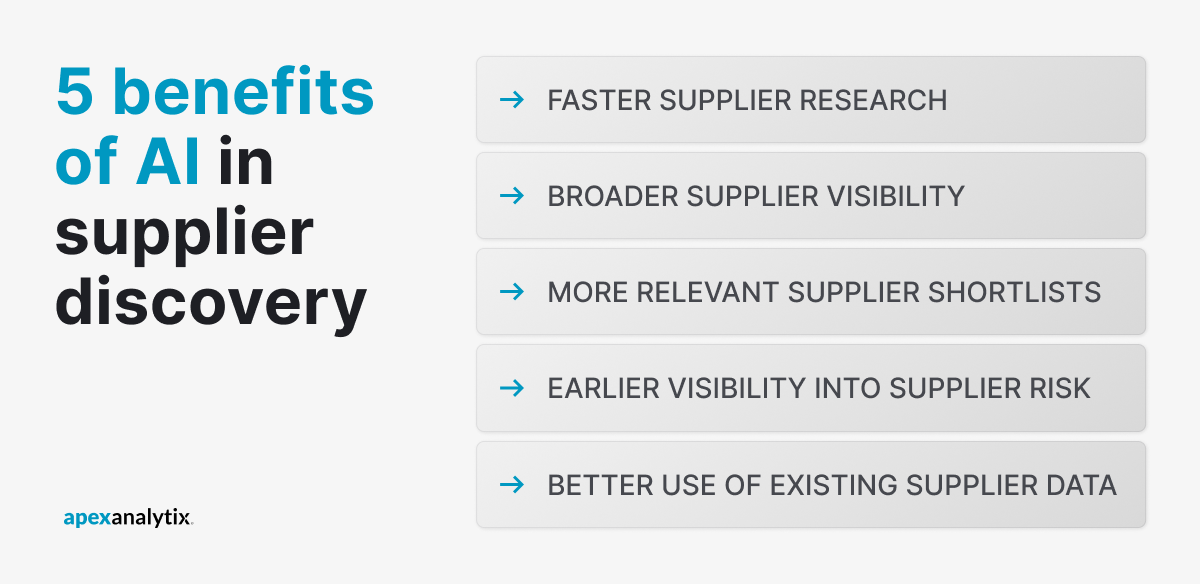
The benefits below explain what changes during supplier discovery:
1. Faster supplier research
Supplier discovery often involves repetitive work before detailed supplier evaluation begins. Initial research can be reduced when AI handles parts of the search and comparison process.
This speeds up:
- Searching across supplier sources
- Organizing potential candidates
- Comparing basic supplier information
Less time spent on initial research leaves more time to compare the candidates that reach the shortlist.
2. Broader supplier visibility
Supplier searches often begin with known companies or existing relationships. AI can look beyond those starting points and identify less familiar companies with relevant capabilities.
This becomes useful when the existing supplier base offers too few options. Some tools can also suggest companies the organization hasn’t worked with before, expanding the search to a wider part of the supplier market.
3. More relevant supplier shortlists
Several sourcing criteria can be considered together, allowing better-matched suppliers to be prioritized over candidates that only partially meet the needs.
Fewer weak matches reach the shortlist, so teams spend their review time on candidates that are genuinely in contention.
4. Earlier visibility into supplier risk
A supplier may meet the sourcing requirement while other information raises concerns about the relationship.
When risk signals are available during discovery, teams can identify potential concerns earlier, rather than only after qualification has begun. That gives procurement teams more context before they invest additional time in a candidate.
5. Better use of existing supplier data
Useful supplier information may already exist somewhere inside a large enterprise. AI-assisted search and entity matching can connect records across business units or systems, making existing supplier relationships easier to find.
Here are some ways surfaced information can be of use:
| Existing information |
Discovery value |
| Internal supplier records across business units |
Reveal suppliers already used elsewhere in the enterprise |
| Transaction history |
Show where and when the supplier has previously been used |
| Related-company data |
Flag when a candidate is connected to an existing supplier through a parent, subsidiary, or affiliate relationship |
Why Supplier Data Quality Matters for AI Supplier Discovery
AI supplier discovery depends on the information used to identify and compare companies. Poor records can affect which suppliers appear and how accurately they’re matched.
In a 2025 HFS Research survey of 87 procurement executives, 65% identified poor data quality and availability as a top barrier to scaling AI, the highest-ranked obstacle in the survey.
The three data problems below show how poor supplier information can weaken AI supplier discovery results:
1. Incomplete or outdated data can weaken supplier matches
Missing or outdated fields can change how well a company appears to fit the sourcing requirement.
A suitable supplier may be overlooked when an important field is missing. Outdated information may also make a supplier appear to meet a requirement it no longer satisfies.
2. Duplicate and fragmented records can distort the supplier view
The same supplier can appear under different names or in separate records across ERPs, regions, and business units. Separate records may also exist for subsidiaries, locations, or slightly different versions of the same company name.
When those identities aren’t connected, the discovery process may treat related records as separate suppliers or fail to show the full relationship the enterprise already has with that company. This can distort the supplier population used for search, comparison, and later risk review.
3. Unverified data can make supplier matches harder to trust
Adding more data sources can also introduce outdated, conflicting, or unreliable information.
A company website may provide useful information about products or capabilities, while legal identity, tax information, prohibited-party status, or other risk data may require government, regulatory, or authoritative third-party sources.
When a match depends on information that hasn’t been checked against an authoritative source, procurement teams can’t easily distinguish a validated supplier fact from an unverified one. Match quality depends on accuracy, recency, identity resolution, and source reliability, not data volume alone.
Limitations of AI in Supplier Discovery
AI can support supplier discovery, but a match or ranking isn’t a final supplier decision.
Here’s why AI results need additional review:
- Supplier coverage can have gaps: AI can only identify suppliers represented in the sources it searches, so relevant companies may still be absent from the candidate pool.
- Narrow criteria can exclude relevant suppliers: Requirements and scoring rules that are too restrictive may filter out companies that could meet the underlying sourcing need.
- Historical data can reinforce existing sourcing patterns: If ranking relies partly on previous supplier choices or existing relationships, suppliers that fit those patterns may receive more visibility than unfamiliar alternatives.
- Ranking logic may not be transparent: A score is more useful when teams can see which criteria, data, and weighting influenced it. Without that context, results are harder to validate or challenge.
- Some decision factors sit outside the model: Risk tolerance, business priorities, exceptions, commercial trade-offs, and stakeholder needs may not be represented in the ranking. Human review still determines how those factors affect the final supplier decision.
How apexanalytix Supports AI in Supplier Discovery
apexanalytix provides an enterprise supplier management platform that connects supplier identity, data validation, registration, approval, and ongoing risk information across the supplier lifecycle. This allows procurement and finance teams to work from a validated supplier record, rather than relying on separate versions of the same supplier across disconnected processes.
For AI in supplier discovery, four capabilities are especially relevant:
- Supplier discovery: Search existing suppliers, prospective suppliers, and external supplier records from one interface.
- Verified supplier data: Validate, enrich, classify, and connect supplier records using authoritative data sources.
- Supplier registration and onboarding: Carry selected suppliers into registration, validation, approval, and ERP record creation without rebuilding the profile from the beginning.
- Supplier risk management: Add risk scoring and ongoing monitoring as the supplier relationship progresses.
A global business services case study shows how better supplier data can support strategic sourcing. apexanalytix used apexarchimedes AI to clean, classify, and enrich more than 35,000 supplier records across nearly 30 databases. The work removed hundreds of duplicate records, added more than 6,000 industry classification codes, and made cross-country supplier relationships easier to identify.
Get started with apexanalytix to turn potential supplier matches into trusted supplier decisions.
FAQ
1. What is the difference between AI supplier discovery and supplier intelligence?
Supplier intelligence is the maintained information used to understand a supplier, such as ownership, financial, certification, relationship, and risk data. AI supplier discovery uses that information to identify and shortlist candidates.
2. Can AI supplier discovery integrate with ERP and procurement systems?
Yes, AI supplier discovery can integrate with ERP and procurement systems when the platform supports the required connectors or APIs. Integration can allow supplier, category, transaction, and vendor master data to move between discovery and existing enterprise systems.
3. How do you measure ROI from AI supplier discovery?
The clearest ROI measures are supplier research hours saved, time to build a shortlist, and the number of usable supplier candidates identified. Enterprises can compare those measures before and after implementation to determine whether AI reduces sourcing effort or expands the available supplier pool.
4. How does AI supplier discovery handle confidential supplier and procurement data?
Data handling depends on the platform’s security controls, access permissions, data architecture, and AI model design. Enterprises need to understand where supplier data is processed, who can access it, how long it’s retained, and whether confidential information is used to train shared AI models.
5. What should enterprises look for in AI supplier discovery software?
Enterprises should look at supplier coverage, data freshness, explainability, integration options, security controls, and governance. A useful platform should also make it clear where supplier information comes from and why a particular company appeared in the results.