A compliance team responsible for a few hundred suppliers might review a handful of documents a week by hand. A team responsible for several thousand can’t review that volume the same way.
AI in supplier compliance changes what’s possible at a larger scale. Instead of just tracking expiration dates, this technology reads the certificate’s actual content, checks it against the issuing body, and flags what looks correct but isn’t.
This guide explains how AI verifies and monitors supplier compliance, what the specific process behind it looks like, and where human review still needs to stay involved.
Key Takeaways:
- AI reads compliance documents instead of only tracking their expiration dates: Extracting and verifying the actual terms inside a document is different from setting a calendar reminder for when it expires.
- Fuzzy matching catches what exact matching misses: A sanctions or watchlist check that only matches identical names lets slightly altered spellings slip through undetected.
- Pattern detection surfaces evasion tactics a single document review never would: Shared addresses or reused identifiers across supposedly unrelated suppliers signal something no individual certificate can show on its own.
- apexanalytix strengthens supplier compliance screening: apexanalytix checks supplier records against trusted outside sources continuously, not only when a document is first submitted. This helps catch compliance gaps before they become payment risks.
What Is AI in Supplier Compliance?
AI in supplier compliance refers to models that read, verify, and monitor the documents and data behind a supplier’s compliance status, rather than software that only tracks dates on a calendar.
Certificates submitted at onboarding get checked against the issuing body, not just filed and forgotten. A sanctions screen looks for close matches, not just exact ones. Plus, compliance statuses that were accurate the day they were verified get checked again as conditions change.
The combination of reading, matching, and re-checking is what separates dedicated AI technology from a tracker that only tells you when compliance has lapsed.
How AI Verifies and Monitors Supplier Compliance
Compliance verification used to depend entirely on a person reading a document and remembering a date. AI changes what happens at each check in five distinct ways.
The table below shows what each mechanism catches that a manual review typically doesn’t:
| Mechanism |
What manual review typically misses |
| Document reading |
Whether a certificate is genuine, not just whether it exists |
| Fuzzy matching |
A name spelled differently but referring to the same entity |
| Pattern detection |
A connection visible only across multiple supplier records |
| Expiration prediction |
A supplier statistically likely to miss a renewal before it happens |
| Regulatory monitoring |
A rule change affecting a supplier that no one flagged as relevant |
Reading and interpreting compliance documents
AI extracts the certifying body, coverage type, and key dates directly from a submitted certificate, whether it arrives as a scan, photo, or structured file.
The technology then checks the content against the issuing authority, so a document that looks official can be confirmed as actually valid.
Fuzzy matching for sanctions and watchlist screening
An exact-match system only catches a name spelled the same way as it appears on a watchlist. Fuzzy matching looks for names that are close, not identical. This means that a different spelling, a missing initial, or a shortened version of a name still gets flagged.
A structured sanctions risk assessment uses the same approach to check every supplier the same way, catching variations that a manual, case-by-case check would likely miss.
Detecting evasion patterns across entities
A single supplier record can look clean while still belonging to a pattern visible only across multiple records:
- A shared business address used by two supposedly unrelated suppliers
- A reused phone number appearing across different registered entities
- An ownership structure that overlaps with a previously flagged supplier
AI compares relationships across the full supplier base at once, something a document-by-document review has no practical way of doing.
Predicting expiration and renewal risk
Most compliance failures start as a missed renewal, not an intentional violation. A model trained on a supplier’s own renewal history identifies suppliers statistically likely to miss an upcoming deadline, giving compliance teams advance warning instead of a post-lapse alert.
Insurance coverage monitoring built on this same prediction can cut certificate renewal follow-up from weeks to mere seconds.
Flagging regulatory changes affecting existing suppliers
A requirement accurate at onboarding can become outdated once the underlying regulation shifts.
By monitoring regulatory sources, AI helps connect that shift to the specific suppliers it affects. This is the kind of work that would otherwise depend on someone noticing the connection independently.
Step-by-Step AI-Driven Compliance Process
Here’s how AI document reading, matching, and pattern detection come together into one structured sequence, from submission to an ongoing status.
1. Intake
A supplier submits a required document, certificate, license, or agreement through a vendor portal rather than email.
The extraction and verification described earlier start automatically as soon as the document arrives, so no one has to wait for someone to open and read it first.
2. Scoring
The results from document verification, watchlist screening, and cross-entity matching don’t sit as three separate outputs. They combine into a single compliance status for that supplier: clear, flagged for review, or blocked outright.
For example, a supplier that passes verification but triggers a near-match on a watchlist lands in “flagged” and not an automatic pass or fail.
3. Routing
What happens next depends on the supplier status achieved by scoring. A clear result activates the supplier without anyone needing to sign off manually. A flagged result routes to a specific person, with the specific reason for the flag attached, so the reviewer isn’t starting from scratch to figure out what triggered it.
4. Ongoing re-verification
A status confirmed today doesn’t stay accurate forever. An approaching expiration, a new name added to a watchlist, or a regulatory update triggers the same checks again automatically.
This way, a supplier cleared six months ago is still being measured against what’s true now, not what was true at the time of the original review.
Benefits of AI in Supplier Compliance
Using AI for compliance checks changes what a team can catch, not just how fast the work gets done. Here’s what happens once it’s implemented:
- Coverage scales without adding headcount: Every supplier gets reviewed the same way, without needing to hire more people to keep up with a growing supplier base.
- Time shifts from document review to judgment calls: A compliance team spends less time reading certificates line by line and more time deciding what to do about the cases that genuinely require a person’s attention.
- Issues surface earlier, not after they’ve already caused a problem: A lapse or a mismatch gets flagged while it’s still manageable, instead of showing up months later during an audit.
- Every supplier gets held to the same standard: A requirement enforced consistently across the full supplier base removes the variation that comes from one reviewer applying a rule more strictly than another.
- Every decision leaves a documented trail: A record of what was checked, when, and why supports a defensible answer if a regulator or an auditor asks how a specific supplier was cleared.
These gains only hold up if the supplier data behind them is accurate, since a check is only as good as what it’s checking against.
Limitations of AI in Supplier Compliance
KPMG’s 2026 Global Third-Party Risk Management Survey found that while more than half of organizations now use AI in third-party risk processes, only 22% rate that use as very effective. AI catches much of what a manual process misses, but it doesn’t eliminate the need for human oversight entirely.
Here are some common limitations of AI in supplier compliance:
- A model only recognizes what it’s been trained to catch: A fraud pattern outside its training data, a document format it hasn’t seen, or a regulatory change after its last update can all pass through without being flagged.
- Fuzzy matching can flag names that aren’t a match: Two suppliers with similar names but no real connection can get grouped together, and someone has to review that result and decide whether it’s a genuine risk or a coincidence.
- A supplier without much digital documentation still needs manual handling: AI works well when there’s enough supplier information to check against, but this data isn’t always available.
How apexanalytix Supports AI-Driven Supplier Compliance
The checks described in this guide only work if they run consistently across every supplier, without relying on someone to remember to run them by hand. apexanalytix builds that consistency into one connected platform.
Here’s what the platform offers:
- Automated compliance workflows built around your specific rules: The platform applies customizable compliance processes for requirements like HIPAA/BAA, insurance, and prohibited list screening, built with 400K configurable business rules rather than one fixed process applied to every supplier regardless of category.
- Continuous monitoring for compliance-related events: Risk event monitoring flags a bank account change, a prohibited list appearance, or negative news the moment it happens, feeding directly into the same supplier record the compliance workflow already tracks.
- An engine that acts on what it finds, not just reports it: apexanalytix’s risk resolution capability can halt payments to a supplier affected by a compliance gap and automatically route the issue to the right stakeholder.
- Verification against 1,200+ trusted data sources: Every compliance check runs against outside sources, confirming a document is genuine instead of assuming it is just because a supplier submitted it.
Results
apexanalytix’s compliance capabilities have produced measurable outcomes across different client engagements:
- A specialty biopharmaceutical company operating in more than 100 countries used AI-driven vendor master cleansing to review more than 16,000 supplier records, identifying 82 vendors who appeared on prohibited entity watchlists.
- A global healthcare organization managing more than 250,000 suppliers across 600+ legal entities built a global Know Your Supplier program with automated tax ID, sanctions, and bank account validation, consolidating fragmented supplier data from 80 ERP instances into a single platform.
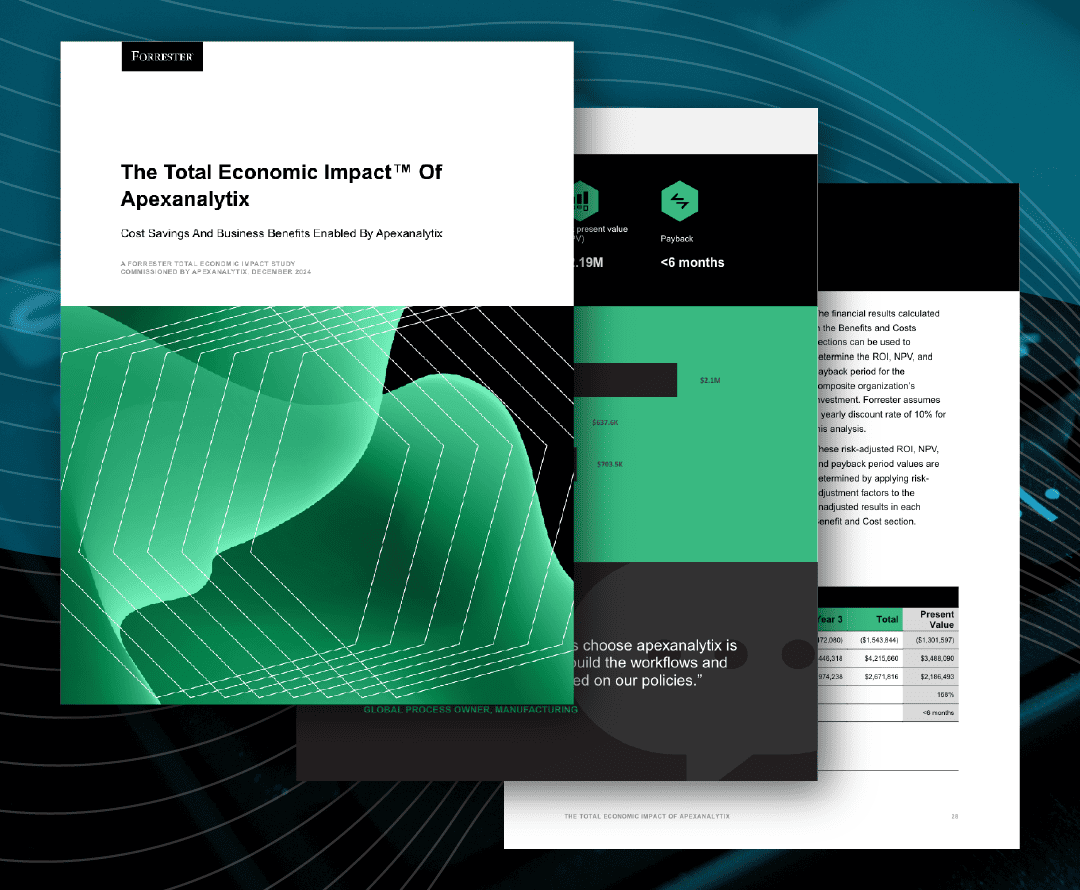
- A Forrester Total Economic Impact study of apexanalytix found customers achieved $2.1 million in recovered value, a 168% ROI, and a six-month payback period, with reduced risk exposure and faster resolution cycles named among the key drivers.
Each of these results traces back to the same foundation: records verified continuously, not just when a supplier first submits them.
Which of your supplier compliance requirements is still being tracked manually, one certificate at a time?
Get started with apexanalytix to see how automated compliance workflows and continuous monitoring work together across your own supplier base.
FAQs
1. Can AI produce inaccurate compliance information with confidence?
Yes, and this is a risk worth understanding. AI models can generate a well-formatted, confident-sounding answer that’s actually wrong, particularly on complex regulatory questions. This is why a flagged result should always go to a person for confirmation and not be treated as final on its own.
2. Is supplier data handled by AI compliance tools subject to data privacy regulations like GDPR?
Yes. Any AI system processing supplier records, especially those involving individuals tied to a business, has to comply with applicable data protection laws, which typically involve clear rules on how long data is retained and who can access it.
3. Does using AI for compliance reduce the need for a dedicated compliance team?
No, it shifts what that team spends time on. Fewer hours go into manually reading documents, and more go into reviewing flagged cases, setting policy, and making judgment calls AI isn’t equipped to make on its own.
4. Does AI apply compliance rules the same way across different countries?
Not automatically. Regulatory requirements vary by jurisdiction, so an AI system needs to be configured with the specific rules that apply in each region a supplier operates in, since one rule set doesn’t fit every location.