AI-driven recovery audits use artificial intelligence to analyze 100% of an organization’s accounts payable (AP) spend and recover overpayments, duplicate payments, and missed credits that standard controls didn’t catch.
These losses persist even at well-run organizations. APQC’s benchmarking data shows that top-performing AP teams still lose close to 0.8% of annual disbursements to duplicate or erroneous payments, while bottom-quartile performers lose more than 2%. At enterprise transaction volumes, such gaps compound fast.
This article explains what an AI-driven recovery audit is, why standard controls still miss overpayments, and how AI is changing each recovery audit stage.
Key Takeaways:
- Traditional recovery audits find what standard controls miss, but AI finds what traditional audits miss: Manual audit processes analyze a sample of transactions and rely on auditor expertise to identify patterns. AI-driven audits surface anomalies that no human review could catch at scale.
- The most recoverable value in an AP audit comes from vendor statement review, not disbursement analysis: Most organizations focus recovery efforts on disbursement data, but the largest share of recoverable credits accumulates on supplier books, where standard AP controls never look.
- Delaying a recovery audit permanently reduces what can be recovered: Supplier credits don’t wait. Every month without a structured audit narrows the recovery window and leaves value on supplier books that may never come back.
- apexanalytix applies AI across every stage of the recovery audit lifecycle: AI handles duplicate identification, supplier behavior analysis, statement communication, and claim resolution simultaneously, scaling to over 3,000 active claims without requiring proportional increases in audit staff.
What Is an AI-Driven Recovery Audit?
A traditional recovery audit reviews historical transaction data to identify duplicate payments, overpayments, and missed credits that standard AP controls didn’t catch. It relies on auditor expertise and typically covers a sample of transactions rather than the full spend history.
Meanwhile, an AI-driven recovery audit analyzes 100% of spend data across every system, assigns risk scores to each transaction, and surfaces the highest-priority findings automatically. The difference isn’t just in efficiency but also the range of errors that become detectable when no transaction is left unreviewed.
Why Standard AP Controls Still Miss Overpayments
Three factors explain why the gap persists even in well-run AP operations.
ERP controls are built for accuracy, not anomaly detection
Standard three-way match catches exact duplicates: same invoice number, same amount, same supplier. The errors that slip through are a different category entirely, and they require more comprehensive detection methods to surface.
Understanding how to prevent overpayment exceptions helps AP teams identify which upstream controls reduce the volume of anomalies that reach a recovery audit in the first place.
Major disruptions spike overpayment rates
ERP migrations, e-invoicing deployments, and system consolidations cause spikes in overpayments because transaction data becomes inconsistent across systems during the transition.
Disruptions that improve AP efficiency in the long term often create short-term exposures that standard controls aren’t calibrated to catch.
The risk is highest following a major system change, when invoice patterns are shifting, supplier data is being migrated, and AP teams are managing higher-than-usual volumes of exceptions.
Most recoverable value comes from supplier books, not disbursement data
Supplier books hold credits, unresolved balances, and pricing discrepancies that accumulate on supplier accounts without triggering any internal AP alert. Standard AP controls are built around disbursement data and never reach the supplier’s books.
Across apexanalytix engagements, statement credits typically account for 75% or more of total recoveries, though the exact share varies by client and industry. Without structured outreach to surface those balances, credits either offset against future invoices or become unrecoverable as supplier contacts change and accounting periods close.
How AI Changes Each Stage of the Recovery Audit
Traditional recovery audits rely on auditor expertise to identify patterns in transaction data. The volume of invoices, the complexity of supplier relationships, and the range of error types that create overpayments all limit what manual processes can cover. AI changes that by operating across every stage of the audit simultaneously, at a scale no manual process can match.
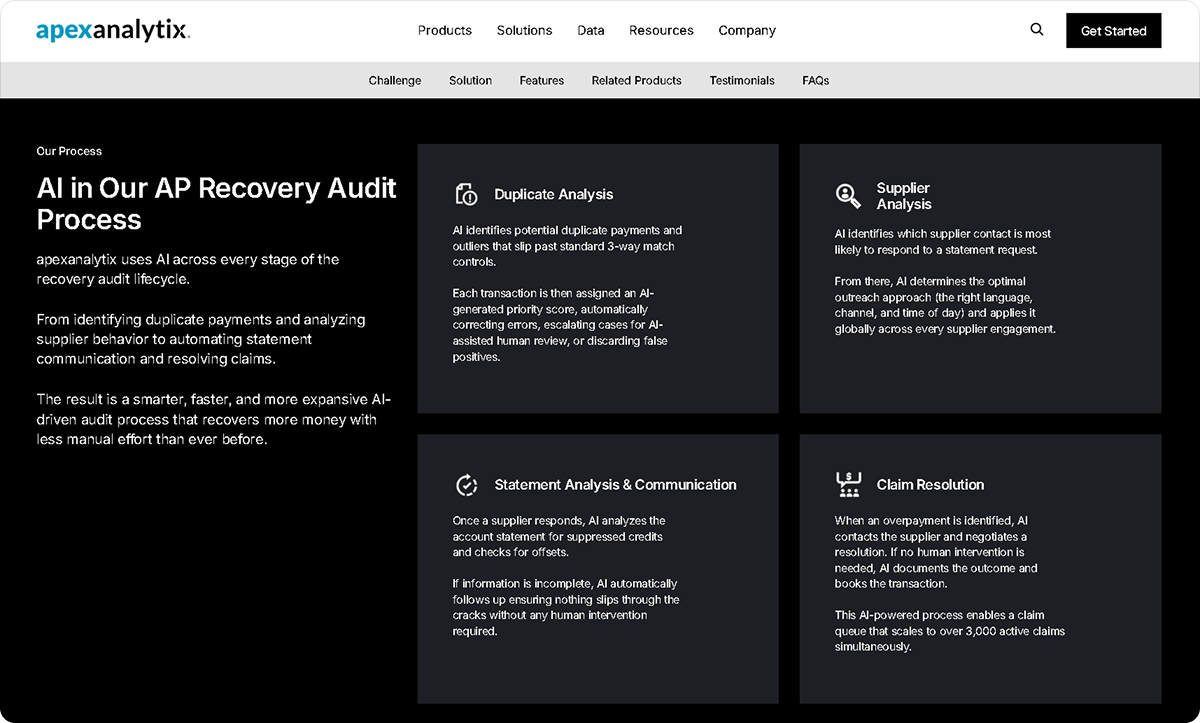
Duplicate analysis
AI identifies potential duplicate payments and outliers that slip past standard three-way match controls.
Each transaction is assigned an AI-generated priority score that automatically corrects errors, escalates cases for AI-assisted human review, or discards false positives without requiring manual triage of every flagged transaction.
The priority scoring model draws on patterns across the full transaction history, not just the current period, which means it catches timing-based duplicates and cross-system errors that rule-based controls miss entirely.
Supplier analysis
Reaching the right supplier contact at the right time through the right channel determines whether a statement request gets a response.
AI identifies which supplier contact is most likely to respond, determines the optimal outreach approach in terms of language, channel, and time of day, and applies that approach globally across every supplier engagement.
The result is higher response rates without adding headcount and without the inconsistency that comes from manually managing global supplier outreach across different time zones and languages.
Statement analysis and communication
Once a supplier responds, AI analyzes the account statement for suppressed credits and checks for offsets. If information is incomplete, AI automatically follows up without human intervention.
This matters because incomplete statement responses are among the most common reasons why recoverable credits go unresolved in manual audit processes.
An auditor managing hundreds of open cases can’t follow up on every incomplete response with the same consistency that an automated system applies to all of them.
Claim resolution
When an overpayment is confirmed, AI contacts the supplier, negotiates a resolution, documents the outcome, and books the transaction. If no human intervention is needed, the entire process runs without a manual touchpoint.
Claim resolution is also where supplier relationships carry the most risk. A recovery claim handled inconsistently or escalated without full context can strain a relationship built over years in a single exchange.
AI reduces that risk by applying the same tone, documentation, and negotiation approach across every claim, so suppliers experience a consistent resolution process rather than a dispute that feels arbitrary from one case to the next.
What AI-Driven Recovery Audits Find That Traditional Audits Miss
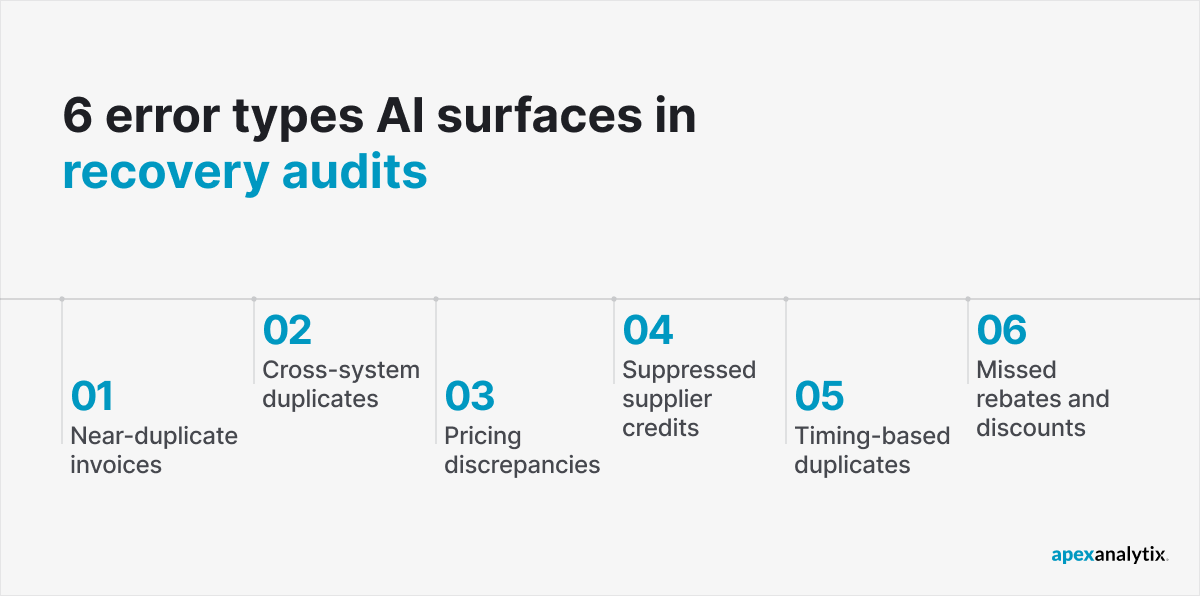
AI doesn’t just process the same errors faster. It detects error types that manual review and rule-based controls aren’t designed to catch at scale, including:
- Near-duplicate invoices: Same vendor, same amount, similar invoice number with minor variations such as a transposed digit, a prefix difference, or spacing inconsistency that exact-match controls pass through without flagging
- Cross-system duplicates: The same payment processed through two ERP systems during a migration, where each system has no visibility into what the other has already paid
- Pricing discrepancies: Invoiced amounts that don’t match contracted rates, freight terms, or agreed discount structures, identified by comparing invoice data against contract terms at scale
- Suppressed supplier credits: Credits sitting on supplier books that were never applied against an open invoice or returned as a cash credit, surfaced through structured supplier statement review
- Timing-based duplicates: Invoices processed in different accounting periods that fall outside the lookback window of standard duplicate detection rules
- Missed rebates and early payment discounts: Negotiated terms that weren’t captured during high-volume processing periods, identified through contract compliance analysis
The Cost of Delaying a Recovery Audit
Organizations that treat audits as periodic exercises leave credits aging on supplier books between engagements. Understanding the cost of an AP recovery audit relative to what it typically recovers helps finance teams make the case for running a continuous program rather than a one-time engagement.
Supplier contacts change, companies get acquired, and accounting periods close. Credits that were clearly owed 12 months ago become harder to validate as the underlying transaction history ages.
Organizations running ERP migrations or major system changes face compounded risk because transition periods create overpayment spikes that grow for every month they go unaddressed.
The practical implication is straightforward. A recovery audit delayed by a year doesn’t return the same value as one run on time. That gap represents recoverable value that’s permanently lost.
AI-Driven Recovery Audit vs. Traditional Recovery Audit
The table below summarizes how AI changes each stage of the recovery audit process compared to a traditional manual approach:
|
Traditional recovery audit |
AI-driven recovery audit |
| Spend coverage |
Sample-based review |
100% of transactions analyzed |
| Error detection |
Rule-based duplicate matching |
AI pattern recognition across all transaction types |
| Supplier outreach |
Manual, typically English-only, business hours only |
AI-optimized language, channel, and timing per supplier |
| Claim resolution |
Manual review and negotiation |
AI-automated with human escalation for complex cases |
| Audit frequency |
Periodic, one-time engagements |
Continuous monitoring and detection |
| Predictive capability |
None |
Forecasts recovery amounts and highest-probability suppliers before the audit begins |
Instead of replacing auditor expertise, AI extends what experienced auditors can do. The benefits of an AP recovery audit compound when AI removes the manual bottlenecks that cap recovery in traditional programs.
How apexanalytix Uses AI in Recovery Audits
apexanalytix is the largest commercial AP recovery audit firm in the world, with 35 years of audit experience and over 200 active recovery audits running at any given time.
What distinguishes apexanalytix from standard recovery audit processes is the combination of data depth, AI capability, and audit expertise. In addition to finding what’s recoverable, the platform suggests where to look, automates the recovery process, and identifies how to prevent the same errors from recurring.
Auditors focus their time on the highest-probability recoveries from day one rather than working through an unranked supplier list.
Here’s a summary of how apexanalytix uses AI in AP recovery audits:
- AI across every audit stage: Handles duplicate analysis, supplier outreach optimization, statement analysis, and claim resolution simultaneously across the full supplier base without requiring proportional increases in audit staff
- Predictive modeling before the audit begins: Draws on a database of 280M+ supplier records to forecast which suppliers are most likely to carry hidden credits before a single statement is requested
- Root cause analysis and corrective action: Identifies which upstream processes caused overpayments and provides recommendations to prevent the same errors from recurring in future periods
Every audit also includes a root cause analysis and a cross-functional corrective action workshop. The process improvements that follow a recovery audit are often where the long-term value compounds, not just from what was recovered but from preventing the same errors from recurring.
Ready to find out what your current AP controls are missing?
Contact apexanalytix to run a recovery audit and see what’s recoverable across your supplier base.
FAQ
1. What is the difference between a recovery audit and overpayment prevention?
A recovery audit looks back at historical transactions to identify and recover funds that have already left the organization. Meanwhile, overpayment prevention and payment fraud controls catch errors before payment is released.
2. How does AI improve supplier outreach in a recovery audit?
AI identifies the right supplier contact and optimal outreach approach for each supplier globally, increasing response rates without adding headcount. More suppliers respond, more credits surface, and the recovery process moves faster than manual outreach programs achieve at scale.
3. How often should organizations run a recovery audit?
Running a recovery audit continuously rather than periodically keeps the recovery cycle active without gaps. Organizations that treat audits as periodic exercises leave credits aging on supplier books between engagements, reducing what is recoverable with each passing cycle.