My colleagues and I sat in a room with nine supplier management and procurement leaders last week and asked a simple question: where is AI actually in production in your supplier processes today, versus where is it still a pilot or an idea on a slide?
For most of the room, AI was still experimental. Not concrete use cases so much as workshop ideas, or a story that started with “we tried this one time and it saved us a few hours.”
That response told me more than any adoption statistic we’d put on a slide that afternoon. And we’d put up a few.
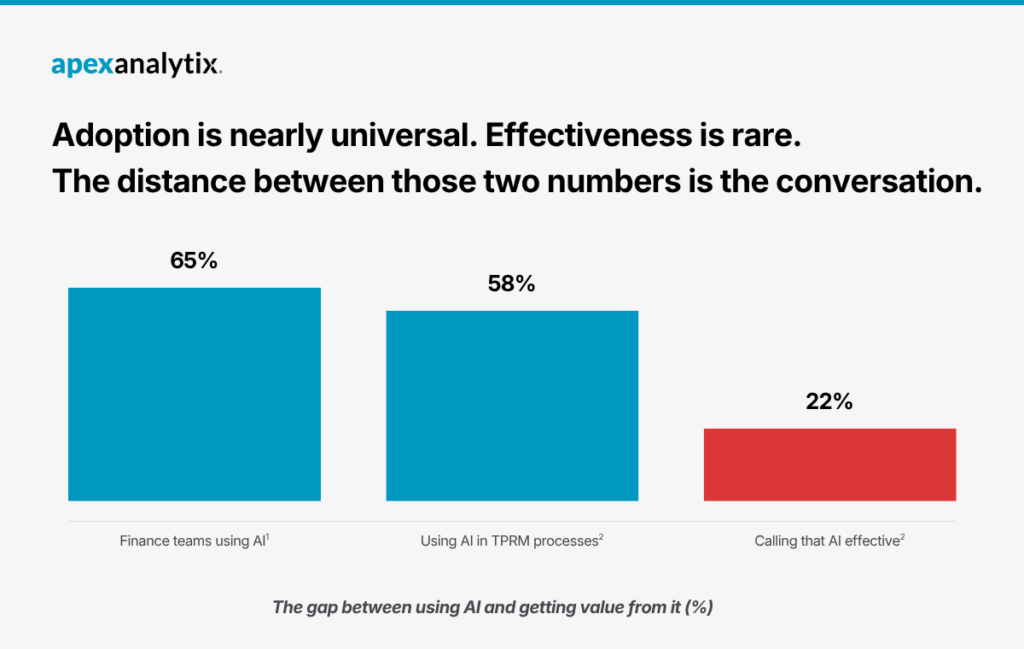
According to the IOFM 2025 Trends Study, around 65 percent of finance teams report using AI in some form today. For TPRM teams, that number is 58 percent (KPMG 2026 TPRM Survey). Those adoption numbers get repeated a lot right now, usually as proof that a shift has already arrived. But adoption was never the hard part.
Only 22 percent of people using AI in their risk processes called it effective (KPMG 2026). The distance between those two numbers is the real story, and it’s not a story about AI.
Everyone Can Turn AI On, Almost Nobody Can Prove It Did Anything
When we asked the room why the effectiveness number was so much lower than the adoption number, nobody blamed the models. The answer came back to data, tools, and ownership.
One procurement leader in the room was in the middle of an M&A integration and was mainly trying to get his arms around the duplicate suppliers and mismatched processes he’d have to clean up before AI could touch any of it.
Dirty or fragmented supplier data blocks most AI use cases before they start, and in most organizations nobody is actually responsible for fixing it. It sits in the gap between procurement, finance, and whoever manages the systems, and everyone assumes someone else has it covered.
That’s a solvable problem. It’s just not the problem people are budgeting for.
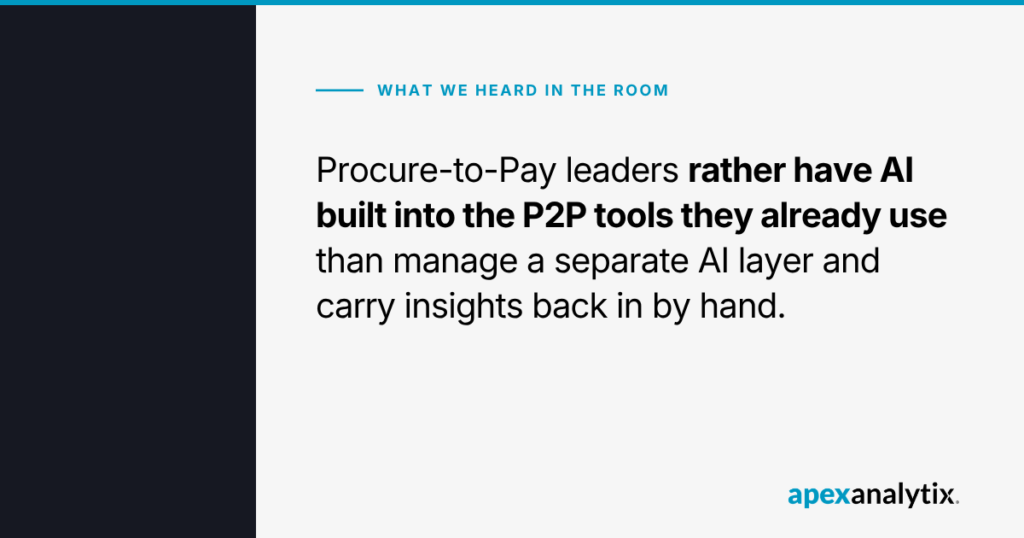
Teams are buying AI tools, or using the AI features already built into tools they have, like Copilot or Gemini, faster than anyone is funding the unglamorous work of cleaning and owning the data those tools depend on. Several people in the room also said flatly that they’d rather have AI built into the P2P tools they already use than manage a separate AI layer and carry insights back in by hand.
 That preference makes sense: it’s hard enough to prove ROI on a new piece of software, and it’s harder still to prove ROI on an AI tool that operates outside your system of record, where nobody agreed in advance how to measure what it changed.
The Use Cases That Work Share One Thing: Someone Can Prove It
The Hackett Group’s 2026 Key Issues Study found procurement teams are piloting or actively investigating generative AI across contract lifecycle management 63 percent, advanced analytics 57 percent, e-sourcing 52 percent, customer support and help desk 51 percent, and purchase order processing 43 percent, all high-volume, checkable work, the same shape as the use cases our room trusted.
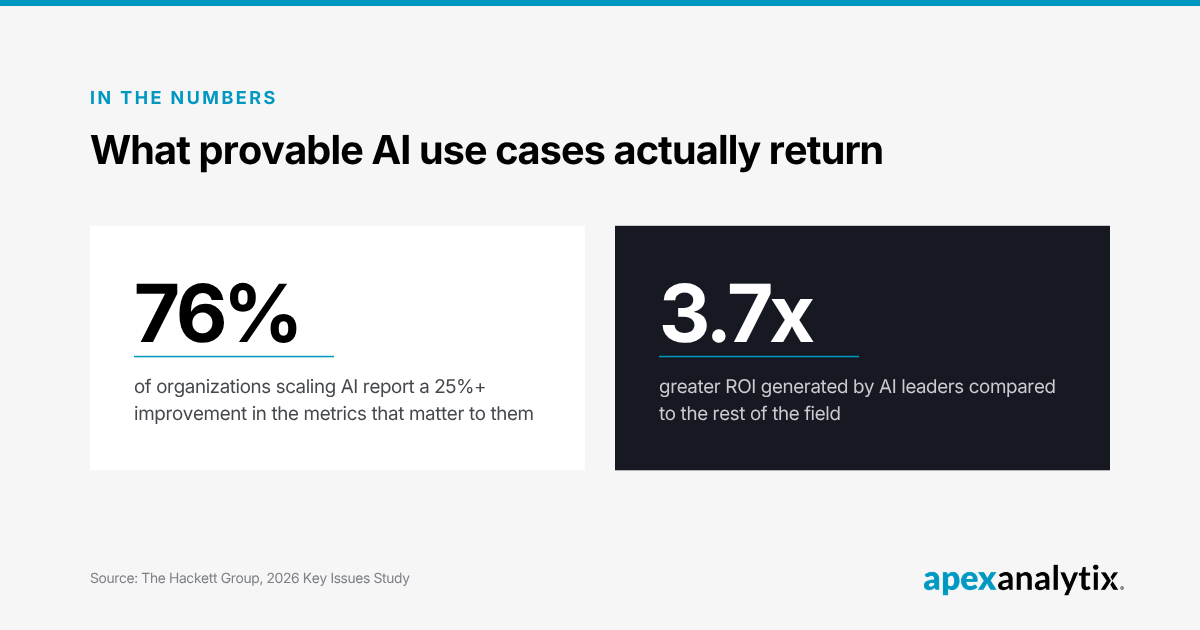
The same research found that among organizations further along in scaling AI, 76 percent report AI-driven improvements of 25 percent or more in the metrics that matter to them, and that leaders are generating up to 3.7 times greater ROI than the rest of the field. The gap isn’t between companies using AI and companies that aren’t. It’s between companies that picked provable use cases and companies that didn’t.
 A few places Procure-to-Pay teams are seeing this play out:
- Supplier onboarding
- Supplier master data
- Sourcing
- Spend classification
- Invoice capture
- Duplicate and overpayment detection
- Risk alert triage
- Risk alert remediation
So how do you know which use cases will actually return ROI for your organization?
Start With the Bottleneck, Not the AI
A session I sat in on at a recent AI summit put a name to something our room had been circling all afternoon without quite saying it: don’t automate the bottleneck blindly. AI can scale a bad process just as easily as a good one, and if you point it at the wrong constraint first, you get a faster version of the same problem instead of a solved one.
The framework was simple, and it’s the piece a lot of AI adoption conversations skip entirely:
- Find the bottlenecks. Before adding a tool, find out where work is actually getting stuck, waiting on approvals, repetitive manual steps, broken handoffs between systems, not where it looks like AI would be interesting to apply.
- Optimize the whole, not the parts. A faster step upstream means little if approvals or review cycles downstream are still the slow part. Speeding up one stage of a broken process just moves the backlog. This actually can be applied to almost every supply chain process.
- Don’t automate the bottleneck blindly. If the process itself is the problem or if the data is inaccurate and has gaps, AI will execute that problem faster and with more confidence, not fix it.
- Move the constraint. Once AI clears one bottleneck, another one becomes the limiting factor. Treat this as ongoing, not a project with an end date.
- Measure throughput, not activity. The goal was never more AI usage. It’s more of the outcome that was actually scarce, faster resolutions, fewer exceptions.
That last point is really the same thing our roundtable was circling with the 58 percent adoption, 22 percent effectiveness gap. A lot of AI activity was getting measured. Not much throughput was. For example, the supplier management leader trying to untangle duplicate suppliers before AI could help his team’s processes was, without naming it, describing exactly this: find the actual constraint first, or you’re just automating the mess faster.
How Do You Prove AI’s ROI to a CFO?
If AI stops a fraud attempt, catches an overpayment before it’s disbursed, or resolves a risk alert before it becomes a headline, that matters to your CFO, but it doesn’t draw attention on its own. The visible result of good work is silence.
Our own Chief Solutions Officer puts it well: “Good software is easy to use, great software doesn’t require users.” If your team isn’t constantly needing to step in, the process or the software is working, but invisible, silent work is genuinely hard to build an ROI case around. That’s a real part of why the room went quiet when we asked whether supplier risk shows up in anyone’s objectives outside their own team.
A few things separated the people in the room who had a real answer from the people who didn’t:
- Baseline before you start. You can’t claim AI prevented a loss if nobody measured what the loss rate looked like before AI touched the process. Teams that could point to a number their CFO trusted had captured that baseline before deployment, not after.
- Tie the metric to something finance already tracks. Cycle time, exception rate, working capital, days payable outstanding. A number that maps to a line finance already reports on gets funded faster than a new metric nobody outside your team recognizes.
- Tie the metric to a CFO goal. CFOs are measured on a short list of priorities, working capital, cost reduction, risk exposure. Find out what’s actually on that list and frame your use case in those terms instead of your own department’s language. A business case that maps to a goal your CFO is already accountable for gets a faster yes than one that only makes sense inside your own team.
- Start with a use case you can already check. The clearest ROI stories in the room all came from work where someone could independently verify the AI got it right. That verification step is what makes a number defensible later, and it’s worth choosing your first use case around it.
Don’t Let the Adoption Metric Hold Your Organization Back From Real, Measurable AI Success
AI adoption is not the metric that matters. That’s worth saying plainly, because most of what gets written about AI in supplier management right now assumes adoption is still the finish line. The honest state of the field is that adoption raced ahead of proof, and the organizations closing that gap aren’t the ones with the most AI running. They’re the ones who can say, specifically, what AI changed.
Step 1: List your team’s bottlenecks, highlight the ones you can measure, and build your AI use cases around closing those gaps.
We’re having this conversation again in Atlanta, Phoenix, Chicago and other cities. I’m curious to hear your thoughts. If you work in supplier risk or procure-to-pay, join us at the next stop.
Register for our next roundtable.