Procurement teams already use AI to analyze data, flag issues, and recommend next steps. AI agents add another layer by planning and executing approved actions across multi-step workflows, reducing the routine work that requires manual coordination.
In April 2026, PwC estimated that AI agents could transform at least 75% of procurement activities, with many becoming agent-driven and others handled through hybrid human-agent workflows. That shift would move more human effort toward decisions, oversight, supplier relationships, and strategy.
This guide explains how agentic AI in procurement differs from traditional automation and generative AI, where it fits, what benefits and risks it entails, and how to introduce it with the right controls and human oversight.
Key Takeaways:
- Agentic AI can reduce the coordination work between procurement decisions: Agents can collect information, route exceptions, trigger follow-ups, and continue approved workflows, letting people focus on higher-impact supplier, financial, and risk decisions.
- The level of autonomy should match the risk of the action: Permissions, audit trails, escalation rules, and human review should reflect the financial, regulatory, or supplier impact of what an agent can do.
- Procurement teams should test one workflow before expanding agentic AI across the function: A controlled first use case makes it easier to compare expected and actual actions, identify weak data or integrations, and decide where broader deployment makes sense.
- Agentic AI depends on trusted supplier data and controls: apexanalytix supports that foundation with validated supplier intelligence, third-party risk management, and accounts payable (AP) recovery audit capabilities.
What Is Agentic AI in Procurement?
Agentic AI in procurement refers to AI systems that can work toward a defined goal, choose among permitted actions, use connected tools, and adjust their next step based on the result.
Traditional automation follows predefined rules, while generative AI mainly creates or analyzes content in response to an input. Agentic AI uses information to decide what approved action should happen next and carries it out through connected systems.
The table below compares the three approaches side by side:
| Capability |
Traditional automation |
Generative AI |
Agentic AI |
| Main function |
Executes predefined rules |
Creates or analyzes content |
Works toward a defined goal |
| Workflow |
Follows a set sequence |
Responds to an input |
Plans and adjusts multiple steps |
| Next step |
Uses predefined decision logic |
Produces an output for a user or another system to act on |
Can select from permitted actions |
| Interaction with systems |
Uses configured integrations |
Primarily produces output |
Can use connected tools or systems to act |
| Human role |
Defines the workflow |
Provides input and reviews output |
Sets goals, permissions, and boundaries |
The main distinction is that agentic AI can move a process forward based on new information or prior results, rather than stopping after producing an analysis or recommendation.
When Agentic AI Makes Sense in Procurement
While procurement is a strong candidate for agentic AI use overall, not every process needs that level of flexibility. Procurement work is the best fit for agentic AI when it has the following characteristics:
- Multiple connected steps: The work moves through several tasks or handoffs rather than ending after one action.
- Variable paths: The next step depends on the information, exceptions, or results that appear during the process.
- Information from several sources: Completing the work requires comparing records, documents, policies, or other available data.
- Clear completion criteria: The result can be checked to determine whether it reached the expected outcome.
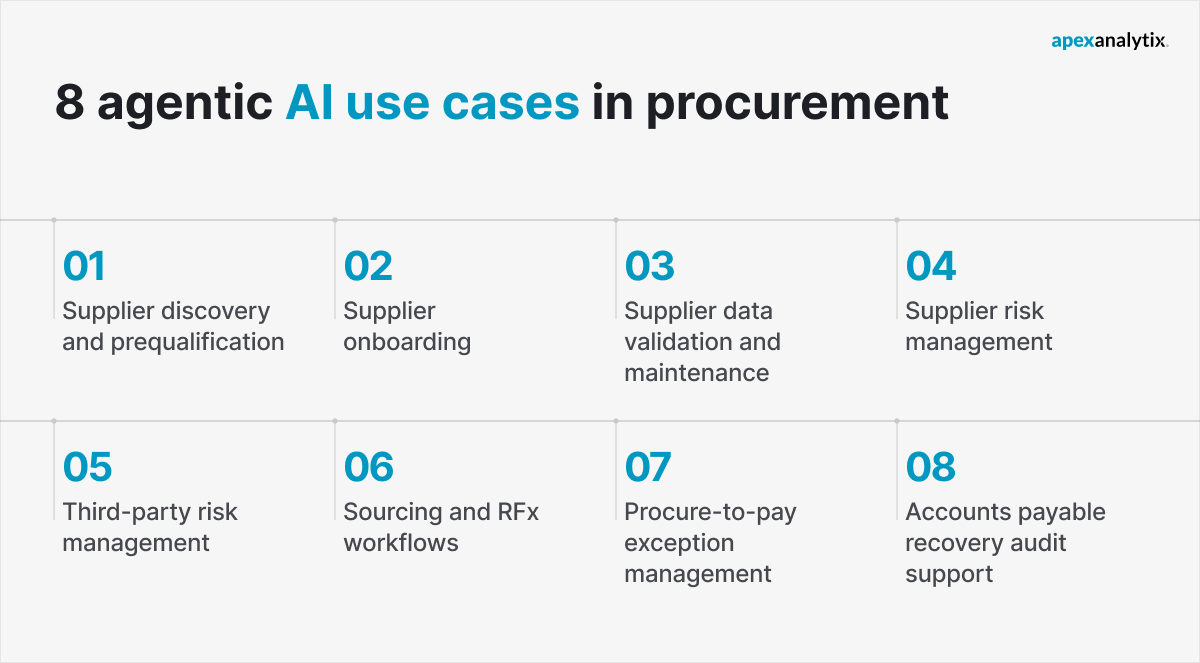
8 Agentic AI Use Cases in Procurement
Agentic AI can support several stages of the supplier and procure-to-pay (P2P) lifecycle.
The examples below show how the role of agentic AI changes depending on the type of work and the decisions involved:
1. Supplier discovery and prequalification
Supplier discovery can start with business requirements rather than a known company name. Those requirements can become search criteria, allowing procurement to compare potential suppliers across approved sources before reviewing a shortlist.
During prequalification, procurement can also collect initial supplier details and supporting documents, flagging incomplete responses for follow-up.
2. Supplier onboarding
Supplier onboarding requirements may differ by supplier type, country, category, or risk level, so the required path can change from one supplier to another.
An agent can use those supplier characteristics to select the required onboarding path and move the supplier to the next approved step.
The process may include:
- Information collection: Request required supplier details and documents.
- Completeness checks: Identify missing fields or evidence.
- Validation requests: Send relevant information through approved checks.
- Exception routing: Direct unclear or failed results to the right reviewer.
- Status coordination: Continue onboarding once requirements are met.
3. Supplier data validation and maintenance
Supplier information changes after onboarding, which can trigger different validation paths. A routine address update may require a standard validation check, while a bank account change may require independent verification before the supplier master is updated.
Duplicate records can also be compared against identifying information, with uncertain matches sent for review before any merging.
4. Supplier risk management
Agentic AI can connect a new risk signal with the workflow needed to investigate it, such as:
- Detect the signal: Monitor defined risk factors for change.
- Add context: Gather relevant supplier and risk information.
- Select the response: Open a reassessment, information request, or review.
- Collect evidence: Add documents or supplier responses.
- Route the finding: Send material or unresolved issues to the appropriate owner.
This path connects risk detection with investigation, rather than leaving a new signal separate from the response workflow.
5. Third-party risk management
Third-party risk management (TPRM) coordinates broader governance across suppliers, contractors, partners, and other third parties. Here’s how agentic AI might support that coordination:
| TPRM stage |
Possible agentic role |
| Relationship scoping |
Assign the third party to the appropriate risk tier and assessment path |
| Assessment scheduling |
Start reassessments according to policy, risk level, or review date |
| Due diligence |
Coordinate questionnaires, evidence, and reviews across risk domains |
| Remediation tracking |
Assign owners and track unresolved findings and deadlines |
| Relationship changes |
Start reassessment when a material factor changes |
6. Sourcing and RFx workflows
During requests for information, proposals, or quotations (RFx), an agent can track responses, follow up on missing submissions, and organize supplier answers against approved criteria.
If a submission is incomplete or inconsistent, the agent can request clarification or route the issue for review as the sourcing event progresses.
7. Procure-to-pay exception management
Different P2P exceptions can require different resolution paths. An invoice mismatch, for example, may need information from the purchase order, receipt, supplier record, and approval history before the correct next step becomes clear.
Ardent Partners’ 2025 State of ePayables benchmarks put the average invoice exception rate at 18.4%. At that volume, agents can reduce manual coordination by gathering the relevant records and routing each exception based on its cause.
8. AP recovery audit support
An AP recovery audit reviews completed transactions for potential recoveries that earlier controls missed.
AI agents can analyze transaction data for patterns linked to duplicate payments, supplier credits, and other potential losses. Agentic workflows can then gather related records, connect supplier information, route evidence for review, and track the case through resolution.
What Are the Benefits of Agentic AI in Procurement?
Agentic AI can improve how multi-step procurement work moves from one stage to the next. The clearest benefits are:
- Shorter cycle times: Reviews, approvals, requests, and follow-ups can create gaps between procurement steps. An agent can continue the workflow once an approval condition is met, reducing the need to restart the process manually each time.
- More consistent execution: Different suppliers, sourcing events, or exceptions may follow different paths, but the same requirements still need to be applied when the same conditions appear. Agentic workflows can support checks, escalation, and control points with the same level of consistency.
- Greater buyer capacity: BCG’s 2026 modeling estimates that an AI-first operating model could free up 60% of buyer capacity. Agentic AI can take on more coordination in multi-step processes, reducing the buyer time spent moving routine work from one stage to another.
What Are the Risks of Agentic AI in Procurement?
Deploying agentic AI introduces additional risk because an incorrect output can update a supplier record, approve a workflow step, or trigger a financial action before a person reviews it.
The table below outlines the main risks, along with appropriate controls:
| Risk |
Why it matters |
Control |
| Poor or incomplete data |
An agent may act without accurate supplier, transaction, or policy information |
Stop or escalate actions when required information is missing or conflicting |
| Excessive permissions |
Access beyond the task can increase the impact of an incorrect action |
Restrict system access and actions to what the workflow requires |
| Security exposure |
Procurement agents may interact with sensitive supplier, contract, payment, or business information |
Apply existing access, authentication, and data-security controls to agent activity |
| Weak auditability |
Teams may struggle to explain what information was used or why an action occurred |
Record inputs, actions, approvals, exceptions, and overrides |
| Overautomation |
An agent can follow its configured rules correctly and still take an action that is inappropriate for the business context |
Keep higher-impact or difficult-to-reverse decisions under human authority |
The degree of human involvement in decisions can also vary:
- Human-in-the-loop: A person reviews or approves an action before it takes effect.
- Human-on-the-loop: The agent handles approved work while people monitor performance and intervene when needed.
- Human-by-exception: Routine actions continue without review unless a defined condition triggers escalation.
For procurement workflows, the appropriate level of autonomy depends on risk, impact, and reversibility. An easy-to-correct administrative action doesn’t need the same oversight as a decision involving supplier approval, sensitive data, or material financial exposure.
How to Introduce Agentic AI into Procurement
Introducing agentic AI is easier to control when the work starts with a defined procurement process rather than a broad goal to “use AI.”
The steps below move from problem definition to controlled expansion:
- Define the procurement problem: Choose one process and specify the outcome that needs to improve. The scope should also show where an agent would enter the process and where its role ends.
- Map the current workflow: Document the inputs, systems, owners, handoffs, decisions, and exceptions that shape the process. The map should make dependencies visible before changing any part of the workflow.
- Check the required data: Identify the information the agent needs at each stage and confirm that it’s available through approved sources. Assess only the data needed for the selected workflow.
- Set permissions and escalation points: Define what the agent may read, change, request, route, or approve. Move cases outside those limits to the appropriate person for review.
- Connect the required systems: Give the workflow access to the procurement platforms, enterprise resource planning (ERP) systems, supplier portals, risk tools, or other applications needed for that process.
- Test with a limited scope: Use a controlled group of suppliers, categories, transactions, or another clear boundary. Compare expected and actual actions, review escalations, and identify where the workflow still needs adjustment.
- Expand based on results: Extend the workflow only after the initial test shows reliable performance. Expansion can mean covering more cases without necessarily increasing the agent’s level of autonomy.
How apexanalytix Supports Agentic AI in Procurement
apexanalytix combines AI agents, supplier intelligence, risk management, and AP recovery capabilities across the supplier and procure-to-pay lifecycle. That gives procurement and finance teams both the data AI needs and tools that move work forward through approved actions.
Here’s how those capabilities connect to agentic AI:
- apexanalytix Agents: When a supplier risk issue requires review, the Risk Response Agent can summarize the risk profile, recommend a resolution, create follow-up tasks, and populate risk assessments.
- Trusted supplier intelligence: AI capabilities run against supplier records validated through more than 1,200 trusted sources and over 280 million supplier golden records.
- Supplier and third-party risk management: AI-powered risk management combines supplier information with changing financial, cyber, compliance, and other risk signals. New findings can feed monitoring, assessment, investigation, and remediation workflows instead of remaining isolated alerts.
- AI throughout AP recovery: In AP recovery audits, AI prioritizes likely recovery opportunities, analyzes supplier statements, automates routine supplier communication, classifies responses, and routes complex cases to recovery specialists. Root cause analysis then connects validated findings with upstream process and control improvements.
Procurement teams can use the same validated supplier context across agent actions, risk workflows, and AP recovery while keeping higher-impact decisions under human oversight.
Do you know where to start with agentic AI in procurement?
Contact apexanalytix to learn how apexanalytix Agents, supplier intelligence, supplier risk management, and AP recovery audit can support your procurement and finance teams.
FAQ
1. How do you build a business case for agentic AI in procurement?
Build the business case around one measurable procurement problem and its current cost. Compare the existing cycle time, manual effort, exception volume, or another relevant baseline with the expected improvement and the cost of implementation, integration, governance, and ongoing support.
2. Should procurement build or buy AI agents?
Procurement should buy or configure existing agents when they support the required workflow, and build custom agents when they don’t. The decision should also account for proprietary logic, integration needs, internal AI capability, and the ongoing effort required to maintain a custom agent.
3. Can agentic AI work with existing ERP and source-to-pay systems?
Yes, if the required data and actions are available through supported integrations, application programming interfaces (APIs), or other approved connections. Procurement teams should confirm exactly what an agent can read, update, and trigger in each system before choosing the workflow.
4. What skills do procurement teams need to work with AI agents?
Procurement teams need process knowledge, data literacy, exception handling, and judgment over AI output. As agent autonomy increases, teams also need people who can redesign workflows, define escalation rules, review performance, and work with IT and risk functions.